Support

Parque Hundido

About

Parque Hundido (Sunken Park), officially named Luis Gonzaga Urbina Park, is a unique urban oasis in Mexico City. Its unofficial name, meaning "sunken" or "submerged," was not given by chance: it is located on the site of a former brick quarry, significantly below the level of the surrounding streets. This creates a sense of seclusion and tranquility, making it a favorite spot for relaxation for both residents of the capital of Mexico and tourists alike.

The park area is famous for its well-kept greenery, shaded alleys, and cozy paths that are perfect for leisurely walks and jogging. It is a wonderful place to escape the city's hustle and bustle and enjoy nature and fresh air.
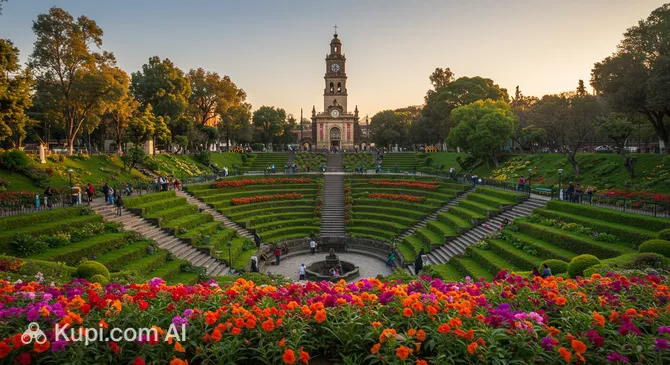
Parque Hundido. Illustration.
Source: Kupi.com AI

Traveler photos:

The main highlights of Parque Hundido are its open-air attractions. It features the largest floral clock in the country, which is impressive in its scale and beauty. Furthermore, themed routes dedicated to Mexico's ancient cultures—Olmec, Maya, Zapotec, and others—run through the park. Precise replicas of famous archaeological artifacts are placed along these paths, turning a stroll through the park into a fascinating journey through pre-Columbian history.

Contacts

Since Parque Hundido is a public urban space, it does not have a centralized contact center like a visitor phone number or email. All necessary information is typically available on-site. The park is located at: Avenida de los Insurgentes Sur s/n, Colonia Extremadura Insurgentes.

The most convenient way to reach the park is by public transport running along Avenida Insurgentes, such as the Metrobús rapid transit system (Parque Hundido station). You can also take the metro to the nearest stations on Lines 7 or 12. For planning the best route, it is recommended to use online maps or city navigation apps.

How to contactContact
AddressAv. Insurgentes Centro s/n, Extremadura Insurgentes, Benito Juárez, 03740 Ciudad de México, CDMX, Mexico
Websitemexicocity.cdmx.gob.mx

What to Do

In Parque Hundido, every visitor will find something to their liking. Lovers of quiet relaxation can enjoy leisurely walks through shaded alleys, admire the numerous statues representing the indigenous peoples of Mexico, and visit the unique open-air museum. Replicas of famous archaeological finds are installed along its paths, offering a glimpse into the country's ancient history. The famous floral clock—a symbol of the park and one of its most photographed objects—is particularly popular with guests.

For those who prefer active pastimes, the park provides special zones. There are children's playgrounds to delight young visitors and chess tables for fans of intellectual duels. Additionally, the park features a pavilion where various cultural events and performances are held periodically. Parque Hundido is ideal for family outings, morning jogs, picnics on the grass, or simply a relaxing day in nature in the heart of bustling Mexico City.

Getting There

Parque Hundido is conveniently located in the southern part of Mexico City, right along the busy Avenida Insurgentes Sur. Thanks to this location, reaching this green oasis is easy regardless of your chosen mode of transport. The park is clearly visible from the main street and has several entrances, making it easy to enter from different sides of the block.

The simplest and most convenient way to get there is by public transport. The nearest metro station, Insurgentes Sur (Line 12, the gold line), is just a few minutes' walk away. Additionally, numerous buses run along Avenida Insurgentes, including the Metrobús (Line 1), which has a stop named "Parque Hundido" located almost directly in front of the entrance.

If you plan to travel by car, keep in mind that the area around the park is quite busy. While there are parking zones in the vicinity, the heavy traffic and potential difficulty in finding a spot mean that public transport or taxis are highly recommended. This will help you avoid unnecessary hassle and save time for your walk in the park.

Nearest city: Mexico City

History & Facts

The history of Parque Hundido in Mexico City is quite unusual and closely linked to the area's industrial past. In the 19th century, this site housed a quarry owned by the Compañía Ladrillera de la Nochebuena, which extracted clay for brick production. After the company ceased operations, a massive depression was left behind. In the early 20th century, it was decided to landscape the area by planting numerous trees, earning it its first name — the "Christmas Forest" (Bosque de la Nochebuena).

The official transformation into a park took place in the 1930s, when city authorities decided to create a proper recreation area here. Later, the park was named in honor of the prominent Mexican poet and writer Luis Gonzaga Urbina, whose work served as a bridge between Romanticism and Modernism in Mexico. Thus, the "sunken" quarry found not only a new life but also a name immortalizing the contribution of one of the nation's cultural figures.

In the 1970s, the park was enriched with new unique features that are now its hallmarks. It was then that the famous floral clock was installed—the largest in the country, created by a prestigious clockmaking company. Additionally, precise replicas of iconic pre-Columbian archaeological monuments representing Olmec, Maya, Zapotec, and other cultures were placed throughout the park. Special themed routes were created, allowing visitors to encounter the country's rich historical heritage during their stroll.

Time Needed

To fully enjoy the atmosphere of Parque Hundido, see its main attractions, and take a break from the city bustle, it is recommended to set aside 1.5 to 3 hours. This will be enough time for a leisurely stroll through all the main paths and to get acquainted with the unique features of this green space.

The planned time will allow you to walk through the picturesque alleys without rushing, take photos by the famous floral clock, and explore the "archaeological trails." A walk along these routes, where replicas of ancient artifacts are displayed, can take about an hour or an hour and a half. The remaining time can be spent resting on a bench in the shade of the trees or simply enjoying the tranquility of this "sunken" oasis.

Of course, the final duration of your visit depends on your personal preferences. If you are planning a quick jog or a short walk, an hour might suffice. However, for a family picnic, a thoughtful study of all the open-air exhibits, or to fully relax with a book in the audio-rama pavilion, you should budget two to three hours in your plan.

Working Hours

Parque Hundido is a public space open to everyone year-round, so no ticket booking or advance registration is required to visit. Entry to the park is free. It is open to visitors daily, generally from early morning until late evening. Typical operating hours are from 6:00 AM to 10:00 PM, allowing you to enjoy it during a morning run or an evening stroll.

While these hours are standard, they may vary slightly depending on the season or special events. Since the park does not have an official website or a centralized information service, it is recommended to check announcements at the park entrances or consult local city resources for the most accurate and up-to-date information. However, access to the park is generally open throughout the day.

Open 24 hours

Nearby

Visiting Parque Hundido is a wonderful opportunity to experience one of the coziest green corners of Mexico City. However, to make your journey even more fulfilling, it is worth exploring the surrounding areas. The neighborhood where the park is located and its adjacent districts are rich with other points of interest, from cultural centers to famous historical monuments.

Getting to know nearby attractions will allow you to dive deeper into the multifaceted atmosphere of the capital of Mexico, seeing the contrasts and diversity of this metropolis. A short walk or a quick ride on public transport will reveal new sides of the city, complementing your impressions of the park visit.

NameDistance
Papalote Children's Museum4.1 km
Museum of Natural History4.2 km
Jazzatlán Capital4.4 km
Chapultepec Castle4.7 km
Axolotl Museum4.9 km
BeerGarden Roma5.1 km
National Museum of Anthropology5.4 km

Have you reached the end of the page?

So the route has been studied inside and out