Support

Basilica of Our Lady of Guadalupe

About

The Basilica of Our Lady of Guadalupe is not just a church, but one of the most important Catholic centers in the world and a landmark attraction in Mexico City. Located at the foot of Tepeyac Hill, this shrine is dedicated to the Virgin of Guadalupe, who is revered as the patroness of Mexico and all of Latin America. It is a place of immense spiritual power, attracting millions of pilgrims and tourists from around the world every year.

The architectural complex consists of several structures, the main one being the modern New Basilica, built between 1974 and 1976. Its unusual circular shape is designed so that the miraculous image of the Virgin Mary housed here can be seen from any point in the hall. Next to it stands the Old Basilica, built in the 17th century, which impresses with its Baroque architecture and historical atmosphere.

The New Basilica can accommodate up to 10,000 people at once, making it one of the largest and most visited churches on the planet. Visiting this site allows you not only to see unique architecture and a famous relic but also to feel the special atmosphere of faith and culture that permeates every corner of this sacred complex.
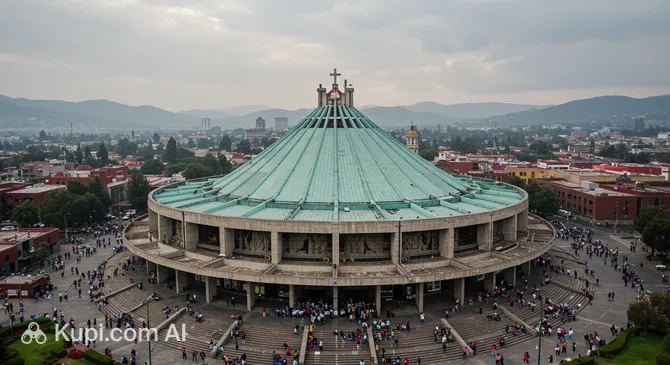
Basilica of Our Lady of Guadalupe. Illustration.
Source: Kupi.com AI

Traveler photos:

Contacts

To plan your visit to the Basilica of Our Lady of Guadalupe, you can use the following contact information. Up-to-date details, including the address and phone number, will help you clarify visit details such as the schedule for masses and special events.

How to contactContact
AddressFray Juan de Zumárraga No. 2, Villa Gustavo A. Madero, Gustavo A. Madero, 07050 Ciudad de México, CDMX, Mexico
Phone number+52 55 5577 6022
Websitevirgendeguadalupe.org.mx

What to Do

A visit to the complex is an opportunity to touch the history and culture of Catholic Mexico. The main draw for visitors is the chance to see the famous relic kept in the New Basilica—the cloak (tilma) of the peasant Juan Diego, upon which the image of the Virgin Mary miraculously appeared. To view the relic, visitors pass by it on a special moving walkway, as approaching or touching it is forbidden. Additionally, you can freely explore both the modern New and the historic Old Basilica, admiring their contrasting architecture.

Beyond the main temples, there are other interesting spots within the vast complex grounds. You can visit small chapels, look into museums to dive deeper into the site's history, or purchase commemorative souvenirs at local shops. Be sure to climb Tepeyac Hill, at the foot of which the basilica is located. The summit offers an impressive panoramic view of Mexico City, making it a perfect end to your visit.

If your trip falls in early December, you can witness one of the most vibrant events in the country's religious life. Every year on December 12th, the Feast of Our Lady of Guadalupe is celebrated here on a grand scale. During this time, the complex fills with thousands of pilgrims, and colorful religious processions, solemn services, and various cultural events take place, creating an unforgettable atmosphere of universal celebration.

Getting There

Getting to the Basilica of Our Lady of Guadalupe is quite simple, as it is located within the city limits. The complex is situated in the north of Mexico City, in the Gustavo A. Madero district, at the foot of the famous Tepeyac Hill. Thanks to a well-developed public transport system, the journey here won't take much time.

The most convenient and fastest way to reach the basilica is by metro. You need the La Villa-Basílica station, which is on the 6th (red) line. From the metro exit, it's just a few minutes' walk to the entrance of the complex. Additionally, numerous city buses run to this area; you can check their routes locally or using online maps.

If you prefer comfort, you can take a taxi or use ride-sharing apps. A trip from central Mexico City will take approximately 30–40 minutes, though keep in mind that travel time depends heavily on traffic conditions. For those traveling by rental car, there is parking available at the complex. However, on major religious holidays and weekends, it can be overcrowded, so public transport is often a better choice during those times.

Nearest city: Mexico City

History & Facts

The history of the Basilica of Our Lady of Guadalupe is inextricably linked to one of the most revered miracles in the Catholic world. According to tradition, in the winter of 1531 on Tepeyac Hill, the Virgin Mary appeared to a humble peasant named Juan Diego. As proof of this apparition, her miraculous image was divinely imprinted on his cloak, or tilma. This event marked the beginning of pilgrimages to the sacred site, where a modest chapel was first built.

As the number of believers grew, a larger temple became necessary. Construction of the so-called Old Basilica began in 1695 and was completed in 1709. This majestic Baroque building served as the primary center of worship for several centuries. However, over time, due to the nature of the local soil, the ancient structure began to sink, threatening its preservation and the safety of the parishioners.

In the 1970s, the decision was made to build a new, more spacious, and safer temple. The project was entrusted to the renowned Mexican architect Pedro Ramírez Vázquez, who created a unique modern building. The New Basilica, opened in 1976, has a circular shape symbolizing the Virgin Mary's mantle and is designed to accommodate the massive flow of pilgrims—about 20 million people annually. Its design allows the main relic—Juan Diego's tilma—to be seen from any point in the hall.

Time Needed

To fully explore the Basilica of Our Lady of Guadalupe complex, it is recommended to set aside 2 to 4 hours. This should be enough time to see the main sites without rushing: visit the modern New Basilica where Juan Diego’s famous tilma is kept, look into the historic Old Basilica, and climb Tepeyac Hill, which offers beautiful views of the city.

If you are short on time, you can focus only on the essentials—the New Basilica and the main relic. Such a visit will take about 1-2 hours. However, keep in mind that on major religious holidays, especially December 12th, and on weekends, the number of visitors increases dramatically. During these periods, a visit may take significantly longer due to the large crowds.

Working Hours

The Basilica of Our Lady of Guadalupe is open to visitors year-round, making it easy to include in any travel itinerary. Generally, the sanctuary doors are open to everyone daily from 6:00 AM to 9:00 PM. However, please remember that operating hours may be adjusted on national holidays, religious celebrations, and weekends.

For a standard visit to the complex, no prior reservation or ticket purchase is required—entrance to the grounds and the temples themselves is free. Nevertheless, to avoid any inconvenience, it is strongly recommended to check the current schedule on the official basilica website before your trip. This is especially important if you plan to visit on a holiday, such as December 12th, when a massive number of pilgrims gather here.

Nearby

Visiting the Basilica of Our Lady of Guadalupe is a profound spiritual and cultural experience. However, to make your trip to this part of Mexico City even more fulfilling, it's worth taking time to explore the surroundings. Near this famous pilgrimage center, you'll find other interesting sites that help illustrate the multifaceted character of the Mexican capital.

From modern entertainment centers to historical museums, there are attractions for every taste within a few kilometers of the basilica. This is a great opportunity to combine a pilgrimage visit with an educational walk through one of the world's largest metropolises.

NameDistance
Michin Aquarium Mexico City2 km
National Museum of Art5.8 km
Templo Mayor Museum5.8 km
Constitution Plaza6 km
Palace of Fine Arts6 km
Museum of Memory and Tolerance6.2 km
El Péndulo8.2 km

Have you reached the end of the page?

So the route has been studied inside and out