Support

Franz Josef Glacier

About

Franz Josef is a true gem of the West Coast of the South Island, nestled comfortably at the foot of the majestic Southern Alps. This is a place where New Zealand showcases its wild and pristine nature in all its glory. The town is located in close proximity to the Tasman Sea and is surrounded by dense rainforests, creating a unique contrast between snow-capped peaks and evergreen vegetation.
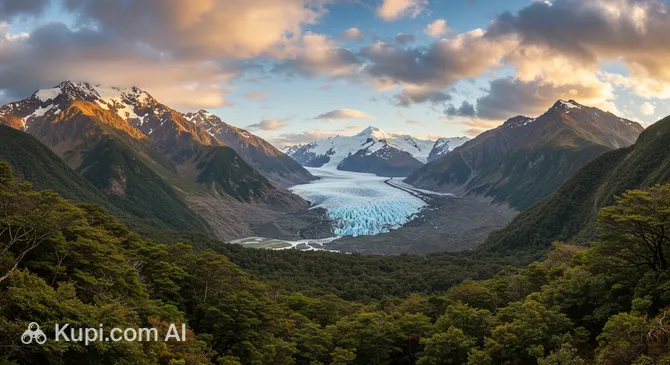
Franz Josef Glacier. Illustration.
Source: Kupi.com AI

The main point of attraction for travelers from all over the world is the famous Franz Josef Glacier, which descends from the mountains almost to sea level. The village serves as the main gateway to Westland Tai Poutini National Park, a UNESCO World Heritage site. Its geographical position makes the climate here humid and changeable, but it is precisely thanks to the heavy rainfall that the local landscapes are distinguished by such lush greenery and picturesque waterfalls.

The settlement itself is very compact: only a few hundred people live here permanently, but during the tourist season, the streets come alive thanks to thousands of adventure seekers. Despite its modest size, the history of the village's development has turned it into a comfortable tourist oasis with well-developed infrastructure. The atmosphere here is surprisingly relaxed: it is an ideal place to take a break from the city bustle, enjoy walks along forest trails, or relax in hot springs after an active day.

Franz Josef offers guests not only contemplative relaxation but also a wealth of activities—from helicopter flights over the glacier to kayaking on mirror-like lakes. If you are looking for harmony with nature and want to see some of the most impressive landscapes in the country, this welcoming corner should definitely be on your itinerary.

Weather Overview

The climate in this part of the West Coast is mild but very humid, which is typical for regions surrounded by dense rainforests and mountains. Thanks to the proximity of the ocean, temperature fluctuations are smoothed out, so the weather in Franz Josef Village rarely presents extreme surprises, although travelers should always be prepared for frequent precipitation.

The warmest time of the year is summer, especially January, when the average temperature is around +13.9°C, and on the finest days, the air warms up to +16.8°C. This is a popular season for visiting the glacier; however, the number of days with precipitation remains significant—up to 17 per month. Expect a moderately warm summer with occasional rain and a cool winter which, contrary to stereotypes, does not grip the region in severe frosts.

The winter months, particularly July, bring freshness: average figures drop to +4.0°C, and night temperatures can fall to +1.5°C. Despite the cool, winter here is not harsh but wet—it rains about 16 days a month. The transitional seasons are characterized by smooth changes: in spring, the temperature gradually rises to +10.0°C by November, and in autumn, it gradually decreases, maintaining the invigorating freshness of the alpine air.

Average monthly temperature

Average monthly precipitation

Interesting Facts

In addition to its impressive landscapes, Franz Josef Village holds many fascinating secrets and legends that give this place a special atmosphere of mystery. Here are a few facts that will help you look at this corner from a new perspective:
  • Where ice meets the jungle. Franz Josef Glacier is a rare natural phenomenon where a stream of ice descends from high mountains directly into a zone of lush subtropical rainforest. Tourists are struck by the surreal contrast: the opportunity to step on ancient ice while surrounded by giant ferns and rich greenery.

  • An Imperial name. The village and glacier owe their name to the explorer Julius von Haast. In 1865, he named the glacier he discovered in honor of the Austrian Emperor Franz Joseph I, forever linking the history of the small New Zealand settlement with a distant European monarchy.

  • The legend of frozen tears. For the indigenous Maori people, this place is sacred and bears the name "Ka Roimata o Hinehukatere" ("The Tears of Hinehukatere"). According to legend, a girl named Hinehukatere cried so bitterly for her lover who died in the mountains that the gods took pity and turned her tears into a river of ice.

  • A sanctuary for the rarest kiwis. The forests around the village have become home to the rarest variety of New Zealand's national symbol—the kiwi bird (the Rowi species). A special center has been created here for their protection, and observing these secretive birds in the wild is considered a true ritual for guests of the region.

How to Get There

When planning a trip to the glaciers, it's worth considering that this cozy corner is located far from major transport hubs. You can find more details on how to get to Franz Josef Village, but the primary way to get here remains a combination of a flight to one of the South Island cities followed by a trip by car or bus along scenic highways.

There is no airport in the village itself that accepts regular flights. The nearest regional hub is Hokitika Airport (HKK), located in the town of Hokitika. The direct distance is about 105 km. This is the most convenient option for those who want to reduce travel time: a trip by taxi or transfer will take approximately 105–120 minutes.

For international travelers, the main gateway is often Christchurch International Airport (CHC). It is located in the city of Christchurch, on the opposite coast of the island. The direct distance is about 190 km, but the path lies through the mountain passes of the Southern Alps, so the drive will take about 5 hours. This is one of the most beautiful routes in the country.

Another popular option is arriving at Queenstown Airport (ZQN), located in the resort town of Queenstown. The distance to the destination is about 208 km. The journey from there by bus or car will take about 5.5 hours, allowing you to enjoy views of lakes and mountains on the way north.

For clarity, here is summary information on the main airports through which you can build your route:

AirportPassenger trafficDistance
Hokitika Airport40 000105 km
Christchurch International Airport6.4 mln190 km
Queenstown Airport2.6 mln208 km
Dunedin International Airport903 396274 km

There is no direct rail connection to the village. The railway on the West Coast ends further north, and the famous TranzAlpine excursion train arrives from Christchurch in the town of Greymouth. From there, tourists need to transfer to an intercity bus or a rental car to travel the remaining part of the way south along State Highway 6 to the glaciers.

Main Attractions

Attractions:

The main natural feature of the region is undoubtedly the Franz Josef Glacier. This is a unique place where an ice tongue descends from high mountains directly into a temperate rainforest zone, stopping just a few kilometers from the sea. Tourists can take a walk to the lookout point at the terminal part of the glacier or embark on an exciting helicopter flight with a landing on the ice to explore blue grottoes and ice caves far from the beaten paths.

To restore your strength after active walks, the Glacier Hot Pools are ideal. The complex is surrounded by dense ferns and ancient trees, creating an atmosphere of complete unity with nature. The water in the pools varies in temperature, allowing guests to relax in the healing warmth and enjoy the silence of the forest, broken only by the singing of local birds.

Special attention should be given to the West Coast Wildlife Centre, where you can get acquainted with a very rare symbol of the country. This is home to a population of Rowi kiwi—the rarest species of these flightless birds. The center has a special incubator and nocturnal house where visitors are guaranteed to see kiwi in conditions as close as possible to their natural habitat and learn about conservation efforts.

Just a few minutes' drive from the village lies the picturesque Lake Mapourika. It was formed thousands of years ago as a result of glacial melting and is famous for its dark, calm water, which creates perfect mirror reflections of the mountain peaks. It is a popular spot for kayaking, fishing, and picnics, and is especially beautiful at dawn when mist drifts over the water, giving the landscape a mystical appearance.

Local Cuisine

Despite its modest size, Franz Josef Village offers tourists an impressive gastronomic variety based on high-quality local products. Thanks to the proximity of the Tasman Sea, the menus of local establishments always feature dishes made from the freshest fish and seafood. Meat lovers should pay attention to the delicacies for which New Zealand is famous: venison steaks and tender lamb raised on nearby farms. For a hearty snack after a walk to the glacier, a traditional meat and mushroom pie is perfect—a hearty classic served in many cozy cafes.

A special charm is added to the local cuisine by small bakeries and farmers' markets where you can find real home-cooked food. Travelers are greeted here with the aromas of hot pies, fresh bread, and cinnamon rolls. For dessert, be sure to try the famous Pavlova cake—an airy meringue often decorated with kiwi slices. You can also find handmade farm cheeses, seasonal berries, and homemade jams made with love on the counters.

The dining culture in the village is characterized by a relaxed and friendly atmosphere. There are no pretentious restaurants with a strict dress code; instead, guests and locals gather in bars and gastropubs to discuss the day's adventures. Evenings are often accompanied by live music and tastings of excellent New Zealand wines or craft beers. Some establishments hold culinary masterclasses, allowing tourists to dive deeper into the gastronomic traditions of the West Coast.

Travel Tips

Welcome to the land of glaciers and evergreen forests! To ensure your trip to Franz Josef Village is as comfortable and safe as possible, we have prepared a list of important recommendations that take into account the unique features of this alpine corner on the wild West Coast.

  1. Clothing and Essentials: The main rule here is layering. Even in summer, the weather changes instantly, so a high-quality waterproof jacket and comfortable trekking boots are mandatory. For hikes to the glacier, take a fleece sweater, hat, and gloves, while sunglasses and sunscreen will save you from the bright mountain sun. Don't forget an adapter for Type I power outlets (as in Australia).

  2. Transport: The village is very compact, and it is best to get around on foot—all cafes and hotels are close by. There is no public transport (buses or subways) within the settlement. For trips to the start of the trekking routes (the glacier parking lot is several kilometers away), it is most convenient to use a rental car or special tourist shuttles (Glacier Shuttles).

  3. Finance: The currency is the New Zealand Dollar (NZD). Visa and Mastercard are accepted almost everywhere, but having some cash for small souvenirs won't hurt. There is an ATM in the village, but it may not work or may run out of cash, so it's better to withdraw money in advance in larger cities. Tipping is not mandatory, but it's customary to leave about 10% for excellent service.

  4. Health and Safety: The main local nuisance is sandflies, whose bites cause intense itching. Be sure to buy a strong repellent at a local store. The pharmacy here is small and does not work 24/7, so bring a personal first-aid kit with basic medicines. The area is safe, but in the mountains, strictly follow the signs and do not go off the trails.

  5. Communication: The official language is English. Mobile service and 4G in the village center are stable, but the signal often disappears in the mountains and on forest trails. We recommend downloading offline maps of the region in advance. It's better to purchase a SIM card (Spark, One NZ) upon arrival at the airport, as there are no specialized mobile stores in the village.

  6. Local Etiquette: New Zealand is famous for its friendliness: it is customary to greet people on walking trails. Follow the "Tiaki" principle—caring for nature: take all your trash with you and do not pick plants. The dress code everywhere is very casual and sporty, even in restaurants.

  7. What to Avoid: Never cross the safety barriers at the glacier. The ice is unstable, and sudden collapses or rockfalls occur regularly—it is deadly. Also, it is strictly forbidden to feed the mountain kea parrots, even if they persistently beg for food: human food kills these intelligent birds.

  8. Additional Tip: If you plan a helicopter flight (Heli-hike), book it for the earliest morning possible. The weather on the coast tends to deteriorate in the afternoon, and morning flights have a much better chance of proceeding. And remember that the only supermarket (Four Square) closes quite early (usually around 7:00 PM – 8:00 PM), so stock up on groceries in advance.

Preparation is the key to a perfect trip through this rugged but beautiful region. By following these simple tips, you can focus on the main thing—contemplating the majestic glaciers and the magic of ancient forests without being distracted by everyday trifles.

Entertainment & Nightlife

Although this settlement is quite small, the entertainment in Franz Josef Village can surprise even seasoned adventure seekers. This place is rightfully considered one of the centers of active tourism on the West Coast, offering guests a rich program that is not limited to just viewing ice masses.

For adrenaline junkies, the main attraction is skydiving. Skydiving jumps here are considered some of the most scenic in the world: the freefall takes place against the backdrop of the snow-capped peaks of the Southern Alps, glaciers, tropical forests, and the blue expanse of the Tasman Sea. In clear weather, from a height, you can see a panorama spanning both coasts of the South Island, making this experience truly unique for those visiting a country like New Zealand.

Those who prefer to stay on the ground but seek a thrill can go on an ATV tour. Routes usually run along the stony bed of the Waiho River and through dense rainforest thickets. This is an excellent opportunity to test the vehicles in off-road conditions, overcoming mud, water obstacles, and rocky embankments while enjoying views of the mountains from an unusual angle.

For a more relaxed but active holiday, horse trekking is popular. Riding through farmland and river floodplains allows you to immerse yourself in the region's rural atmosphere. In addition, the surrounding area is crisscrossed by a network of hiking trails of varying difficulty. If the hike to the glacier seems too crowded, you can choose the Callery Gorge or Tatare Tunnels routes, where you can see old mining tunnels and glowworms hiding in the damp darkness of the forest.

Evening life in the village is centered around several cozy bars and restaurants where travelers from all over the world gather. The atmosphere here is always friendly and informal: tourists share their impressions by the fireplace or over a game of pool. There is also a small cinema in the village, which becomes a real savior on rainy days, offering the latest movie releases and documentaries about local nature.

Parks & Museums

Immersion into the atmosphere of this unique place is impossible without getting to know its natural treasures and cultural points of attraction. Although Franz Josef Village is known primarily for its icy giants, there are amazing park areas and educational sites here that will help you gain a deeper understanding of the history and ecology of the region, where New Zealand appears in all its wild splendor.

Westland Tai Poutini National Park is a grand natural area surrounding the village and is listed as a UNESCO World Heritage site. The park is unique in its diversity: from the snow-capped peaks of the Southern Alps to the pristine beaches of the Tasman Sea. For tourists, this is not just a forest, but a living encyclopedia of nature where you can see a change in climatic zones over a short distance. Dozens of trails are laid out here, allowing you to enjoy views of ancient rimu and rata trees covered with mosses and epiphytes.

For a more intimate encounter with nature, Peters Pool is ideal. This small kettle lake, formed about 200 years ago as a result of glacial melting, is located just a few minutes' walk from the main road to the glacier. The place is famous for its mirror-like surface: in windless weather, the mountains and ferns are perfectly reflected in the dark water. It is a very quiet and accessible area, suitable for meditative relaxation and creating stunning photos without the need for difficult climbs.

Among the cultural and educational sites, the West Coast Wildlife Centre stands out. While many know it as an incubator for kiwi birds, it is also a full-fledged museum. The interactive "Glacier" zone tells the fascinating story of the region's exploration, explains the geological processes behind the formation of ice rivers, and demonstrates the life of the first gold miners and settlers. It is a great place to hide from the rain and learn how the region developed in harsh isolation.

Special attention is deserved by the historic St James Church. This small Anglican building, constructed in 1931 in Tudor architectural style, is a true monument to resilience and faith. The main feature of the church is a huge panoramic window behind the altar, which offers a view not of icons, but of the dense rainforest and mountain peaks. This architectural solution symbolizes the inseparable connection between spirituality and the grandeur of the surrounding nature.

If you are looking for something special and hidden from the eyes of most tourists, head for a walk along Terrace Walk after sunset. Armed with a flashlight (but turning it off from time to time), you can see thousands of glowworms shining in the roots of trees and under overhanging branches, turning the night forest into a fairytale starry sky.

Getting Around

Given the miniature size of this settlement, the classic public transport system familiar to residents of megacities is absent here. In Franz Josef Village, you will not find subways, trams, trolleybuses, or an extensive network of city buses. All main infrastructure is concentrated along one main street (State Highway 6), and it is most convenient to move around the center on foot: from most hotels to restaurants, shops, and helicopter pads, you can walk in 5–15 minutes.

The only equivalent of local public transport is the special tourist shuttles (for example, Franz Josef Glacier Shuttles). They perform a vital function: transporting tourists from the village center to the parking lot at the beginning of the glacier valley walking route. The distance to this point is about 4–5 kilometers, and while it is possible to walk there, most travelers prefer to save their energy for the trekking itself. Shuttles run on a schedule several times a day back and forth.

The fare payment system here is as simple as possible. No complicated transport cards, zones, or mobile apps for validating tickets exist. The fare is paid either in cash or by bank card directly to the driver when boarding, or at the transport company's office in the village center. The cost is usually fixed for a return trip. It is recommended to keep your paper ticket until the end of the journey, as it will need to be shown to the driver on the way back from the glacier.

A major role is played by InterCity intercity buses, which connect the village with other regions. Their stop is located in the center, and for many tourists, this is the main way to arrive and depart. Tickets for them must be booked in advance online or at information centers, as seats fill up quickly in high season. However, it is impossible to use these buses for moving within the village itself.

As for alternative ways of getting around, taxi services here are very poorly developed, and familiar apps like Uber do not exist. If you need an individual transfer, it generally needs to be ordered in advance through your hotel reception or at the tourist center. The most popular alternative is renting a car—this gives complete freedom of movement around the area. Also, in good weather, bicycle rental is popular, allowing you to see the picturesque surroundings at your own pace.

Accommodation

The choice of accommodation in Franz Josef Village, despite its compactness, is capable of satisfying the needs of a wide variety of travelers. The tourism industry here is the foundation of life, so the range of offers varies from budget campsites and bustling youth hostels to cozy family-style motels and luxurious five-star eco-lodges offering seclusion amidst the wild nature.

In terms of location, two accommodation options can be distinguished. The first is the village center, located along State Highway 6. By staying here, you will be within walking distance of restaurants, a supermarket, helicopter pads, and bus stops, which is ideal for those traveling without a car. The second option is accommodation on the outskirts or in the forest zone. These hotels are often separate bungalows or cottages surrounded by dense rainforest. The main advantage here is the silence, birdsong, and panoramic mountain views, creating an atmosphere of total immersion in nature.

Booking Tip: The West Coast is a region with limited room stock and high demand. During peak season (from December to February), finding a vacant room "on the day" is almost impossible. It is highly recommended to book accommodation 2–3 months before your trip to guarantee comfortable placement.

The price policy here is slightly above the national average due to the region's remoteness. Budget options (a bed in a hostel) are available but sell out quickly. The middle segment is represented by high-quality motels with kitchenettes, which are very popular in New Zealand. Booking is best done through major international online platforms or directly on hotel websites, which sometimes allows you to get better terms or a complimentary breakfast.

Nearby Cities

For those who want to explore the surroundings and continue their journey through the South Island, Franz Josef Village serves as an excellent starting point for trips to several iconic places in the region. Given the mountainous terrain, some of these cities are better planned as a next destination or for a longer visit, but they are definitely worth the time:

Queenstown is perhaps the country's most famous resort, bearing the title of "adventure capital of the world." Located on the shores of picturesque Lake Wakatipu, it offers tourists an incredible range of emotions: from bungee jumping and jet boating to wine tasting in the Gibbston Valley. It is a place where energy is in full swing year-round.

Another important destination is Christchurch, the largest city on the South Island. It is often called the "Garden City" for its abundance of greenery and parks. Here you can enjoy British colonial architecture, visit museums, and see how the city has transformed, combining historical heritage with modern street art and innovative buildings.

Below is information about the nearest major population centers that may interest travelers:

CityPopulationDistance
Fox Glacier14 km
Mount Cook15 km
Hokitika2 892104 km
Timaru27 501133 km
Ashburton20 400135 km

These nearby destinations allow you to get a complete picture of the diverse culture and landscapes of the region, from high-altitude lakes to vibrant urban centers.

Shopping & Souvenirs

Shopping in Franz Josef Village is purely utilitarian and souvenir-oriented, fully corresponding to the spirit of the place—a base for wilderness explorers. You won't find high-fashion boutiques or mass-market retail giants here. The village's commercial sphere is focused on providing travelers with everything they need for a comfortable stay in the mountains: from high-quality trekking shoes and warm jackets to food and memorable gifts.

All commercial life in the settlement is concentrated along the main transport artery—State Highway 6 (often called simply Main Road) and the adjacent Cron Street. Thanks to the compactness of the village, you can walk around all the points of interest literally in 20–30 minutes. Strolling through the shops here is a relaxed activity that is pleasant to do in the evening after an active day on the glacier.

There are no large shopping centers or malls in the village. Trade is conducted in the form of small, cozy shops located on the ground floors of buildings or in detached wooden houses, which gives the streets a special alpine charm. Often, a cafe, a souvenir shop, and an equipment rental point can be found under one roof.

Usual open-air markets are also not to be found here. The role of the main place for buying food and essential goods is performed by the Four Square supermarket. This is a center of attraction for all tourists: here you can buy fresh fruit, ready-made sandwiches for a picnic, drinks, and basic household chemicals. Sometimes, at the entrance to the store, you can find local stalls with home baking or charity sales, but this is the exception rather than the rule.

As for souvenirs, New Zealand is famous for its unique goods, and Franz Josef is an excellent place to purchase them. Special attention should be paid to products made of pounamu (jade). This stone is mined in the rivers of the West Coast and has great cultural significance for the Maori. Also popular are:

  • Clothing and accessories made from a blend of merino wool and possum fur—a unique local material that is lighter and warmer than cashmere.
  • Natural cosmetics based on Manuka honey or glacial mud.
  • Products made from rimu wood and paua shells with their unique pearlescent shimmer.

Shops usually open around 9:00 AM. Souvenir shops and clothing stores typically close by 5:00 PM – 6:00 PM, although in the height of the summer season they may stay open a little longer. The grocery supermarket is open longer, often until 8:00 PM. Credit cards (Visa, Mastercard) are accepted everywhere, and contactless payment terminals are available even in small shops. Cash might only be useful for very small expenses.

The Tax Free system in the country works in a specific way. Goods and Services Tax (GST) is 15% and is included in the price. You cannot get it back at the airport for ordinary purchases made in town and packed in a suitcase. However, some specialized souvenir shops offer a "Duty Free" service on the condition that they send the purchased goods by mail to your home address abroad. In this case, the tax is deducted from the purchase price at the checkout.

Reached the end of the page?

That means the route is fully explored