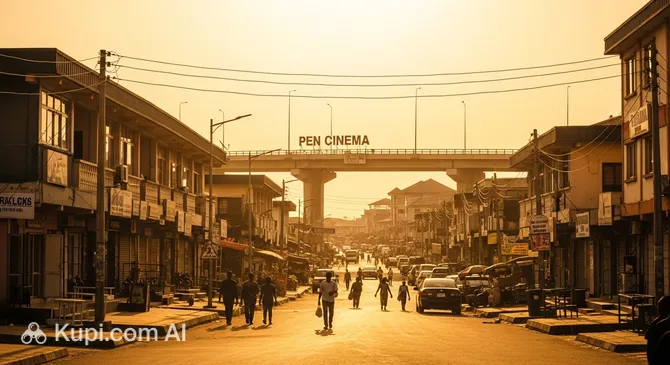
Agege is one of the most vibrant and densely populated areas in Nigeria, located in the northern part of the massive Lagos metropolis. This district possesses a very special energy: it lacks the polish of elite neighborhoods, but it more than makes up for it with an authentic spirit of everyday African life. As a major residential and commercial hub, the area attracts those who want to see the "real" Lagos unfiltered.
Geographically, the city sits on a plain in Lagos State and covers an area of just over 12 square kilometers. However, the population density here is staggering—various estimates place the number of people living in Agege between 450,000 and 1.5 million. This concentration of people creates an atmosphere of constant motion, noise, and incredible activity characteristic of major African suburbs.
Agege. Illustration.
Source: Kupi.com AI
Speaking of the history of this area, it is worth noting that until 1927, it even served as the capital of the Ikeja Division. Today, Agege is better known as a residential area populated primarily by the Yoruba people. Its main features are its giant markets, developed infrastructure for the middle class, and the nationally famous local bread, which has become a true gastronomic symbol of this part of the city.
A visit to Agege is an opportunity to immerse yourself in the chaotic yet fascinating rhythm of Nigerian daily life. We invite you to explore the local streets, where every corner reveals a new facet of modern West African urban culture.
Weather Overview
The climate in Agege is typical for the tropical coast of West Africa. A tropical monsoon regime prevails here, characterized by high humidity and consistently high temperatures throughout the year. The average temperature range fluctuates from 25°C at night to 32°C during the day. Due to dense construction and the lack of large parks, an "urban heat island" effect is often felt, so the weather in the city can feel hotter than it actually is.
Two distinct seasons stand out during the year: wet and dry. The rainy season lasts from April to October, peaking in June and July. During this time, expect heavy downpours that may be accompanied by thunderstorms and lead to local street flooding. The dry season arrives in November and continues until March. This period is characterized by less rainfall, but the air can become dusty due to the influence of the Harmattan—a dry wind from the Sahara.
When preparing for a trip to Agege, be ready for changeable conditions: even in the dry season, brief rains are possible, and the high humidity requires light clothing made of natural fabrics. The hottest month is usually February, when average maximums reach 34°C, while the coolest and wettest is August, bringing long-awaited but rainy relief from the heat.
Average monthly temperature
Average monthly precipitation
Interesting Facts
Until 1927, Agege held the status of capital for the Ikeja Division during the colonial period before the administrative center was moved.
The district is known for its extremely high population density—official figures place it at around 55,800 people per square kilometer, though some unofficial estimates suggest it is even higher.
The city's name is firmly associated by Nigerians with the famous Agege bread—a special type of soft white bread baked here in massive quantities and distributed all over Lagos.
The vast majority of the district's residents belong to the Yoruba ethnic group, which leaves a deep mark on the local culture, language, and traditions.
Despite its compact area of just 12.25 km², there are more than 70 large and medium-sized enterprises officially registered in Agege.
How to Get There
The transport accessibility of Agege is due to its location in the northern part of Lagos, making it an important link between the suburbs and the business center. Most travelers arrive here via the country's main air gateway located nearby, using the developed road network. Detailed information on routes can be found in the section on how to get to the city.
The main aviation hub for the region is Murtala Muhammed International Airport (LOS). It is located in neighboring Ikeja, and the journey from the terminal to the center of Agege by taxi can take from 30 minutes to an hour. However, it is worth remembering the famous Lagos traffic jams, known as "go-slow," which can increase travel time to two hours or more during peak periods.
Railway communication in the area is actively developing. One of the key lines connecting Lagos with other parts of the country passes through Agege. The city's railway station serves as a departure point for trains heading toward Ibadan and Nigeria's northern states. This is a convenient, though not always predictable, way to travel for those looking to avoid road traffic.
Station
Passenger traffic
Distance
Lagos Terminus Railway Station
5
21 km
Lagos Terminus Railway Station
5
21 km
Train Station Ibadan
1
107 km
To travel from other Nigerian cities like Abuja or Kano, many people use intercity buses. These usually arrive at major Lagos terminals, from where you can reach Agege via local minibuses ("danfo") or by using ride-hailing apps, which operate quite reliably here.
Main Attractions
In Agege, you won't find the typical architectural monuments of global significance or ancient castles, as it is primarily a residential and business district. However, for the curious traveler, there are unique points of interest. The "heart" of the district is the Agege Market—one of the largest trading hubs in Lagos, where you can feel the incredible scale of local commerce and see the lives of thousands of people in their natural element.
The cultural and social life of the city is centered around religious sites. Local mosques and Christian churches serve not only as places of worship but also as vital community centers where meetings and celebrations are held. The architecture of these buildings, often in a modern style, stands out against the dense residential backdrop of the area.
For those looking for modern locations, the city has small shopping centers and event venues. Although Agege is rarely considered a tourist center in its own right, its value lies in the chance to see the authentic lifestyle of the continent's largest megalopolis, free from tourist gloss.
Local Cuisine
The gastronomic scene in Agege is a true feast for lovers of bold spices and hearty meals. The cuisine here is predominantly based on the traditions of the Yoruba people. The district's main culinary brand is Agege bread—a fluffy, slightly sweet loaf that pairs perfectly with spicy sauces or simply with butter and tea. You can try it fresh from the oven at numerous bakeries scattered throughout the district.
Be sure to try Nigerian staples: pounded yam with thick egusi soup, made from melon seeds and greens. Also ubiquitous is jollof rice—rice stewed in a tomato sauce with peppers, served with fried chicken or fish. In the city's markets, especially Agege Market, you will find suya—thin slices of beef coated in peanut flour and spices, then grilled over an open fire.
Favorite drinks include the refreshing zobo (a cold hibiscus tea) and palm wine—natural wine that is best enjoyed fresh. Street food in Agege is the foundation of local food culture: small eateries known as "bukas" offer authentic flavors at very affordable prices, creating the unique atmosphere of a lively African city.
Travel Tips
A trip to Agege can be one of the most vivid experiences in Nigeria if approached with the right mindset and knowledge of local specifics. These tips will help you feel more confident in this bustling district.
Transport: Use the Uber or Bolt apps to get around the city and beyond. This is safer and more comfortable than street taxis or yellow danfo minibuses, especially if you are unfamiliar with the area.
Safety: Agege is a very densely populated area. Avoid walking alone after dark and always keep valuables, phones, and cameras in closed bags. In crowded places like markets, beware of pickpockets.
Health: Drink only bottled water and avoid ice in drinks from street cafes. Before your trip, be sure to get a yellow fever vaccination and take preventive measures against malaria (use repellents).
Finance: The primary currency is the Nigerian Naira. Cards are only accepted in large stores, so always carry a supply of cash in small denominations for markets and transport.
Clothing: Choose clothes made of light natural fabrics due to the high humidity and heat. When visiting mosques or churches, dress modestly: shoulders and knees should be covered.
Connectivity: Buy a local SIM card (e.g., MTN or Airtel) directly at the airport or an official store. Mobile internet works stably, but do not rely on public Wi-Fi in Agege.
Etiquette: Nigerians are very sociable people. Always greet people before asking for anything. The word "Sorry" is often used here not as an apology, but as an expression of sympathy (for example, if you trip).
What to avoid: Do not photograph people, government buildings, or bridges without explicit permission. This can cause aggression or trouble with the police.
Be open to new experiences, show respect for local traditions, and Agege will reveal its hospitable and energetic side. Enjoy your journey!
Entertainment & Nightlife
Nightlife in Agege itself is relatively low-key, as the district is primarily considered residential. Most local activity after sunset is centered around street cafes and food spots, where people gather for dinner and informal conversation. Young people often meet in small video parlors to watch football matches or in local bars playing modern Nigerian music—Afrobeats.
If you are looking for real nightclubs, luxury lounge bars, or concert venues with live sound, it is best to head to neighboring districts like Ikeja or Victoria Island. A taxi ride will take between 30 to 60 minutes, and that is where the famous Lagos nightlife thrives with its endless parties and dancing until dawn.
During the day, entertainment in Agege is more down-to-earth. This might involve visiting the markets or watching local football teams play on school pitches. For a full cultural experience, a trip to the cinema, or major shopping, Agege residents typically head to the modern entertainment centers in nearby Ikeja.
Parks & Museums
Due to the dense development and high pace of life, Agege cannot boast an abundance of green zones or cultural institutions in the classical sense. There are no museums within the district itself—to explore the history and art of Nigeria, tourists are usually advised to head to the National Museum in central Lagos.
The situation with parks in the city is also quite challenging: due to the shortage of available land, there are almost no full-scale recreational zones. Small squares and landscaped areas are only found near some educational institutions or major administrative buildings. However, the lack of parks is compensated for by the lively atmosphere of the market squares, which are themselves a kind of open-air museum showcasing modern daily life.
If you crave silence and walks among trees, the best solution is a trip toward Ikeja. There, you can find more spacious areas with landscaped elements and places to relax away from the noise of engines and trade. Agege remains a place of action rather than contemplation, which also holds a certain charm for urban jungle explorers.
Getting Around
The transport system in Agege reflects the overall situation in Lagos: it is chaotic and crowded, yet surprisingly functional. The main mode of transport for most residents is the danfo—yellow minibuses. They run along all major routes, are very cheap (from 50 to 200 Naira), but are often overcrowded, and a ride in one on a hot day requires a certain amount of endurance.
A more comfortable and safer alternative are the red BRT (Bus Rapid Transit) buses. They have dedicated lanes on major highways like Agege Motor Road, allowing them to bypass traffic jams significantly faster. Payment on these buses is often made using special electronic cards that can be purchased at terminals.
For short trips within neighborhoods, okada (motorcycle taxis) and keke napep (three-wheeled tuk-tuks) are popular. For tourists and expats who value comfort and safety, it is highly recommended to use ride-hailing apps like Uber or Bolt. This is the most reliable way to move around the city, avoiding price disputes and ensuring the presence of air conditioning, which is a necessity rather than a luxury in the local climate.
Accommodation
The choice of accommodation in Agege is primarily geared toward those visiting the city for business or long-term stays. There are virtually no luxury five-star international hotel chains here, but there is a wide selection of budget guesthouses and mid-range apartments. Most accommodation options offer a basic set of amenities: air conditioning (which is critical), secured premises, and sometimes breakfast.
For tourists, the most convenient areas to find a hotel are those adjacent to major road arteries like Agege Motor Road. This ensures a faster exit toward central Lagos or the airport. If you are looking for a higher level of comfort and service, experts recommend considering options in neighboring Ikeja, where quality business hotels and boutique stays are concentrated.
When booking accommodation in Agege, it is worth checking if the hotel has its own generator, as power outages from the central grid are common. It is recommended to book rooms in advance through international services, especially if your trip coincides with major religious holidays or festivals when the demand for budget housing spikes.
Nearby Cities
Thanks to its location in the northern part of the Lagos megalopolis, Agege is a convenient starting point for exploring the surroundings. Just a few kilometers away are key administrative and cultural centers of the state, each with its own character and set of attractions.
The closest and most important destination for a trip is Ikeja, which is only about 9 kilometers away. This is the capital of Lagos State, home to government offices, large shopping malls, and the famous airport. A bit further away is the massive Lagos—the country's economic heart, where you can visit Victoria Island with its fashionable restaurants or the Atlantic Ocean beaches.
For those who want to swap urban landscapes for something more historic, a trip to Abeokuta is an excellent option. This is the capital of the neighboring Ogun State, famous for its sacred Olumo Rock. The drive takes about an hour and a half, making the city an ideal choice for a day trip away from the hustle and bustle of Agege.
Shopping & Souvenirs
Shopping in Agege is first and foremost an immersion into the element of traditional Nigerian markets. The main place for shopping here is the famous Agege Market. It is a vast area where you can find absolutely everything: from the freshest tropical fruits and spices to electronics and household goods. Haggling is expected here, and the buying process itself turns into an emotional interaction with local vendors.
If you are looking for souvenirs with local flavor, pay attention to textiles. In Agege, you can buy high-quality fabrics, including batik prints and traditional adire clothing, hand-dyed with natural indigo. It is also worth looking at leather goods and handmade African jewelry, which are often sold at small stalls along the main streets.
For those who prefer a more modern shopping format with air conditioning and fixed prices, there are small local shopping centers in the city. However, for global brands and a full "mall shopping" experience, residents usually head to Ikeja City Mall, located just 15–20 minutes away. In Agege stores, cash is the primary payment method, although larger outlets are beginning to accept local bank cards.