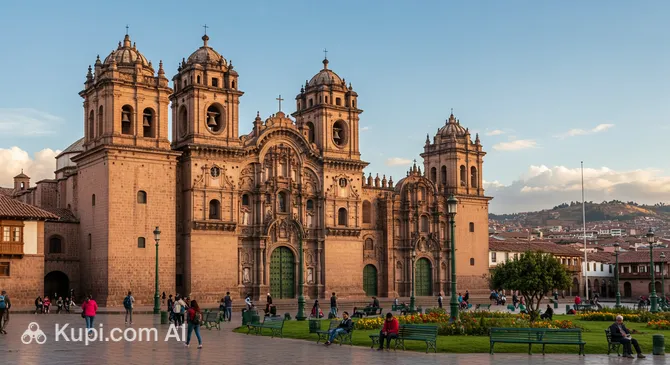
The majestic Cusco Cathedral, also known as the Cathedral Basilica of the Assumption of the Virgin, is the true heart and architectural landmark of the ancient city of Cusco. Located on the famous Plaza de Armas, this temple is considered one of the most significant colonial-era monuments in all of Peru.
Cusco Cathedral. Illustration.
Source: Kupi.com AI
Traveler photos:
This monumental structure is a unique fusion of European Renaissance and local traditions. Built in the shape of a Latin cross, the building impresses with its scale and richly decorated Plateresque facades. The cathedral serves not only as an active religious center but also as a true treasure trove of art, housing priceless collections of paintings and sculptures within its walls.
The main feature of the temple is its internal atmosphere, where the strictness of Catholic canons intertwines with the spirit of the Inca past. For travelers, this is a must-visit destination that allows them to touch the complex and multifaceted history of the region.
Contacts
To clarify visiting details or organize special tours, you can use the cathedral's official contact information. The main contact details are provided below:
Inside Cusco Cathedral, visitors will encounter masterpieces of religious art. One of the main treasures is the collection of paintings from the Cusco School—a unique artistic movement where biblical scenes were adapted to the vision of local masters. Be sure to find the famous painting of the “Last Supper”, where Jesus and the apostles are served a roasted guinea pig (cuy)—a traditional Peruvian delicacy.
Your attention will surely be drawn to the main altar, completely clad in silver, which shines brightly in the dim light of the cathedral. No less impressive are the carved choir stalls and the pulpit, crafted from precious woods with incredible detail. Every decorative element here—from the massive doors to the small sculptures—speaks to the skill of colonial-era craftsmen.
While walking through the side naves and chapels, note the synthesis of cultures: in some ornamental details, you can spot symbols significant to the Incas, such as images of the sun or local plants. This turns a simple tour of the temple into a fascinating exploration of how two great cultures found common ground.
Getting There
Finding the cathedral is easy, as it is located in the heart of the city on the main square, Plaza de Armas. For most tourists staying in the historic center, the walk will take only a few minutes. A walking route through the narrow cobbled streets is the best way to soak up the atmosphere of the ancient Inca capital.
If you are staying in outlying districts, it is most convenient to take a taxi. A trip to the main square is inexpensive and takes very little time. Many city bus routes also pass through the center, but a taxi remains the most comfortable and fastest option for guests of the city.
Travelers arriving in the region by plane will first land at the airport, from where you can reach the cathedral by transfer or official taxi in about 20–30 minutes, depending on traffic.
Nearest city: Cusco
History & Facts
The history of this grandiose structure's construction is inextricably linked to the period of the Spanish conquest. Construction of the Cusco Cathedral began in 1559. Symbolically, the foundation for the Christian temple was the palace of the eighth Inca, Viracocha. In this way, the Spaniards emphasized the transition of religious eras and the establishment of the new faith in the lands of the empire.
The building was designed by the architect Juan Miguel de Veramendi. Construction was a massive and labor-intensive process that spanned nearly a century—work was only fully completed in 1654. One of the most interesting details is the use of stones from the Saqsaywaman fortress, which were transported here by the local population.
Thanks to its massive construction, the cathedral has survived several powerful earthquakes that caused serious damage to the city over the centuries. Today, it is considered one of the most fully preserved monuments of early colonial architecture in Latin America.
Time Needed
To explore the interiors without rushing, examine the details of the famous paintings, and appreciate the grandeur of the silver altar, you usually need 1 to 2 hours. If you plan to use an audio guide or study each of the side chapels in detail, your visit may take slightly longer.
It is recommended to visit the cathedral in the morning, when the lighting best highlights the beauty of the interior decoration. Also, keep in mind that tourist access to some parts of the temple may be restricted during religious services, so plan your visit accordingly.
Working Hours
The Cathedral is open to visitors daily, making it easy to include in any travel itinerary. Please note the slightly shorter opening hours on Sunday:
From Monday to Saturday, the cathedral doors are open from 6:00 AM to 8:00 PM. On Sunday, the schedule is slightly shorter—from 6:00 AM to 6:00 PM. Morning hours are often reserved for worship services, which adds a special solemnity to the visit.
Day
Working hours
Monday
6:00 – 20:00
Tuesday
6:00 – 20:00
Wednesday
6:00 – 20:00
Thursday
6:00 – 20:00
Friday
6:00 – 20:00
Saturday
6:00 – 20:00
Sunday
6:00 – 18:00
Nearby
Due to the cathedral's location in the historic center, many other iconic sites are concentrated around it. A walk from the temple will allow you to see ancient Inca stonework, cozy squares, and viewpoints all in one day.
Below are the most interesting sites located within walking distance of the cathedral: