Support

Stary żuraw portowy

About

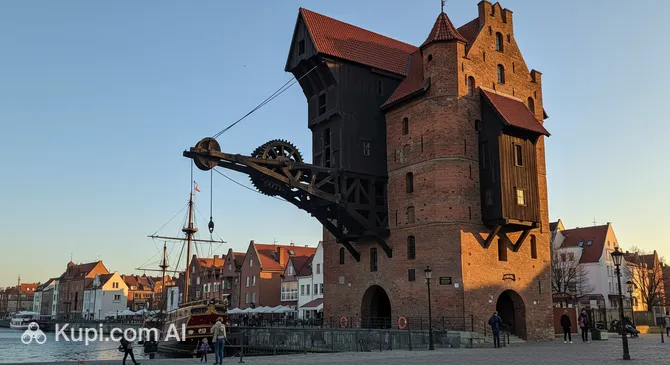
If you find yourself on the picturesque Motława River embankment, your attention will inevitably be drawn to a massive and unusual building—the Crane. This majestic architectural monument, located in the city of Gdańsk, represents a unique synthesis of a medieval city gate and a powerful port crane. All of Poland is rightfully proud of this site, as it is recognized as the largest and oldest preserved port crane in Europe.
\n
The Crane
The Crane. Иллюстрация. Источник: Kupi.com AI
\n

The structure is not just a historical artifact, but a true visual hallmark of the city. Along with Neptune's Fountain, the Crane has become a recognizable symbol, without which it is impossible to imagine the panorama of the Long Embankment. Its dark wooden body, protruding over the brick walls, holds the secrets of the Hanseatic League masters and the spirit of a wealthy merchant past.

\n

Today, this technical monument operates as an important branch of the National Maritime Museum. It is a place where the engineering excellence of the past meets the curiosity of modern tourists wishing to understand how Gdańsk became one of the main maritime hubs of the Baltic.

Contacts

For those planning a visit to the famous Gdańsk crane, it's useful to have the exact coordinates at hand. Finding this majestic structure on the city map is quite easy.

How to contactContact
AddressSzeroka 67/68, 80-835 Gdańsk, Poland

What to Do

The main reason to visit the Crane is the chance to see the inner workings of one of the Middle Ages' most complex mechanisms. Visitors can inspect massive wooden shafts that were once powered by the strength of human legs. The National Maritime Museum's exhibition detailedly recreates the life and technology of a trading port, literally allowing you to touch the history of the Hanseatic era.

For lovers of beautiful panoramas, this place is a real find: the building's windows offer a magnificent view of the Motława River and the lively Długie Pobrzeże embankment. You can watch vintage-style ships sail by, creating a unique sense of traveling back in time.

Additionally, the Crane serves as an excellent landmark and starting point for water excursions. You can embark on a boat trip through the canals right from its walls. After visiting the crane, it's worth walking along the embankment to the nearby Green Gate, which often hosts interesting art exhibitions.

Getting There

The landmark is located in the heart of the historical center on the Długie Pobrzeże embankment. If you are already in the Old Town, the best way to reach it is on foot, enjoying the ancient architecture and the atmosphere of the maritime capital.

For those traveling from more distant areas, public transport is the most convenient option. The nearest tram and bus stops are just a few minutes' walk from the waterfront. You can also use a local taxi or car-sharing service by providing the address: Szeroka 67/68.

Ближайший город: Gdansk

History & Facts

The history of this unique structure dates back to the 14th century. Originally, the Crane was built as a multi-functional facility: it served not only as a powerful lifting mechanism for servicing ships in the port but also as a defensive city gate. It was used to install masts on ships, reload cargo barrels, and perform complex rudder repairs.

The engineering ingenuity of medieval craftsmen is impressive: the mechanism was powered by massive wooden wheels, inside which people "stepped" to create the necessary traction. Until the beginning of the 19th century, the crane remained a vital technical hub of the port, until economic shifts and new administrative changes led to its decommissioning. Afterward, the building even housed a barbershop and various workshops.

In 1945, the wooden superstructure was destroyed and the stone walls were severely damaged. However, after these events, the monument was carefully restored to its historical appearance, becoming a symbol of the city's resilience. Notably, an image of this crane-gate even featured on the 5-gulden coins of the Free City of Danzig in 1932.

Time Needed

About 30–40 minutes is enough to leisurely admire the exterior and take atmospheric photos against the backdrop of the Motława River. However, if you plan to go inside and explore the Maritime Museum exhibition, you should set aside more time.

Usually, a full tour of the interior and studying the mechanisms takes between 1 and 2 hours. This is plenty of time to experience the scale of medieval engineering and enjoy the views from the upper-level windows.

Working Hours

You can admire the exterior of this legendary landmark and walk along the nearby embankment at any time. According to current information, access to the site is open 24/7, allowing tourists to enjoy the crane's night lighting in the evening atmosphere of the city.

However, keep in mind that if you plan to visit the interior museum exhibition, the operating hours depend on the National Maritime Museum's schedule, so it's best to choose daytime for going inside.

Круглосуточно

Nearby

A stroll around the port area allows you to dive deeper into the spirit of the ancient city. Many interesting locations are concentrated right next to the historic crane, ranging from modern entertainment to major transport hubs.

Exploring the embankment and the adjacent islands is a great addition to visiting the main attraction, allowing you to see the contrasts between medieval heritage and modern urban life.

NameDistance
St. Mary's Gate0.1 km
St. Mary's Basilica (Bazylika Mariacka) in Gdańsk0.3 km
Long Market0.3 km
Polish Baltic Philharmonic0.3 km
Neptune's Fountain0.4 km
AmberSky Ferris Wheel0.4 km
Deja Vu Museum0.5 km

Reached the end of the page?

That means the route is fully explored