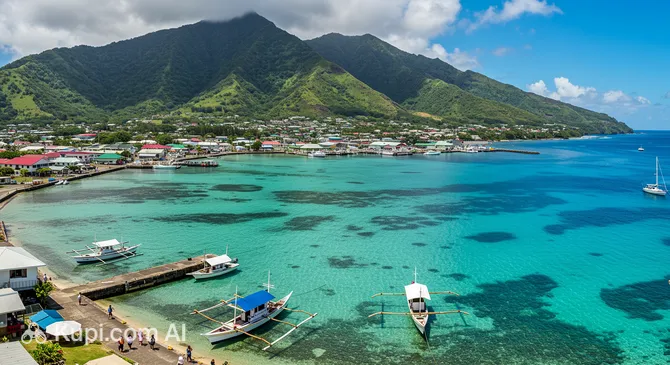
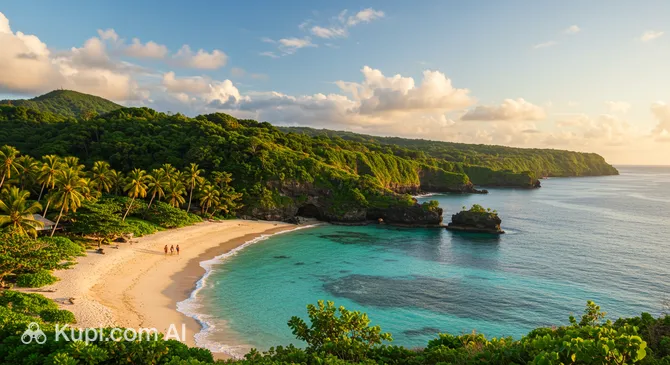
American Samoa (USA) is a unique corner of Polynesia where the pristine nature of the Pacific Ocean blends harmoniously with American influence. The archipelago attracts travelers with its volcanic landscapes, dense tropical forests, and azure bays, while remaining one of the most authentic destinations in the region. The main focus here is on ecotourism and immersion in the traditional way of life known as "Fa'a Samoa" (the Samoan way).
The heart of the islands is the picturesque city of Pago Pago, located in a deep natural harbor surrounded by majestic cliffs. The capital serves as a starting point for exploring the country's main natural riches, including the only US National Park in the Southern Hemisphere. Here you can encounter rare fruit bats and enjoy the silence on secluded beaches that have not yet been reached by mass tourism.
Illustration.
Source: Kupi.com AI
In addition to the capital, places such as Ofu, famous for its snow-white shores, and the colorful village of Tavave are worth your attention. The atmosphere of American Samoa is permeated with tranquility and hospitality, making it an ideal destination for those seeking solitude and wanting to see the real Oceania in all its beauty.
Currency
Since the territory is a possession of the United States, the official currency here is the US dollar (USD). Standard US banknotes and coins are in circulation, which significantly simplifies financial matters for many travelers. Prices in shops and restaurants are usually listed in dollars, and cash remains the most reliable method of payment, especially outside the capital.
Credit cards of international systems (Visa, Mastercard) are accepted in major hotels, supermarkets, and restaurants in Pago Pago. However, when visiting remote villages or small islands such as Fitiuta, be sure to carry a sufficient supply of cash. You can withdraw funds from ATMs in the capital, but their number is limited, so it is better to take care of exchanging or withdrawing currency immediately upon arrival at the airport.
Visa Requirements
Special entry rules apply for visiting American Samoa, which differ from the visa regime of the US mainland. Citizens of most countries, including the USA, Canada, and many EU nations, usually do not require a standard visa, but must obtain a special entry permit — an Entry Permit — or "OK to Board" status before departure. Travelers from CIS countries generally require an advance permit arranged through the immigration office in Pago Pago.
Your primary document should be a passport valid for at least six months from the date of intended departure. Border services may also ask to see return tickets and proof of sufficient funds for the duration of your stay. As rules can change, it is strongly recommended to check current information on the official website of the Government of American Samoa or consult with your airline before purchasing tickets.
We’ll tell you if you need a visa
Enter where you’re going, or
Your citizenship
Destination
Timezones
The entire territory of American Samoa is located in a single time zone, officially called Samoa Standard Time (SST). The difference from Greenwich is UTC-11. This is one of the westernmost time zones in the world, which is why the archipelago is often called the place where "the day ends last."
It is important to remember that daylight saving time is not observed here, so the time difference with other regions remains constant throughout the year. When planning calls home or connecting flights through Honolulu or Apia, be sure to check your watch, as neighboring independent Samoa is on the other side of the International Date Line and is nearly a full day ahead of American Samoa.
Getting There
This remote corner of Polynesia can be reached primarily by air. The main link to the outside world is Pago Pago International Airport. Regular flight service is established with Honolulu (Hawaii), making this the most popular route for international travelers. There are also regional flights from the neighboring independent state of Samoa (Apia), which are operated on small aircraft.
There is no land connection between the islands of the archipelago, so domestic flights or government ferries are used to move between Tutuila and the Manu'a Islands. On the main island, colorful family buses (aiga buses) are popular; they are not only a mode of transport but also an important part of the local culture. They are brightly painted and provide a budget-friendly and interesting way to travel between settlements.
Maritime connections are mainly represented by cargo-passenger vessels and cruise ships that periodically call at the capital's deep-water harbor. When planning your trip, it is recommended to book flights in advance, as the number of flights is limited and demand increases significantly during holiday periods. Be sure to take into account that domestic flight schedules may change depending on weather conditions.
A journey through American Samoa opens up a world of contrasts to tourists: from the bustling port life to the absolute tranquility of uninhabited shores. The main center of attraction remains Pago Pago — a city nestled comfortably in the crater of an ancient volcano. This is where all the infrastructure, the best restaurants, and markets are concentrated, allowing you to feel the rhythm of modern Polynesian life.
For those who dream of "picture-perfect" views, a visit to the island of Ofu is a must. Its beaches with fine white sand and turquoise water regularly appear on lists of the most beautiful places on the planet. Fans of wilder and more untouched nature will enjoy the settlements of Tavave and Fitiuta, where you can see traditional Samoan "fale" houses and learn about the daily life of local communities.
Illustration.
Source: Kupi.com AI
Each of these places offers its own unique experience: in the capital, it is access to museums and shops, and on remote islands, it is the opportunity to be alone with the ocean and the stars. Regardless of your choice, the hospitality of the locals will make your stay unforgettable.
Top Attractions
The main pride and most significant attraction of the country is the National Park of American Samoa. This is a unique protected area covering three islands and including both tropical forests and coral reefs. Picturesque hiking trails are laid out here, such as the route to the summit of Mount Alava, which offers breathtaking views of the harbor and the vast ocean.
For history and culture enthusiasts, a visit to the Cultural Center in Pago Pago is a mandatory part of the program. Here you can see firsthand the process of creating traditional canoes, mat weaving, and learn the secrets of applying Samoan tattoos, which have a deep sacred meaning for the locals. The center building itself is an example of traditional architecture with its characteristic dome-shaped roof.
Another natural wonder is the Fagatele Bay Marine Sanctuary. This secluded bay, formed in a submerged volcanic crater, is home to hundreds of species of fish, sea turtles, and dolphins. The crystal-clear water makes this place ideal for diving and snorkeling, allowing tourists to experience the rich biodiversity of the Pacific Ocean in its pristine form.
Best Time to Visit
When planning the perfect trip to American Samoa, it is important to consider the islands' tropical climate. The high season here falls between June and September. During these months, the weather is most comfortable and dry, which is ideal for hiking in national parks and beach vacations. This time also coincides with many cultural festivals; however, keep in mind that flight prices may be slightly higher.
The low season lasts from December to March and is characterized by high humidity and heavy rainfall. This is the time for tropical storms, but even during the rainy period, the sun often comes out from behind the clouds, and nature becomes incredibly vibrant and lush. A plus of traveling in the off-season is the absence of crowds and the opportunity to find better deals on accommodation in Pago Pago or on remote islands like Ofu.
If your goal is marine life watching or participating in local holidays, such as Flag Day in April, it is worth booking your accommodation in advance. Overall, thanks to the consistently high water and air temperatures, visiting American Samoa is possible at any time of year if you are prepared for short but intense tropical downpours.
Traditions
The culture of American Samoa is based on the ancient code of conduct Fa'a Samoa, which defines relationships between people, respect for elders, and love for the land. For a tourist, it is important to know that every village has its own chief, and when visiting communal territories, one should be polite and modest. It is customary to remove shoes when entering a traditional fale house, and during a conversation with locals, it is better to sit with legs crossed, as standing above those seated is considered impolite.
Religion and Sunday rest are of particular importance on the islands. On this day, life practically comes to a standstill: shops and markets close, and families go to church. In some villages, the evening prayer hour Sā is still observed (usually between 18:00 and 19:00), during which passers-by are asked to stop and remain quiet until the signal marking the end of the ritual sounds. This custom should be treated with understanding and respect.
In terms of clothing, Samoans adhere to a conservative style. When outside of beach areas, tourists are recommended to wear clothing that covers the shoulders and knees, especially when visiting religious sites or residential villages. The traditional male and female sarong — the lavalava — is everyday wear here and will be an excellent purchase for a traveler wishing to blend harmoniously into the local environment.
Entertainment
Entertainment in American Samoa is closely linked to its natural potential and cultural heritage. The main magnet for outdoor enthusiasts is diving and snorkeling. The archipelago's coral reefs, especially around the island of Ofu, are considered some of the most pristine in the world. For those who prefer to stay on land, there are numerous hiking trails through the jungle and climbs to the peaks of extinct volcanoes, offering panoramic views of the Pacific Ocean.
The cultural life of the islands centers around traditional ceremonies and holidays. Tourists often get the chance to see a "fiafia" show — vibrant performances with Polynesian dances, music, and fire shows, which are usually held in the major hotels of Pago Pago. This is a great way to get acquainted with local folklore and try dishes cooked in a traditional "umu" earth oven.
Shopping on the islands is local in nature: in the capital, you can find authentic souvenirs such as siapo cloth (hand-painted tree bark), wood carvings, and shell jewelry. The nightlife here is quite quiet and concentrated in a few bars and restaurants in the capital, where you can enjoy live music in a relaxed island atmosphere.
Currency rates
Planning a trip? Wonderful! To ensure the financial side of your journey doesn’t come as a surprise, it’s important to remember that currency exchange rates are constantly changing. Therefore, we highly recommend tracking the latest rates both before you fly and throughout your trip. You can use the data provided below for this — we monitor exchange rates 24/7 and strive to provide the most up-to-date information.