Support

Museum of Science and the Cosmos

About

The Museum of Science and Space (Museo de la Ciencia y el Cosmos) is a fascinating modern interactive science center located in Santa Cruz de Tenerife, Spain. Opened on May 11, 1993, on the initiative of the Institute of Astrophysics of the Canary Islands and the Cabildo of Tenerife, the museum quickly earned a reputation as one of the leading educational and cultural centers in the Canary Islands. It invites visitors of all ages to embark on a thrilling journey through the world of scientific discovery.
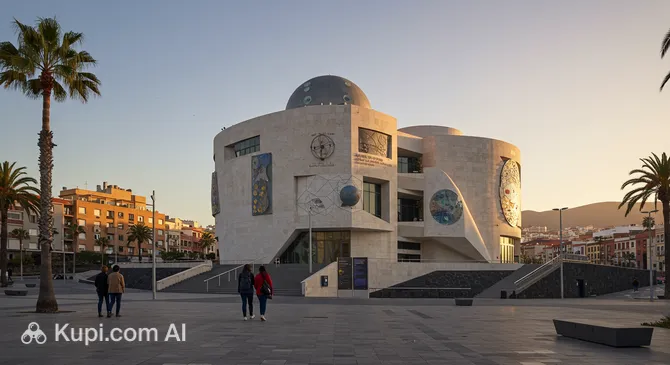
Museum of Science and the Cosmos. Illustration.
Source: Kupi.com AI

Traveller photos:

The architectural design of the museum, created by Jordi Garcés and Enric Soria, is noteworthy in itself. The building has an original semi-star shape, symbolically emphasizing the astronomical focus of the exhibits. While the main emphasis is on the mysteries of the Universe and astronomy, the museum also covers a wide range of other scientific disciplines, presenting them in an accessible and engaging way.

The main highlight of the Museum of Science and Space is its interactivity. Here, you can do more than just look at the exhibits; you can interact with them, conduct experiments, and experience the laws of nature firsthand. This makes a visit to the museum not only educational but also incredibly fun, turning learning into a thrilling adventure for both children and adults. If you are looking for a place to spend time in a fun and useful way while immersing yourself in the world of science, this museum is an excellent choice.

Contacts

If you are planning to visit the Museum of Science and Space and have any questions, you can contact the museum administration. It is always best to check the official website or call for up-to-date information on opening hours, ticket prices, and special events.

How to contactContact
AddressAv. de los Menceyes, 70, 38205 La Laguna, Santa Cruz de Tenerife, Spain
Phone+34 922 31 52 65
Websitewww.museosdetenerife.org

What to Do

At the Museum of Science and Space, a world of fascinating discoveries awaits visitors, where science comes to life before your eyes. The main feature of the museum is its interactivity. Here, you are not just a passive observer but an active participant in experiments. You can experience the Earth's rotation for yourself, understand the principles of solar activity, explore orbits around stars, and even peer into the mysterious world of black holes. The exhibitions also cover more down-to-earth but equally interesting topics: from the laws of optics and mechanics to the principles of mobile communication and the amazing human anatomy.

Special attention is given to astronomy. The special astronomical hall features models of famous telescopes, including the impressive Gran Telescopio Canarias and instruments from the Teide observatories. The real gem is the modern planetarium, where a state-of-the-art projection system allows you to see up to 2,800 stars and enjoy captivating popular science shows about the Universe. On the museum grounds, you can also find a real radio telescope, curious analemmatic sundials, and a dedicated observation deck for stargazing, making your visit even more rewarding.

In addition to the permanent exhibitions, the Museum of Science and Space regularly hosts a variety of events designed for a wide audience. Guests can enjoy informative lectures from experts, engaging workshops where you can create something scientific with your own hands, and romantic astronomical evenings under the open sky. For young explorers and their parents, there are even themed camps that turn the study of science into an unforgettable adventure.

Getting There

The Museum of Science and Space is conveniently located in the La Laguna district, near the center of Santa Cruz de Tenerife. If you are planning to travel by car, getting to the museum is quite simple—there is convenient parking on-site, which is a big plus for road trippers.

One of the most comfortable and popular ways to reach the Museum of Science and Space is by public transport. A tram runs regularly between Santa Cruz and La Laguna. You will need to get off at the aptly named “Museo de la Ciencia” (Museum of Science) stop, making the route intuitive even for first-time visitors.

In addition to the tram, the museum can be reached by other forms of city transport, such as buses or taxis, which also serve the area. Due to its excellent location and accessibility, the Museum of Science and Space is deservedly popular with both tourists and locals, especially on weekends and holidays. Therefore, if you want to avoid large crowds, it is worth planning your visit in advance.

Nearest city: Santa Cruz de Tenerife

History & Facts

The idea for the Museum of Science and Space was born in the late 1980s. The concept was ambitious—to create not just an exhibition space, but an innovative platform capable of sparking an interest in science among a wide audience. This vision came to life on May 11, 1993, when the museum officially opened its doors to its first visitors, marking the beginning of a new era of science popularization in the Canary Islands.

Since its inception, the museum has established close partnerships with the Institute of Astrophysics of the Canary Islands (IAC). This collaboration is no coincidence, as the Canary Islands are world-renowned for their leading astronomical observatories. Initially, the museum's exhibits were heavily focused on astronomy, reflecting the region's unique connection to international space research. Joint exhibitions and educational programs with the IAC have become a vital part of the museum's activities.

Over time, the Museum of Science and Space did not rest on its laurels and significantly expanded the scope of its exhibitions. Today, visitors can explore almost all major fields of modern science—from physics and biology to technology and the study of the human body. Thanks to this diversity and constant development, the museum has become one of the most visited and significant scientific venues not only in Santa Cruz de Tenerife but across the entire Canary archipelago, continuing to inspire discoveries for visitors of all ages.

Time Needed

To fully enjoy all the exhibitions at the Museum of Science and Space and not miss a fascinating session in the planetarium, it is recommended to set aside at least 2–3 hours. This is usually enough time to explore the main interactive zones, participate in demonstrations, and get a general idea of the scientific concepts presented.

However, if you are traveling with curious children who will want to examine every exhibit in detail, or if you plan to take part in one of the educational workshops or lectures occasionally held at the museum, you might need significantly more time. In that case, to immerse yourself in the world of science without rushing, it is better to plan about half a day for your visit to the Museum of Science and Space. This will allow you to get the most enjoyment and knowledge from visiting this interesting place in Santa Cruz de Tenerife.

Working Hours

The Museum of Science and Space in Santa Cruz de Tenerife is usually open to visitors from Tuesday to Sunday, from 9:00 AM to 7:00 PM. It is closed on Mondays. The museum is open year-round, although it is worth noting that the schedule may change during holidays and the summer season.

While pre-booking tickets is not always mandatory, it is highly recommended to visit the official museum website or contact them directly for the most up-to-date information on opening hours, potential schedule changes, and whether pre-registration or online ticket purchase is required. This will help you plan your visit effectively and avoid any potential inconvenience.

DayOpening hours
Monday9:00 – 19:00
Tuesday9:00 – 19:00
Wednesday9:00 – 19:00
Thursday9:00 – 19:00
Friday9:00 – 19:00
Saturday9:00 – 19:00
Sunday10:00 – 17:00

Nearby

Visiting the Museum of Science and Space in Santa Cruz de Tenerife is an exciting adventure in its own right. However, to make your trip even more fulfilling and informative, it is worth checking out the attractions located nearby. Exploring the surrounding area will allow you to dive deeper into the city's atmosphere and discover new interesting places.

There are several noteworthy sites near the Museum of Science and Space that can complement your experience in Spain. These could be other cultural institutions or simply picturesque spots in the city where you can enjoy your time. Below is a list of some of them, including their distance from the museum.

NameDistance
Museum of the History of Tenerife1.6 km
La Vega Park2.3 km
Taberna Ramón4.9 km
Plaza de los Patos5.2 km
Casa del Carnaval5.3 km
Meridiano Shopping Centre5.3 km
Bodegón El Puntero5.4 km

Reached the bottom of the page?

Looks like you know this route inside out