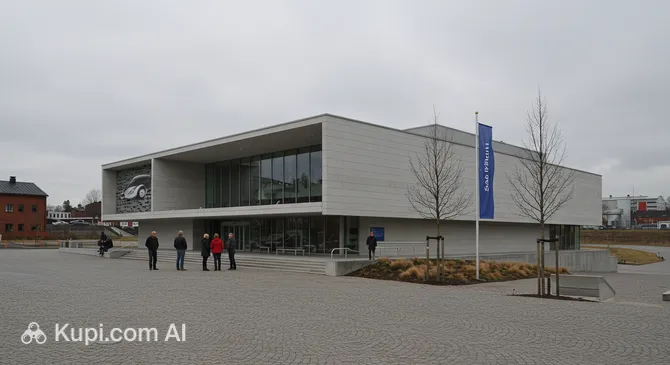
If you appreciate engineering genius and Scandinavian design, the Saab Car Museum is a must-visit on your itinerary through Sweden. Located in the country's industrial heart, the city of Trollhättan, this museum is a true treasure trove for transport history enthusiasts. It houses a unique collection of about 120–130 cars that tell the fascinating story of the legendary brand, whose roots go deep into aircraft manufacturing.
Saab Car Museum. Illustration.
Source: Kupi.com AI
Traveller photos:
The exhibition covers all the significant milestones of the brand's development: from the very first UrSaab prototype to concept cars and triumphant sports cars that won prestigious races. Of particular value is the fact that the collection was fully preserved thanks to the decisive actions of the municipality, which bought it after the company's bankruptcy in 2011, preventing the sale of unique specimens to private collectors.
Visitors can see firsthand how aviation technology and aerodynamic principles were translated into car bodies. The museum offers not only visual enjoyment of Saab's aesthetics but also access to archives, as well as a cozy shop with souvenirs and scale models that make a great gift for any automotive fan.
Contacts
To plan your visit to the Saab Car Museum, it is helpful to have up-to-date contact information on hand. You can check tour details or special visiting conditions by contacting the administration directly.
The main reason to visit this museum is the opportunity to trace the evolution of Swedish engineering. You can examine the car collection in detail, which includes not only production models but also hand-assembled units and experimental prototypes. Walking through the halls allows you to appreciate how Saab's forms and technical equipment have changed over the decades.
Be sure to pay attention to the brand's sporting achievements. The museum displays rally cars that still bear the marks of past victories and demonstrate the incredible reliability of Swedish machines. Photography is allowed here, and every exhibit is in perfect condition, allowing for excellent shots against the industrial interiors.
In addition to exploring the main collection, visitors have access to archival materials that allow for a deeper dive into the brand's history. After the tour, stop by the museum shop: you can buy books on the history of Saab or collectible scale models, which will serve as a wonderful reminder of your visit to the city of Trollhättan.
Getting There
Getting to the museum is quite simple as it is located within the city of Trollhättan. If you are traveling by car from Gothenburg, the drive along the E45 highway will take about an hour. The museum provides convenient and free parking for visitors, which greatly simplifies logistics.
For those who prefer public transport, the railway is an excellent option. Trains from Gothenburg Central Station run regularly, with a travel time to Trollhättan Centralstation of about 40–60 minutes. From the station, you can reach the museum by taxi in 10 minutes or take local buses heading toward the Innovatum industrial area.
If you are flying in from another country, the nearest major airport is Göteborg Landvetter, located approximately 90 kilometers away. From the airport, it is most convenient to rent a car or take a bus to the center of Gothenburg and then transfer to a train to Trollhättan.
Nearest city: Trollhättan
History & Facts
The history of this place is inextricably linked to the industrial rise of the region. Saab (Svenska Aeroplan Aktiebolaget) originally specialized in the production of aircraft, and only after the end of World War II was it decided to direct its engineering potential toward creating automobiles. The first prototype, known as the UrSaab, was introduced in 1947 and still holds a place of honor in the exhibition.
A dramatic turn in the museum's fate occurred in 2011 when the Saab company faced bankruptcy. The entire unique collection was at risk of being sold off piece by piece at auctions. However, the city municipality, together with industrial groups, purchased the collection for $4.1 million, preserving its integrity and ensuring the museum's continued existence in its home city.
The museum itself is located in a historic building of the Innovatum District, in former workshops where production once took place. This location emphasizes the city's role as a center for Swedish heavy industry and innovation, turning a visit to the museum into a true journey through time dedicated to the successes and challenges of Scandinavian automotive engineering.
Time Needed
To thoughtfully study all the exhibits and read the information stands, most visitors need between 2 and 3 hours. If you are a true fan of the brand or are interested in technical details and blueprints in the archives, your visit could easily last half a day.
The museum is organized quite compactly, but the concentration of interesting models per square meter is very high. It is recommended not to rush, so you have time to examine the car interiors and feel the spirit of each era represented in the hall.
Working Hours
When planning your visit to the museum, please note that it is closed to visitors on Mondays. On other days, the doors are open to guests from morning until mid-afternoon, and on Thursdays, the opening hours are extended, which is convenient for an evening tour of the collection.
Current opening schedule: Tuesday to Sunday (except Thursday) — from 11:00 to 16:00; on Thursday, the museum is open from 11:00 to 19:00. Please note that the schedule may change during public holidays, so it is recommended to check the official website before your trip.
Day
Opening hours
Monday
Closed
Tuesday
11:00 – 16:00
Wednesday
11:00 – 16:00
Thursday
11:00 – 19:00
Friday
11:00 – 16:00
Saturday
11:00 – 16:00
Sunday
11:00 – 16:00
Nearby
A visit to the Saab Museum can easily be combined with a walk to other interesting places in the city, as it is located in an area with a rich industrial and natural heritage. Exploring the surroundings will allow you to better understand the history of the region and enjoy the power of Swedish hydraulic structures.
We use cookies and services to collect user information. This is essential for the functioning of the site and for marketing purposes. You can find out more in .
Other popular routes
Where travelers fly most — pick a route and check prices