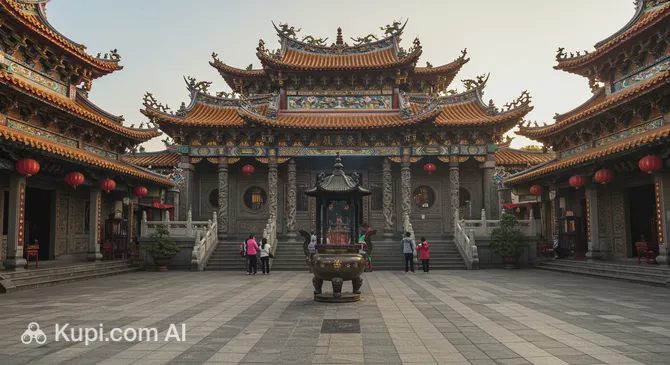
The `Lukang Longshan Temple` has a rich and long history dating back to the 18th century. It was founded by immigrants from Fujian Province who brought with them not only their customs but also their deep faith. Originally built, according to some records, in the late 17th century and later significantly rebuilt and expanded in 1786 at its current location, the temple is one of the oldest and most significant Buddhist sanctuaries in Taiwan. From the beginning, it has been dedicated to Guanyin, the Goddess of Mercy, and remains an important center for her veneration today, attracting both believers and tourists.
One of the most remarkable features of the `Lukang Longshan Temple` is its outstanding architecture and decorative art, leading it to often be called an "art palace" or a "living museum of Taiwanese temple architecture." The temple is built in the traditional Southern Fujian style and is famous for its incredibly intricate wood carvings, especially on ceiling structures—such as the famous octagonal caisson ceiling in the main hall—and on the altars. Also impressive are the stone sculptures depicting dragons, phoenixes, and other mythological creatures, as well as the exquisite Koji pottery decorating the roofs and walls. Every element here is a work of art created by the best masters of their time.
`Lukang Longshan Temple` is not just a historical monument, but an active spiritual center that plays an important role in the local community and attracts pilgrims from across Taiwan and abroad. The temple has witnessed many historical events and changes in the town of Lukang, which was once one of the island's largest ports. In 1983, the temple was officially recognized as a first-class national historical monument, highlighting its exceptional cultural and historical value. A visit to the temple provides an opportunity not only to admire its beauty but also to touch living history and traditions.
An interesting fact is that the `Lukang Longshan Temple` is considered one of the best-preserved examples of Qing Dynasty temple architecture in Taiwan. Its layout, consisting of several courtyards and halls arranged along a north-south axis, its materials, and its decorative elements largely reflect the construction canons of that period. Inside the temple, you can see many ancient artifacts, including old steles with inscriptions, ritual objects, and sculptures of deities. Special attention is drawn to the main hall dedicated to Guanyin, where an atmosphere of peace and spirituality prevails, as well as the rear hall dedicated to Mazu, the goddess of the sea, reflecting Lukang's historical connection to maritime trade.