Support

Moravian Pottery & Tile Works Museum

About

Immersion into the world of traditional craftsmanship awaits you in the city of Doylestown, home to the famous Moravian Pottery and Tile Works. This is not just a museum, but a unique working factory recognized as a U.S. National Historic Landmark. Here, the secrets of decorative tile production established over a century ago are still carefully preserved.
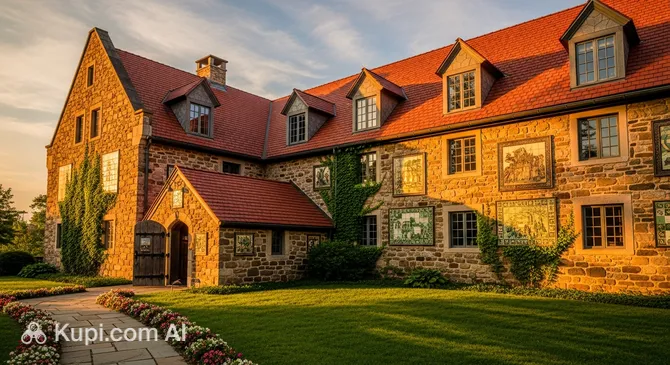
Moravian Pottery and Tile Works. Source: Kupi.com AI

This striking Spanish Colonial-style building, constructed of cast-in-place concrete in the early 20th century, is a work of art in its own right. It was founded by Henry Chapman Mercer, who sought to revive the aesthetics of hand labor during the Industrial Revolution. Today, the site is owned by Bucks County and continues to produce unique ceramics.

The main feature of the workshop is its use of over 6,000 original designs by Mercer. Artisans create tiles from local clay, drawing inspiration from medieval and Renaissance motifs, flora, fauna, and themes from classical literature. A visit to this site allows you to see firsthand how the masterpieces that decorate interiors across the country are born.

Contacts

For further details before your visit or to book group tours, you can use the organization's contact information.

Address 130 E Swamp Rd, Doylestown, PA 18901, USA
Phone +1 215-239-9797 ext. 5
Website thetileworks.org

What to Do

The main highlight for visitors is the factory tour, which is held every half hour. You can walk through the historic workshops and see all the stages of transforming raw clay into an elegant product. The process begins in a special pug mill and goes through hand-pressing into molds, drying, and firing in antique kilns.

Observing the work of modern artisans who use traditional technologies that haven't changed in over a hundred years is particularly impressive. You will see how glaze and hand-painting are applied, and how the famous mosaic murals depicting scenes of folk life and old Pennsylvania trades are created.

At the end of your tour, be sure to stop by the exhibition galleries to see the finest examples of tiles and visit the workshop's gift shop. Here, you can purchase authentic souvenirs—from small decorative tiles with symbolic images to complex ceramic compositions that will become a unique decoration for any home.

Getting There

Finding the workshop is easy: it is located at 130 E Swamp Rd in the northern part of the city. If you are traveling by private or rental car, the most convenient routes are Route 313 or Route 202. Free parking is available for visitors on-site.

From the city center, you can quickly reach the site by taxi or by using Uber or Lyft, which takes no more than 10 minutes. For those who prefer public transport, it is best to check the current bus schedules for Bucks County in advance, although the walk from the nearest stops can be quite long.

The workshop's location is very convenient for tourists, as it is in close proximity to other iconic sites associated with Mercer's name, allowing you to create a rich walking itinerary for the entire day.

History & Facts

The founder of this amazing place was Henry Chapman Mercer—a prominent archaeologist, anthropologist, and collector. In 1898, he decided to establish a production facility to preserve the dying art of handmade ceramics, characteristic of the Moravian settlers in Pennsylvania. Mercer was an ardent supporter of the Arts and Crafts movement, advocating against soulless factory production.

The building we see today was erected in 1912. It is an architectural experiment in itself: Mercer used cast-in-place concrete to create whimsical forms in the Spanish Colonial style. Within these walls, he embodied his philosophy, combining medieval labor methods with construction technologies that were innovative for the time.

The workshop quickly gained national fame. Mercer's unique tiles became highly sought after by the leading architects of the era. Today, they can be seen in iconic locations such as the Pennsylvania State Capitol in Harrisburg and the Isabella Stewart Gardner Museum in Boston. Every piece made here still carries a part of history and its creator's passion for traditional craft.

Time Needed

To leisurely explore the exhibition and observe the production process, it is recommended to set aside 1 to 2 hours. This is enough time to take a guided tour of the main halls and browse the gift shop.

If you plan to combine your visit to the workshop with a trip to the neighboring Fonthill Castle, it is better to allow half a day for the excursion. The peaceful atmosphere of the grounds around the workshop often encourages visitors to linger longer, admiring the decorative details of the building.

Working Hours

The workshop is open to visitors from Tuesday to Sunday, 10:00 AM to 5:00 PM. Please note that the museum and production facility are closed on Mondays.

Tour schedules may change on holidays, so it is recommended to check for current information on the official website or contact the administration by phone before your visit.

Nearby

The area surrounding the workshop in Bucks County is filled with history and culture. A stroll through the adjacent grounds will allow you to immerse yourself deeper in the atmosphere of old Pennsylvania and see historic markers dedicated to the prominent figures who lived in the region.

Below is a list of interesting sites located within walking distance or a short drive:

Attraction Distance (km)
Little Stone House in the Fonthill Woods 0.3
Charles Sheeler Pennsylvania Historic Marker 0.4
Aaron Siskind (1903-1991) Pennsylvania Historic Marker 0.5
OOKA 0.8
Bucks County Pennsylvania Historic Marker 1.4
104th Pennsylvania Monument 1.5
The Hattery Stove & Still 1.6
Station Taphouse 2
Margaret Mead (1901-1978) Pennsylvania Historic Marker 2.1
Build the Kingdom at Kids Castle 4.6

Reached the end of the page?

That means the route is fully explored