Support

Fort Mose Historic State Park

About

Amidst the picturesque landscapes of Florida lies a place of exceptional historical significance — Fort Mose Historic State Park. Located on the outskirts of St. Augustine, this site is the first legally sanctioned settlement for free Africans in the USA. Founded in 1738, the fort became a symbol of hope and a refuge for those seeking escape from slavery in the British colonies.
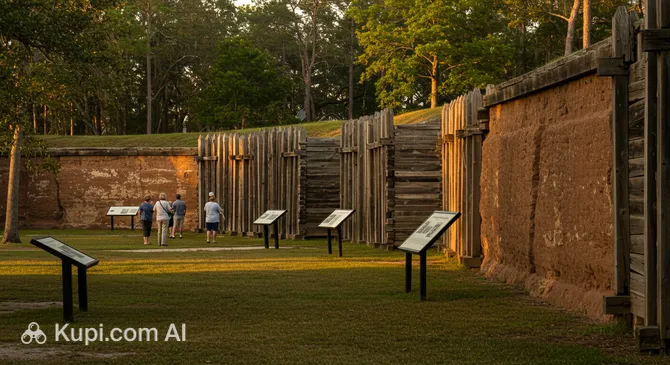
Fort Mose Historic State Park. Source: Kupi.com AI

Today, the park covers 24 acres and is recognized as a National Historic Landmark. Here, visitors can touch the unique heritage of the Gracia Real de Santa Teresa de Mose community, which for decades united the cultural traditions of Africa, Spain, and the indigenous peoples of America. It is not just an open-air museum, but a living testament to the struggle for freedom and the resilience of the human spirit.

The park harmoniously combines its educational mission with natural charm. While strolling along its trails, guests can not only learn about the details of archaeological excavations that revealed the fort's secrets to the world in the late 20th century but also enjoy the tranquility of the wetlands, home to many rare birds and animals.

Contacts

To clarify visit details or organize group tours, you can contact the park administration directly.

Contact Information:

Address 15 Fort Mose Trail, St. Augustine, FL 32084, USA
Phone +1 904-823-2232
Official Website floridastateparks.org

What to Do

The best way to start exploring the park is with a visit to the museum, where modern interactive displays and tactile exhibits literally bring history to life. Fascinating video materials are broadcast here, telling the story of the daily lives of the settlement's first residents. If you're lucky, you might catch one of the historical reenactments: volunteers in authentic colonial clothing demonstrate the skills of the militia of that time, which is especially popular with children and school groups.

For nature lovers, there are two scenic boardwalks. One leads to a kayak launch, and the second to an observation deck overlooking the salt marshes. This is an ideal location for ecotourism and wildlife photography: graceful roseate spoonbills, herons, and blue crabs are often captured in the lens.

The recently completed partial reconstruction of the 18th-century fortifications allows guests to visualize what the defensive line looked like hundreds of years ago. The administration plans further expansion of the complex, so each new visit may bring new discoveries and impressions from this inspiring place.

Getting There

Getting to the historic park from the city center is quite simple — the drive takes only 5–10 minutes. The main route follows the US-1 highway or the scenic A1A road. The exact address for navigation is: 15 Fort Mose Trail, St. Augustine, FL 32084. Convenient parking for visitors is provided on-site.

Since public transportation in the area is limited, tourists are most often recommended to use taxis or popular services like Uber and Lyft. Walking from downtown St. Augustine can be tiring, as the distance is about 4 miles (over 6 km).

For those arriving from other regions of the USA, the nearest major aviation hub is Jacksonville International Airport (JAX), located approximately an hour's drive to the north. St. Augustine Regional Airport is also nearby, serving private and small flights.

History & Facts

The history of this place began in 1738, when the Spanish Governor of Florida, Manuel de Montiano, established the settlement of Gracia Real de Santa Teresa de Mose. It was a bold and unique project for its time: the fort became an official refuge for Africans fleeing slavery from the British colonies of the Carolinas. The primary condition for gaining freedom was an oath of allegiance to the Spanish Crown and conversion to the Catholic faith.

For a quarter of a century, Fort Mose served as home to a community of about 100 people. A remarkable cultural environment formed here, where African, Spanish, and Native American traditions intertwined. The settlement also fulfilled an important strategic task, serving as the first line of defense for Spanish St. Augustine against its northern neighbors.

After Florida came under British control in 1763, the residents were forced to leave their homes and evacuate to Cuba. For many years, the location of the fort was forgotten until archaeological excavations in 1986 revealed the remains of this important historical site to the world. In 1994, the monument was designated a National Historic Landmark, cementing its title as the cradle of freedom for Africans in the USA.

Time Needed

To leisurely explore the exhibits and walk through the grounds, most travelers need between 45 to 90 minutes. This is ample time to get acquainted with the museum collection, watch the informational film, and walk along the scenic boardwalks to the observation decks.

If you plan to attend a historical reenactment or are an avid birdwatcher, you should budget a bit more time — about two hours. The park offers a peaceful atmosphere conducive to thoughtful historical study away from the city noise.

Working Hours

Fort Mose Historic State Park welcomes guests according to the following schedule:

  • Monday: 09:00 – 17:00
  • Tuesday: Closed
  • Wednesday: Closed
  • Thursday: 09:00 – 17:00
  • Friday: 09:00 – 17:00
  • Saturday: 09:00 – 17:00
  • Sunday: 09:00 – 17:00

Please note that the park is closed to visitors on Tuesdays and Wednesdays, so plan your visit in advance.

Nearby

A visit to Fort Mose can be easily combined with exploring other iconic sites of America's oldest city. Proximity to the historic center allows for a packed full-day itinerary, immersing you in the colonial atmosphere and the region's natural beauty.

Exploring the surroundings will help you better understand the context of the era and enjoy a variety of attractions, from ancient fortresses to modern aquariums.

Attraction Name Distance (km)
Ponce de Leon's Fountain of Youth Archaeological Park 2.6
Fountain of Youth Ticket Office 2.7
Castillo de San Marcos National Monument 3.7
Historic Downtown St. Augustine 4.2
Saint Augustine Distillery 4.5
St. Augustine Lighthouse & Maritime Museum 6.0
St. Augustine Aquarium 7.4
GLOBAL BITES | Food Truck Park 8.9
Adventure Landing St. Augustine 9.2
Custom Aquarium 14.8

Reached the end of the page?

That means the route is fully explored