Support

The Butler Institute of American Art

About

If you are looking for a place where the cultural heritage of the New World is represented in all its diversity, the Butler Institute of American Art will be a true discovery for you. Located in the city of Youngstown, this museum proudly holds the title of the world's first institution dedicated exclusively to the work of artists from the USA.
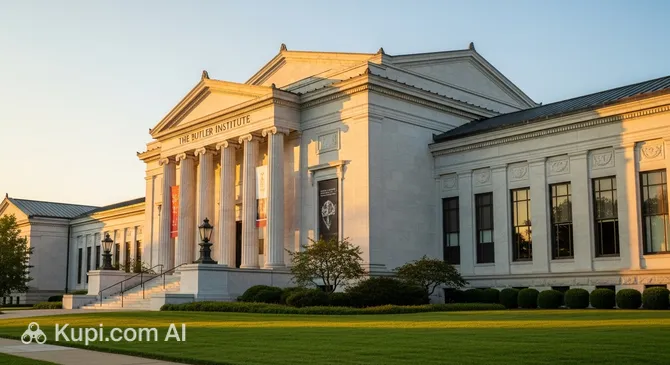
The Butler Institute of American Art. Illustration.
Source: Kupi.com AI

Traveler photos:

The museum building itself is a work of art. Built in the Italian Renaissance Revival style from noble Georgian marble, it was designed by the renowned architectural firm McKim, Mead and White. Its majestic facades and classical proportions have earned the institute a place on the National Register of Historic Places.

Founded in 1919 by philanthropist Joseph G. Butler Jr., the museum remains true to its mission today — making art accessible. For over a hundred years, it has operated on a non-profit basis with no admission fee, making it a unique cultural gem of Ohio.

Contacts

To plan your visit, it is helpful to have up-to-date contact information at hand. The museum administration is always happy to welcome guests and is ready to answer questions regarding current exhibitions.

How to contactContact
Address524 Wick Ave, Youngstown, OH 44502, США
Phone+1 330-743-1107
Websitewww.butlerart.com

What to Do

Inside the museum, a fascinating introduction to over 22,000 works of art spanning three centuries of American history awaits you. Be sure to find Winslow Homer's legendary painting "Snap the Whip" and Albert Bierstadt's monumental canvas "The Oregon Trail", which are considered among the collection's greatest treasures.

Beyond the classics, the galleries showcase works by prominent masters of various eras: from the poignant portraits of Norman Rockwell (including his famous Lincoln) to the refined canvases of Mary Cassatt and James Whistler. Modern style lovers will appreciate Alfred Leslie's large-scale work "Americans: Youngstown, Ohio" and pieces by Robert Motherwell.

Visitors can also explore interesting exhibits of 1930s prints created under the WPA program. These works vividly demonstrate the industrial spirit and social changes in America at that time. For those interested in the connection between sports and culture, the museum features a specialized gallery where athletic achievements are immortalized in artistic forms.

Getting There

Getting to the city's cultural heart is easy. The Butler Institute of American Art is located at 524 Wick Ave, practically on the university campus. If you are traveling by car, it is easiest to follow major highways I-80 or I-76, which will lead you to downtown Youngstown. Parking is available for museum visitors next to the building.

For those choosing public transport, the Youngstown MRT bus system is an optimal choice. Most routes pass through the central terminal, from where the museum entrance is a pleasant 10–15 minute walk. Additionally, you can always use taxi or rideshare services directly from your hotel or the station.

Nearest city: Youngstown

History & Facts

The history of this unique place began in 1919 thanks to the vision and generosity of industrialist Joseph G. Butler Jr. He did not just found a museum; he created the world's first institute whose mission was entirely focused on preserving American creative heritage. Margaret Evans became the institution's first director, and her contributions helped set high standards for museum management.

Over the years, the building designed by the famous McKim, Mead and White firm gradually grew. In 1931, additional lower wings were added, and in 1968, the complex was expanded with second floors. An important recognition of the site's significance was its inclusion in the National Register of Historic Places in 1974. Later, in 1987, the West Wing opened, housing the Hopper Library and the unique Donnell Gallery of American Sports Art.

Interestingly, the continuity of generations has always played a key role here: in 1934, Joseph G. Butler III took over as director, and in 1981, Louis A. Zona assumed leadership, under whom the institute gained its modern dynamic. The museum continues to be a symbol of philanthropy, maintaining the tradition of free admission for all visitors for more than a century.

Time Needed

To fully appreciate the scale of the collection and take your time exploring all the main halls, the average visitor is recommended to allow 2–3 hours for their visit. This will give you enough time to enjoy the main masterpieces and browse the temporary exhibitions without feeling rushed.

If you consider yourself an avid art enthusiast and want to study the library or the sports art collection in detail, you should set aside half a day. Given the museum's calm atmosphere, this is an excellent way to spend time in intellectual pursuit and aesthetic contemplation.

Working Hours

When planning your itinerary, please note that the museum is closed on Mondays. From Tuesday to Saturday, the institute is open to visitors from 11:00 AM to 4:00 PM, and on Sundays, the exhibits can be viewed on a slightly shorter schedule — from 12:00 PM to 4:00 PM.

To get the most up-to-date information on possible changes to the operating hours during holidays or special exhibitions, we recommend checking the official website before your visit.

DayWorking hours
MondayЗакрыто
Tuesday11:00–16:00
Wednesday11:00–16:00
Thursday11:00–16:00
Friday11:00–16:00
Saturday11:00–16:00
Sunday12:00–16:00

Nearby

The area around Wick Avenue is rich in interesting locations, so a visit to the museum can easily be combined with a stroll through the surroundings. Exploring these places will allow you to dive deeper into the atmosphere of academic and historic Youngstown.

Below are sites located in the immediate vicinity of the institute:

NameDistance
Cassese's MVR0.3 km
Noble Creature Wild Ales & Lagers0.4 km
Whistle and Keg0.7 km
OH WOW! Children's Center for Science & Technology0.7 km
Covelli Centre1 km
Topsy's Lounge1.6 km
Pit Stop Cafe1.9 km

Reached the end of the page?

That means the route is fully explored