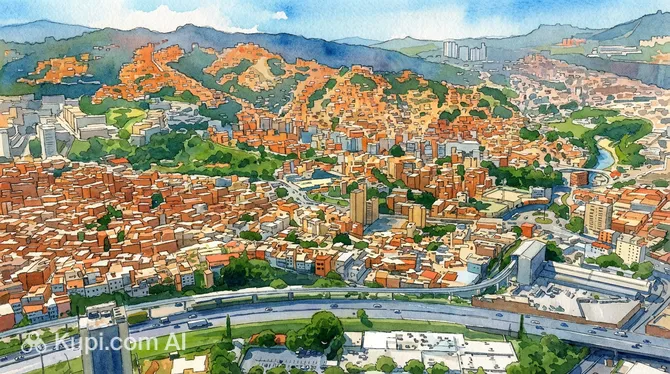
Located in the eastern part of the capital district, Petare is one of the most populous and contrasting areas in Venezuela. Founded back in 1621 under the resonant name Dulce Nombre de Jesús de Petare, this city eventually grew into a massive residential area sprawling across the picturesque hills of Miranda State. Today, Petare is the pulsing heart of the informal economy and a unique example of the complex urbanism of Latin America.
Petare. Illustration.
Source: Kupi.com AI
Geographically, the city occupies the foothills of the central highlands, which defines its hilly terrain and dense, sometimes chaotic development. Estimates of the district's population range from 370,000 to 450,000 people, making it one of the largest such settlements in the world. Life here hums according to its own laws, based on close social ties and the daily energy of local residents who commute every day to work in neighboring areas of the metropolis.
The rich history of Petare began with the small settlement of San José de Guanarito; today, it attracts urban environment researchers and those wishing to see the authentic, non-touristic side of the region. A visit to this area allows you to feel the colossal scale of the Latin American capital and get to know the resilient character of its inhabitants. We recommend visiting Petare accompanied by local guides to fully appreciate its complex structure and unique atmosphere.
Weather Overview
A classic tropical climate prevails in Petare, typical of the central highlands of Venezuela. Thanks to its elevated location, there is no stifling coastal heat, and the average annual temperature fluctuates within comfortable limits from +23°C to +25°C. A detailed forecast for the coming days and the region's climatic features can be studied on the weather in Petare page.
Two distinct seasons are clearly visible throughout the year: the dry season (December to April) and the rainy season (May to November). The most intense rainfall usually occurs in September and October, reaching 170–214 mm per month. During this period, the city's hilly terrain can create certain difficulties for travel due to soil erosion and humidity, so tourists should plan their trips for the first half of the day.
An important feature is the high humidity and specific micro-circulation of air in low-lying areas due to the dense development. Sunny days are most frequent from January to March, when the sky remains clear and a light breeze from the mountains brings pleasant coolness. If you are planning a visit, the best time is the winter months, when the risk of rain is minimal and the air temperature is most pleasant for walking.
Average monthly temperature
Average monthly precipitation
Interesting Facts
Petare is considered one of the largest informal settlements (slums) in the world, ranking second in Latin America after Mexico's Neza-Chalco-Itza.
The city was officially founded on February 17, 1621, and in 2021, local residents celebrated its 400th anniversary.
The district's name has indigenous roots and translates from the local tribes' language as "face facing the river," referring to its geographical position on the banks of the Guaire River.
Petare's terrain is so steep that in many parts of the city, the main modes of transport are motorcycles and special staircases connecting houses at different levels of the hills.
Despite its complex social environment, the city is an important economic contributor to the capital, providing a workforce for most service sectors in the metropolis.
How to Get There
The transport accessibility of Petare is due to its close integration into the capital region. The main link to other districts is the first line of the metro, allowing for quick travel from the central part of the metropolis to the eastern outskirts. Detailed information on routes and travel times can be found in the how to get to Petare section.
For those arriving by air, the nearest aviation hub is Maiquetía International Airport. The journey from the terminals to Petare by taxi or bus usually takes between an hour and an hour and a half, depending on traffic. It is important to keep in mind that during morning and evening rush hours, the roads leading to the district can be heavily congested due to the dense flow of commuters.
Rail service in this direction is underdeveloped, so the main alternative to the metro is buses and private minibuses. A car trip from central Caracas can take as little as 20 minutes in light traffic; however, due to the complex hilly terrain, navigating within the district itself can be difficult for inexperienced drivers.
Station
Passenger traffic
Distance
Libertador Simón Bolívar Terminal
6
15 km
Las Adjuntas
7
23 km
Main Attractions
Petare is not a typical tourist destination with classic monuments, but it is of immense interest to those studying urbanism and the social structure of modern megacities. The main "attraction" here is the fabric of the city itself—the endless labyrinths of neighborhoods climbing the hillsides, creating a unique visual landscape.
One of the key modern sites in the area is Parque Cerro Verde. This is a contemporary complex that combines shopping, dining, and entertainment opportunities. For local residents and the occasional visitor, this place serves as an important hub where one can spend time in a comfortable environment that contrasts with the dense residential development of the surrounding blocks.
The central squares and bustling markets of Petare serve as everyday cultural centers. While not oriented toward foreign visitors, it is here that you can see the authentic rhythm of the district, its commercial hustle, and traditional way of life. Visiting such places provides a deeper understanding of how society is organized in South America's largest informal settlements.
Local Cuisine
The gastronomy of Petare is a vivid reflection of Venezuelan Creole cuisine, where affordable and nutritious products play the leading role. Walking through the streets, you will surely smell the aroma of freshly baked arepas—corn cakes that are filled here with everything from grated cheese to meat stews. Hearty empanadas, fried to a golden crisp, are also popular at the city's markets.
The main dish found in local family restaurants remains the traditional pabellón criollo. This is a harmonious combination of rice, black beans, succulent shredded meat, and sweet fried plantains. For a drink, locals prefer freshly squeezed tropical fruit juices or chicha—a thick, sweet rice or corn-based drink that perfectly quenches thirst on a hot day.
Special mention goes to a place called Dulces Criollos, where you can try traditional Venezuelan sweets and desserts. The food culture in Petare is closely tied to street food; however, tourists should choose busy stalls with a high turnover of products. The gastronomic scene here is devoid of pretension but full of authentic flavors passed down through generations.
Travel Tips
Preparing for a trip to Petare requires attentiveness and a practical approach. These tips will help make your visit more comfortable and safe.
Safety first: Petare has a reputation as an area with high crime rates. Visit it only during daylight hours, preferably as part of a group or accompanied by a local guide you trust.
Clothing and footwear: Choose simple, unobtrusive clothing. Due to the steep hills and numerous stairs, you will definitely need comfortable athletic shoes with good grip.
Finances: Carry small denominations of US dollars in cash, as they are accepted everywhere. ATMs in the area are rare and may not work with international cards.
Transport: Use the metro or verified taxi apps for trips from Caracas. Within the district, it is better to move around using official minibuses or trusted motorcycle taxis.
Communication: Buy a local SIM card (such as Digitel or Movistar) in the central districts of Caracas, as public Wi-Fi access in Petare is extremely limited.
Local etiquette: Be polite but reserved. Do not display expensive equipment (cameras, smartphones) outdoors unnecessarily. Greet local residents—basic respect is valued here.
What to avoid: Do not enter deep into the residential neighborhoods (barrios) alone and never photograph people without their explicit consent to avoid conflict situations.
Health: Always carry a supply of bottled drinking water and hand sanitizer, as hygienic conditions in street cafes may differ from what you are used to.
Following these simple rules will allow you to experience the unique energy of Petare and see Venezuelan life from an unusual perspective.
Entertainment & Nightlife
Traditional nightlife is virtually non-existent in Petare, as the area is predominantly residential. Evening entertainment for locals is usually limited to home gatherings or socializing in small family cafes within the neighborhoods. To visit major nightclubs, bars, or concert halls, residents typically travel to the central districts of Caracas, a journey that takes about 30–40 minutes.
During the day, Parque Cerro Verde remains the main place for recreation and leisure. It features modern cinemas, food courts, and lounge areas that attract youth and families from all over the district. This is the safest and most well-maintained leisure spot in this part of the city.
The cultural life of the district is closely tied to street activity: football matches often take place on improvised fields, drawing many spectators, and markets turn into social hubs. Tourists are advised to plan their leisure activities so they return from entertainment trips before dark, prioritizing established venues in the neighboring, more tourist-friendly zones of the capital.
Parks & Museums
Given the extremely dense development, Petare experiences a shortage of large public parks and state museums. Nevertheless, local residents find opportunities for relaxation in small green areas and on sports fields, which serve as important centers for social integration within the neighborhoods.
The main place for walks in this area is Parque Cerro Verde. Although it is a modern complex, it includes well-maintained open spaces offering panoramic views of the city's endless hills. It is one of the few places where you can escape the hustle and noise of the overcrowded neighborhoods while surrounded by modern landscape design.
In terms of cultural enlightenment, Petare is interesting for its "street art" and self-built architecture, which are themselves a living open-air museum. The absence of classic galleries is compensated for by the vibrant uniqueness of local life; however, to visit traditional historical exhibitions and art museums, guests of the city are better off heading to the central districts of Caracas.
Getting Around
The public transport system in Petare is adapted to its complex terrain and massive passenger flow. The most important transport hub is the Puente La View metro station (Line 1), which connects the district with the city center. The metro is the fastest and most affordable way to get around, operating from early morning until late evening.
Within the district itself, the primary role is played by so-called "podales"—minibuses that ply the winding hill roads. This is an informal but highly effective network that allows reaching even the most remote neighborhoods. Motorcycle taxis are also extremely popular here, as they are the only way to quickly navigate narrow alleys and steep climbs where a regular car cannot pass.
Payment for buses and the metro is usually made in cash or with special cards available at ticket offices. Tourists are recommended to use official routes or taxi apps for trips beyond the main thoroughfares. It should be noted that during rush hours, transport can be very crowded, and significant traffic jams often form on the roads.
Accommodation
Infrastructure for short-term accommodation in Petare is minimally developed, as the area is not a classic tourist destination. Most housing options here are provided by the private sector and are geared toward long-term rentals for those working in the region.
Nevertheless, in the lower blocks of the city, you can find small guesthouses and posadas, such as Posada Los Granados. These establishments offer basic living conditions and are popular with local travelers or those needing to stay in the area for business. The level of service in such places is usually modest but hospitable.
Most tourists planning a visit to the area are recommended to choose hotels in the central or western parts of Caracas, where a wide range of options is available—from budget hostels to international hotel chains. This will ensure a higher level of safety and comfort while allowing for day trips to Petare.
Nearby Cities
Due to its location, Petare can serve as a starting point for exploring the eastern part of the capital region and Miranda State. Neighboring districts and towns offer a completely different pace of life and architectural character, making short trips from the city quite interesting for the contrast they provide.
Just a few kilometers away is the Las Mercedes district, considered the main gastronomic and shopping hub of the capital. The best restaurants, trendy boutiques, and art galleries are concentrated here. It is also worth visiting the city of Baruta, which offers a calmer atmosphere and modern shopping complexes. For those who want to see the historical center and the country's main museums, a trip to Caracas, easily reachable by metro, is a must.
Exploring the surrounding areas allows you to see the multifaceted nature of Venezuela: from bustling informal neighborhoods to modern business centers and cozy colonial suburbs. A developed network of public transport and taxis makes traveling between these cities convenient and accessible.
Shopping & Souvenirs
Shopping in Petare is primarily an experience of immersion into the daily life of Venezuelans. The main commercial activity is concentrated in numerous street markets and small shops selling everything from fresh tropical fruits to household goods. These are places of colossal energy where it is customary to haggle and interact with vendors.
For those who prefer a more familiar shopping format, the main destination is the Parque Cerro Verde shopping center. Here you will find clothing stores of famous brands, electronics, and cosmetics. The center also features modern food courts and supermarkets, providing comfortable conditions for Western-style shopping.
As souvenirs from this area, you can bring back items made by local artisans, occasionally found at the markets, or traditional Venezuelan products such as coffee and chocolate. Stores in shopping centers usually operate from 10:00 to 20:00, while markets open early in the morning. Many places accept both local bolivars and US dollars in cash, which significantly simplifies transactions for travelers.