Support

Meridian Gate

About

A journey to the heart of the ancient capital of Vietnam is incomplete without visiting the main entrance to the Imperial City — the majestic Meridian Gate (Ngo Mon). Located in the city of Hue, this monumental five-arched structure served as the ceremonial portal through which the Nguyen dynasty rulers addressed their people and held crucial state ceremonies.
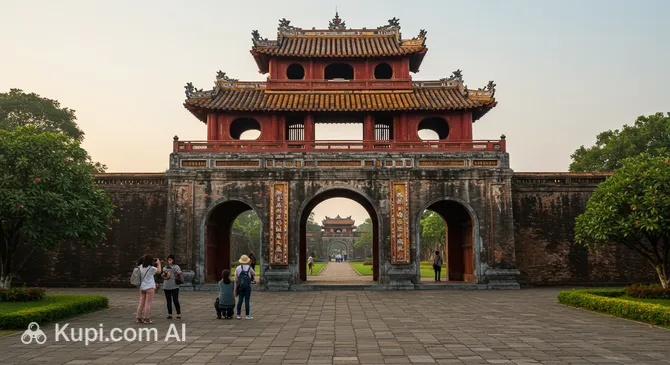
Meridian Gate
Meridian Gate. Иллюстрация. Источник: Kupi.com AI

The gate's architecture is a striking blend of Vietnamese traditions with elements of Indian and European styles. The five-level structure, topped by the elegant "Five Phoenix Pavilion," is aligned strictly with the cardinal points. The Meridian Gate is a key element of the Kinh Thanh Citadel — a massive fortress surrounded by a ten-kilometer rampart and a water-filled moat.

Today, this site is listed as a UNESCO World Heritage site. It attracts tourists not only with its fortification strength but also with the delicate aesthetics of its carvings and ornaments. Near the gate, you can see the "Nine Holy Cannons" — giant artillery pieces that were never used in battle but served as spiritual guardians of the empire.

Contacts

To plan your visit to this historical landmark, you can use the official contact details of the managing organization.

How to contactContact
AddressFH9H+3MF, Phú Hậu, Huế, Thua Thien Hue, Vietnam
Websitewww.hueworldheritage.org.vn

What to Do

Passing through the massive arches of the Meridian Gate, you enter the majestic ceremonial courtyard of Dai Noi. It is an ideal place to feel the spirit of the past: from here, a direct path leads to the Palace of Supreme Harmony (Thai Hoa). Be sure to peek inside the hall, where 80 columns decorated with golden dragons have been preserved, and take a stroll along the shaded paths of the Thuong Uyen royal garden.

For photography enthusiasts, the best vantage point is the gate's upper gallery, offering a panoramic view of the square and the moat. While examining the architectural details, pay attention to the intricate carvings and symbolism woven into the facade designs. To ensure you don't miss important historical details, it is recommended to use an audio guide or join an organized tour.

Continue your walk along the fortifications and bastions, where you can admire the gentle curve of the Perfume River. In the hotter months, it's best to plan your visit for early morning — the soft light highlights the beauty of the brass cannons and dynastic urns, and the absence of heat allows for a pleasant exploration of every hidden corner of the Forbidden City.

Getting There

The majestic Meridian Gate is located in the heart of the city, on the northern bank of the picturesque Perfume River (Huong River). If you are arriving from Phu Bai International Airport, the journey is about 15–20 kilometers. The easiest way is to use a taxi or the Grab mobile app; the ride will take between 30 to 45 minutes depending on traffic.

For those already in the central part of Hue, the walk to the Kinh Thanh Citadel takes only 10–20 minutes. Many tourists prefer to rent bicycles or electric scooters, allowing for comfortable movement between the massive fortress walls. You can also use city buses (routes #1 or #2), which stop near the main entrance.

Parking is available at the main entrance to the complex. Travelers who prefer waterways might enjoy combining their visit with a trip on the Perfume River, disembarking within walking distance of the Truong Tien Bridge, which is very close to the historical quarter.

Ближайший город: Hue

History & Facts

The history of this grand structure began in 1804 by decree of Emperor Gia Long, the founder of the great Nguyen dynasty. The construction of the entire Citadel, which required about 80,000 workers, lasted nearly three decades and was only completed in 1832 under Emperor Minh Mang. It was then that Hue officially became the political and cultural center of a unified Vietnam.

The Ngo Mon Gate (Meridian Gate) was designed not just as an entrance but as a symbol of imperial power. Its architectural style is a unique synthesis of Eastern traditions and Western influence. The design features traits of Indian temple towers and Romanesque elements introduced by French military advisors who assisted in designing the fortifications.

Over the centuries, the gate served as the main stage for key state events. Imperial decrees were announced here, and military parades and solemn ceremonies were held. Notably, the Nguyen Dynasty remained faithful to this location until the mid-20th century, when the last emperor, Bao Dai, abdicated, marking the end of the monarchical era.

Today, the site is under UNESCO protection. Attentive visitors may notice the surviving bronze urns dating back to 1835 and the nine holy cannons, which symbolize the five elements of nature and the four seasons, guarding the peace of the ancient capital.

Time Needed

To fully appreciate the architectural elegance of the Meridian Gate, explore the adjacent ceremonial courtyard, and see the famous cannons, it usually takes about 1–2 hours. This is enough time for a leisurely stroll and taking beautiful photos against the backdrop of the massive walls.

However, if you plan to continue further into the Imperial City, including visits to the Forbidden Purple City and the garden complexes, we recommend setting aside at least 3–4 hours or even half a day. The scale of the complex is impressive, and every corner hides interesting details that deserve attention.

Working Hours

The attraction is open to visitors daily, including weekends. You can plan your visit for any convenient time during daylight hours.

Opening Hours:
Monday — Sunday: 7:00 AM to 5:00 PM.

7:00 – 17:00

Nearby

Exploring the surroundings of the imperial residence allows you to dive deeper into the atmosphere of ancient Vietnam and see how history intertwines with the modern rhythm of the city. Around the Citadel, there are many monuments and picturesque parks that will complement your journey with vivid impressions.

NameDistance
Phu Van Lau0.3 km
Imperial City of Hue0.3 km
Kien Trung Palace0.5 km
Museum of Royal Antiquities0.5 km
Luc Bo Cultural Space0.6 km
Nguyen Dinh Chieu Walking Street1.1 km
Imperial City of Hue1.2 km

Reached the end of the page?

That means the route is fully explored