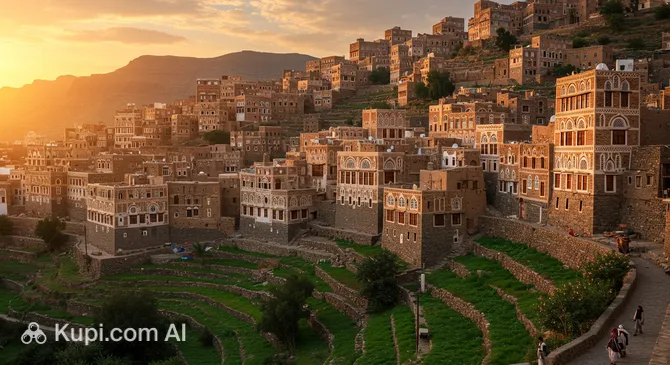
Nestled in the heart of Yemen's picturesque mountain regions, Ibb is rightfully considered one of the most beautiful and "greenest" cities in the country. Situated at an altitude of about 2,000 meters above sea level on the slopes of the Jabal Badan mountains, it is surrounded by fertile terraces and emerald meadows, creating a landscape that is unique for this region. With a population of over 350,000, the city serves as an important economic and administrative center while retaining the charm of a traditional Arabian province.
The architectural appearance of Ibb is truly imaginative, dominated by multi-story tower houses built from stone and burnt brick. The facades of the buildings, decorated with elegant white gypsum plaster, create a unique contrast with the surrounding greenery. The history of this settlement dates back to ancient times, specifically to the Himyarite Kingdom, and every street in the Old City is literally steeped in the spirit of the past.
Ibb. Illustration.
Source: Kupi.com AI
For the traveler, Ibb is, above all, an opportunity to see the real, non-touristy Yemen. There are no pretentious hotels here, but there is the sincere hospitality of the local residents, bustling oriental bazaars, and breathtaking panoramic views of the mountain terraces. A visit to the city will be an unforgettable experience for those seeking an authentic atmosphere and wanting to touch the living heritage of South Arabia.
Weather Overview
Thanks to its high-altitude location, Ibb possesses a temperate subtropical climate, which is considered one of the most pleasant in Yemen. Unlike the sweltering coast, freshness and moderate temperatures prevail here. The city's climate is characterized by distinct seasonal rainfall, which provides the region with its famous lush greenery.
Typical daytime temperatures throughout the year range from 22°C to 28°C, while at night they can drop to 11–18°C. The wettest month is August, when heavy rainfall feeds the agricultural terraces. Winters (December–January) are usually dry and sunny, with cool nights requiring warm clothing.
Precipitation here is a blessing that turns the surrounding mountains into a continuous green carpet. Travelers should keep in mind that during the rainy season, mountain roads can become more difficult to navigate; however, it is at this time that the city and its surroundings appear in their maximum beauty.
Average monthly temperature
Average monthly precipitation
Interesting Facts
The city of Ibb hides many interesting details that make it a unique place on the map of the Middle East:
Ancient Name: It is believed that in the pre-Islamic period, the city was known as Tsogha and served as an important strategic node on the trade routes of the Himyarite Kingdom.
The Green Heart of Yemen: Due to its relatively high rainfall and abundance of greenery, Ibb Province is often called the "Emerald of Yemen" or simply the "Green Province."
Architectural Traditions: Traditional houses in Ibb are built using a unique gypsum cladding technique, which not only decorates the buildings but also protects them from mountain moisture.
High-Altitude Status: The city is located at an altitude of over 2,000 meters, making its climate significantly milder and cooler compared to the hot coastal areas of the country.
Religious Heritage: The city preserves buildings from the 18th-century Ottoman period, including the Al-Jalaliyya Mosque, whose brick minaret is a recognizable symbol of the local skyline.
How to Get There
The transport accessibility of Ibb is due to its strategic position on the country's key mountain highway. The city does not have its own airport, so the journey here almost always lies through other major hubs in Yemen. Nevertheless, regular road connections make a trip to this region quite feasible for a prepared traveler.
The primary way to reach the city is via paved roads. Ibb is located on the highway connecting the capital Sana'a and the port city of Aden. The distance from Sana'a is about 170 km, and the journey by car takes 3 to 5 hours, considering the mountain switchbacks and potential traffic. From the nearest large city, Taiz, located 65 km to the southwest, the drive takes about 1.5–2.5 hours.
As there are no airports in the city itself, travelers should look for flights to larger cities. The terminals in Sana'a or Aden are most commonly used, from where one can reach Ibb by taxi or intercity buses.
There is no railway service in this mountainous region, so all passenger traffic is distributed between public buses, minibuses, and private carriers. For comfortable travel along mountain roads, renting a car with an experienced local driver is recommended.
Station
Passenger traffic
Distance
Nagad railway station
5
293 km
Main Attractions
The main treasure of Ibb is its Old City, which is a living open-air museum. Here, you can wander endlessly through narrow, winding streets, admiring the traditional Yemeni tower houses. These unique structures, reaching several stories high, are masterpieces of folk architecture and reflect the centuries-old way of life of the local inhabitants.
Among the religious monuments, the Old Mosque deserves special attention. According to tradition, it was founded during the era of Caliph Omar ibn al-Khattab, making it one of the oldest Islamic structures in the region. Another gem of the city is the Al-Jalaliyya Mosque, built in the 18th century. Its distinctive red brick minaret is a striking example of Ottoman influence in Yemeni architecture.
No less impressive are the agricultural terraces surrounding the city. Artificially created on steep mountain slopes, these green steps demonstrate the skill of ancient farmers. The best panoramic views of this man-made wonder of nature can be seen from the peaks of the nearby Jabal mountains, where you can take a short climb for unforgettable photographs.
Local Cuisine
The culinary traditions of Ibb represent the quintessence of Yemeni mountain cuisine, where hearty and aromatic dishes made from natural products are held in high regard. Thanks to the region's developed agriculture, the tables of local residents are always filled with fresh vegetables, grains, and greens. The basis of the meal is most often various types of khubz flatbreads, baked in traditional ovens.
You should definitely try the national treasure — saltah. This is a thick, piping hot stew based on meat broth with the addition of fenugreek paste (hilbah). No less popular is fahsa — tender meat stewed with spices. Rice lovers will enjoy mandi — a dish where meat is slow-cooked over rice in a special underground oven, soaking the rice with its juices and aroma.
Yemeni coffee culture deserves a special mention. In Ibb, it is customary to drink strong coffee with spices or qishr — a drink made from coffee husks with ginger and cinnamon. Meals usually take place in simple establishments in the markets or in small restaurants in the Old City, where local residents gather at shared tables. This is the best opportunity to appreciate the true taste of authentic Arabian food.
Travel Tips
A trip to mountainous Ibb promises to be exciting but requires some preparation. These tips will help you make your journey as comfortable and safe as possible.
Clothing and Dress Code: Since you are in a conservative region, choose modest clothing that covers shoulders and knees. Women will need a headscarf to visit mosques. Due to the mountain climate, evenings can be cool, so bring a light jacket or sweater.
Footwear: Be sure to bring comfortable closed-toed shoes with good soles — you will have to walk a lot on stony streets and steep slopes.
Finance: International cards are practically not accepted in the city, and ATMs are rare. Always carry a sufficient supply of cash in the local currency to pay for food, transport, and purchases.
Safety: It is recommended to stick to central areas and markets. Avoid traveling on mountain roads after dark due to their difficulty. Always follow current safety recommendations for the region.
Communication: The primary language is Arabic. English is not widely spoken, so learn a few basic phrases: "As-salamu alaykum" (hello), "Shukran" (thank you). It is best to buy a SIM card upon arrival at the Sana'a or Aden airport.
Etiquette: Greet people with your right hand and always ask for permission before photographing local residents, especially women.
What to Avoid: You should not publicly discuss political or sensitive social topics. Also, try not to display expensive equipment or large sums of money unnecessarily.
Health: Drink only bottled water and use sunscreen, as the mountain sun can be very intense even in cool weather.
Following these simple rules will allow you to enjoy the beauty of the "Green Province" and leave only pleasant impressions from visiting this amazing city.
Entertainment & Nightlife
Entertainment in Ibb is predominantly traditional, as the city is oriented towards daily life and trade. You will not find the nightclubs, bars, or large cinemas typical for European tourists here. Evening life centers around local tea houses and central squares, where residents gather for leisurely conversations and to discuss the latest news over a cup of strong coffee or fragrant tea.
Daytime leisure for guests usually involves walking through the Old City and exploring the local markets. It is an ideal place for those who want to observe the authentic rhythm of Yemeni life. For nature lovers, hiking in the surrounding hills is available, offering stunning views of the "Green Province," which are especially impressive during the sunset hours.
More active entertainment can be found in larger neighboring centers, such as Taiz, which can be reached in a couple of hours. In Ibb itself, recreation involves the quiet contemplation of architecture and landscapes. The main events in the city's life are often religious holidays, during which traditional events are held, allowing for a deeper acquaintance with the local culture.
Parks & Museums
While you won't find classic museums with vast halls in Ibb, the Old City itself functions as an open-air museum. Every building here is a historical monument, and the traditional way of life within these walls has been preserved for centuries. History buffs should visit the local mosques, which often house ancient manuscripts and serve as centers of education.
As for parks, the role of recreational areas is fulfilled by the famous agricultural terraces. These green cascades surrounding the city are a wonderful place for contemplation and quiet walks. Within the city limits, there are few public parks due to dense historical development, but the green slopes of the Jabal Badan mountains are always within walking distance.
For tourists, the natural areas outside the dense urban development will be the most interesting. It is there that you can see how mountain streams feed the terraced fields, creating the "Green Province" that the residents of Ibb are so proud of. This is an ideal place for those seeking solitude and wanting to enjoy the silence among the majestic mountains.
Getting Around
The public transport system in Ibb is adapted to the challenging mountain terrain and the city's compact layout. The main means of transport for most residents and guests are minibuses and private taxis. Minibuses run between the main districts, connecting the central markets with residential neighborhoods on the outskirts.
Fares are paid in cash directly to the driver. There are no unified travel cards or mobile apps for payment here, so it is always useful to have small change with you. Fares in minibuses are extremely low, while a taxi ride will require prior negotiation of the cost with the driver.
Due to the narrow streets of the Old City and the mountainous landscape, congestion can occur in the central districts during peak hours. Walking is the best way to explore the historical center; however, for long-distance trips or travel to high-altitude viewpoints, it is better to use taxi services. Bicycles are rarely used in the city due to the steep climbs and heavy traffic.
Accommodation
The hotel infrastructure in Ibb is moderately developed and primarily oriented toward local residents and business travelers. There are virtually no luxury five-star complexes, but you can find decent middle-class options and budget guesthouses that allow for a deeper immersion into the local environment.
Most hotels are concentrated in the central part of the city, near the main markets and administrative buildings. Staying here is convenient from a logistical point of view: transport hubs and major retail outlets are nearby. It is worth noting that the service in local hotels can be quite simple, but this is compensated for by affordable prices.
For those planning to stay in the city for a long period, renting private apartments is a popular option. This allows you to feel like part of the urban community and is often more economical. When booking, it is recommended to clarify the availability of necessary amenities in advance and remember that during peak periods associated with local holidays, vacancies can fill up quickly.
Nearby Cities
Ibb is an ideal starting point for exploring the country's central mountain regions. The city's surroundings are rich in historical settlements, each possessing its own unique character and architectural style.
Just 6 kilometers from the city lies Jibla — one of Yemen's most significant historical centers. In the 11th century, it was the capital of the Sulayhid state and the residence of the legendary Queen Arwa. A visit to the magnificent Queen Arwa Mosque and a walk through the ancient cobbled streets is a must. Also interesting is a trip to Yarim, located at an altitude of over 2,500 meters, and the major economic center of Dhamar, known for its university and horse breeding.
Exploring neighboring cities will allow you to see the diversity of Yemeni culture: from the majestic mosques of Taiz to cozy mountain villages. Traveling through these places requires some preparation but rewards you with incredible views and a touch of living history.
Shopping & Souvenirs
Shopping in Ibb is an immersion into the atmosphere of a true Oriental bazaar. There are no modern shopping and entertainment centers in the usual sense, but traditional markets (souks) operate at full strength. The main trading rows are concentrated in the city center, where life bustles from early morning until late evening.
Here, you should look for traditional Yemeni fabrics and clothing: bright scarves, embroidered shirts, and textiles famous for their quality. The spice market will delight you with the aromas of freshly ground coffee, cardamom, cumin, and unique local spice blends. Ibb is also known for its metalwork and traditional crafts, which make excellent souvenirs.
Shops typically operate from morning until noon and reopen after a lunch break. Payment is primarily made in cash using the local currency. Bargaining in the markets is not only appropriate but is an important part of the social process, allowing tourists not only to save money but also to get to know the local merchants better.