Support

Catedral de Nuestra Señora de la Encarnación

About

Towering over the historic center of San Miguel de Tucumán, the Cathedral of Our Lady of the Incarnation (Catedral de Nuestra Señora de la Encarnación) is one of the most significant religious and architectural landmarks in Argentina. This grand Neoclassical temple, featuring eclectic elements, serves as the spiritual heart of the province and is recognized as a National Historic Monument.
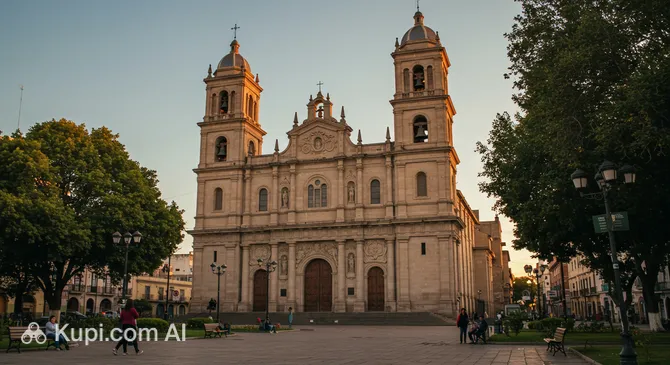
Cathedral of Our Lady of the Incarnation
Cathedral of Our Lady of the Incarnation. Иллюстрация. Источник: Kupi.com AI

The building impresses with its monumentality: its facade features a graceful portico with six columns, while elegant Italian-style towers and Byzantine-inspired domes rise above the city. Designed by the French architect Pedro Delgare Echeverry, the cathedral became a symbol of the region's prosperity in the 19th century. Its interior, crafted by the artist Félix Revol, continues to captivate visitors with its intricate workmanship and solemn atmosphere.

Today, the cathedral is not just a place of prayer but also a key point on the country's tourist map. It consistently receives high praise from travelers for its aesthetic beauty and historical depth, remaining a living witness to the evolution of Argentine architecture and culture from colonial times to the present day.

Contacts

To check the current service schedule or to plan a group visit, you can use the official communication channels. The Cathedral is open to both parishioners and tourists, offering a chance to discover the region's spiritual heritage right in the heart of the city.

How to contactContact
AddressAv. 24 de Septiembre 420, T4000CNJ San Miguel de Tucumán, Tucumán, Argentina
Phone+54 381 255-8597
Websitewww.facebook.com

What to Do

A visit to the cathedral is, first and foremost, an aesthetic immersion into the Neoclassical era. Be sure to spend time exploring the interior: look up at the vaults and frescoes created by the French master Félix Revol in the mid-19th century. Decorative elements combining Doric, Ionic, and Corinthian orders create a unique play of light and shadow inside the temple, especially on sunny days.

For those seeking spiritual solitude or a taste of local culture, attending a mass is recommended. The sound of organ music and chants echoing under the high vaults creates a particularly solemn atmosphere. If you have the chance, notice the campaniles (bell towers) — their Byzantine style is a rare and remarkable feature for the region's architecture.

Photography enthusiasts are encouraged to linger at the entrance at sunset, when the rays of the setting sun paint the facade in soft golden tones. The cathedral steps are a great vantage point to watch the life of Plaza Independencia, the city's main square, which is always bustling with activity, fountains, and street performers. A visit to the cathedral is a wonderful cultural experience for the whole family, allowing everyone to connect with history through art and architecture.

Getting There

The Cathedral of Our Lady of the Incarnation is located in the heart of the historic center at Av. 24 de Septiembre 420. Due to its position directly opposite the city's main square, Plaza Independencia, it is easily accessible on foot from anywhere in the downtown area. It serves as an ideal starting point for a walking tour of the colonial streets.

If you are traveling from outlying districts, you can use public transportation: numerous bus routes and trolleys stop in the immediate vicinity of the square. For those arriving from Tucumán Airport (SAAC), a taxi or a ride-sharing service like Uber/Cabify will take approximately 20–30 minutes (a distance of about 15 km). From the central railway station, the cathedral is a pleasant 10–15 minute walk away.

Travelers arriving by car should note that the central zone around the square is primarily pedestrian-oriented. It is recommended to leave your vehicle in one of the paid parking lots on the adjacent streets and continue on foot to fully enjoy the city center's architectural ensemble.

Ближайший город: San Miguel de Tucumán

History & Facts

The history of this grand structure is inextricably linked with the fate of the city itself. Originally, San Miguel de Tucumán was founded in 1565 in a place called Ibatín, but due to persistent flooding and shifting trade routes, the settlement was moved to its current location in 1685. At that time, a modest first church made of adobe (sun-dried brick) with a characteristic Colonial Baroque tile roof was built opposite the main square.

By the mid-19th century, the old building had fallen into disrepair, creating a need for a temple that matched the status of the growing city. In 1845, Governor Celedonio Gutiérrez commissioned the French engineer Pedro Delgare Echeverry to design the project. Construction proceeded rapidly, and the cathedral was solemnly consecrated on February 19, 1856. The sermon at the opening was delivered by the famous Franciscan Fray Mamerto Esquiú, and the building was recognized at the time as one of the finest architectural examples in the Argentine Confederation.

The cathedral's modern appearance is the result of an evolution from a simple rural chapel to an architectural masterpiece of national importance. On August 12, 1941, the temple was officially declared a National Historic Monument, and in 1947, it was granted the honorary status of a cathedral. The interior also underwent changes: in the mid-20th century, the walls were further decorated by the artist Luis Brige, adding even more solemnity to the space.

Time Needed

To explore the Cathedral of Our Lady of the Incarnation at a leisurely pace, 1–2 hours is usually sufficient. This allows enough time to examine the facade with its grand columns, enjoy the silence inside the temple, and admire the frescoes by Félix Revol.

If you plan to attend a mass or climb the towers for a panoramic view of the city (if accessible on the day of your visit), it's worth setting aside a bit more time. The cathedral is located near several other attractions, so its visit can be conveniently combined with a stroll through Plaza Independencia, taking up about half a day in total.

Working Hours

The Cathedral welcomes visitors daily, except for Sundays. The schedule is divided into morning and evening hours, which is typical for the lifestyle in this region of Argentina:

Monday – Saturday: 09:00 AM – 1:00 PM and 5:00 PM – 9:30 PM.
Sunday: Closed.

Please note the afternoon break (siesta), during which the temple is closed to visitors. Plan your visit for either the first half of the day or the evening, when the facade is beautifully illuminated.

DayWorking hours
Понедельник9:00 – 13:00, 5:00 – 21:30
Вторник9:00 – 13:00, 5:00 – 21:30
Среда9:00 – 13:00, 5:00 – 21:30
Четверг9:00 – 13:00, 5:00 – 21:30
Пятница9:00 – 13:00, 5:00 – 21:30
Суббота9:00 – 13:00, 5:00 – 21:30
ВоскресеньеЗакрыто

Nearby

The cathedral's location in the city's historic core opens up many opportunities for tourists to further explore the region's culture. Just steps away from the temple are iconic sites inextricably linked to the history of the country and its daily life.

A walk through the surrounding area will allow you to see both cozy colonial courtyards and modern cultural spaces, turning a simple cathedral visit into a complete sightseeing route through the city center.

NameDistance
Independence Square0.1 km
House of Tucumán0.2 km
Casa Histórica de la Independencia0.2 km
Government House of Tucumán0.2 km
ML Calentitas0.3 km
La Gaceta Shop0.5 km
Maipú Gallery0.5 km

Reached the end of the page?

That means the route is fully explored