Support

National Monument to the Dead of World War II

About

The National Monument to the Dead of World War II, located in sunny Rio de Janeiro, Brazil, is a landmark historical site and an important memorial complex. This monument serves as a solemn reminder of past events, immortalizing the memory of the Brazilian soldiers who gave their lives during World War II.
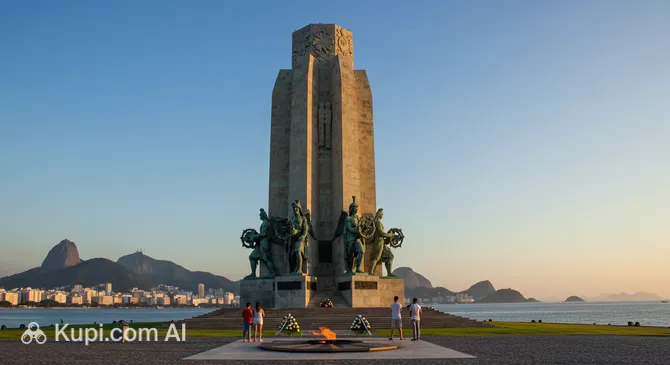
National Monument to the Dead of World War II. Illustration.
Source: Kupi.com AI

Traveler photos:

The central part of the monument is a mausoleum where the remains of 467 Brazilian warriors rest. These soldiers heroically fought and died during combat operations in Italy, contributing to the Allied cause. Visiting this site allows for a deeper understanding of Brazil's involvement in the global conflict.

The memorial is located in the picturesque southern part of the city of Rio de Janeiro, on the Flamengo Embankment (some sources also mention the Botafogo Embankment), near the Glória Marina and the vast Flamengo Park. This location makes it easily accessible to everyone who wishes to pay tribute to the fallen and learn more about this period of history.

The National Monument to the Dead of World War II holds great symbolic significance for the country. It personifies not only grief for the fallen but also pride in Brazil's contribution to the fight against Nazism and Fascism. Notably, Brazil was the only South American country to send its troops to participate in military actions in Europe on the side of the Allies, making this monument a particularly important witness to national history.

Contacts

Since the National Monument to the Dead of World War II is a significant historical site, often with open access, direct contact phone numbers for the general public may not be available. To obtain the most up-to-date information on visiting hours, possible tours, or special events, we recommend contacting official Rio de Janeiro tourism resources or local information centers.

The monument is located on the Flamengo Embankment, making it easily accessible for independent visits. You can reach it using public transport heading to the Flamengo district or by taxi.

How to contactContact
AddressAvenida Infante Dom Henrique, 75 - Glória - Glória, Rio de Janeiro - RJ, 20021-140, Brazil
Phone number+55 21 2519-4609

What to Do

Visitors to the National Monument to the Dead of World War II in Rio de Janeiro can first and foremost pay their respects to the Brazilian soldiers who died in battle. This place, permeated with an atmosphere of remembrance and pride, is always kept clean and orderly. Here, you can not only honor the memory of heroes but also learn more about Brazil's participation in World War II by exploring the information presented within the memorial complex.

A special experience awaits those who visit the memorial during solemn ceremonies and military parades. Such events take place regularly on the grounds of the complex, but the most significant ones are timed to May 8—the anniversary of Nazi Germany's surrender. On these days, visitors can witness moving events involving war veterans, active military personnel, and civilians who gather to keep the memory of those times alive. Watching the ceremonies of laying wreaths and flowers at the monument by various delegations, including foreign guests, leaves a deep impression and allows one to feel the connection across generations.

Getting There

The National Monument to the Dead of World War II is conveniently located in the southern part of Rio de Janeiro, on the scenic Flamengo Embankment (also sometimes referred to as the Botafogo Embankment). It can be found near famous landmarks such as the Glória Marina and the extensive Flamengo Park, in the Santa Teresa district. This central position within the tourist zone makes the monument easily accessible to visitors.

The memorial can be reached by various types of public transport. Rio de Janeiro has a well-developed network of bus routes, many of which pass through the Flamengo district or in the immediate vicinity of the embankment. The metro is also a convenient option—the nearest stations allow you to quickly reach the desired area, from where you can walk to the monument or take a short trip on local transport.

If you prefer a more comfortable way to travel, you can always use taxi services. A trip from downtown Rio de Janeiro or from your hotel to the National Monument to the Dead of World War II won't take much time, especially outside of peak hours. Thanks to its location, the monument is easy to find using navigation apps on your smartphone, making your trip even simpler.

Nearest city: Rio de Janeiro

History & Facts

The National Monument to the Dead of World War II was officially inaugurated on April 7, 1957. Its construction was a sacred tribute to the 467 Brazilian soldiers who gave their lives heroically fighting as part of the Brazilian Expeditionary Force in Italy during World War II (1939-1945). This grand memorial symbolizes not only the grief of loss but also the boundless courage and self-sacrifice of those who defended freedom far from their home shores.

One of the most significant and touching chapters in the monument's history is the return of the fallen soldiers' remains to their homeland. Initially, the Brazilian soldiers who died during the Italian campaign were buried in a military cemetery in Pistoia, Tuscany region, Italy. It was not until 1960, three years after the official opening of the memorial in Rio de Janeiro, that their ashes were transported with great honors from Italy to Brazil and solemnly interred in the monument's mausoleum. This event allowed the fallen heroes to find eternal peace in their native land.

The creation of this monumental complex highlights Brazil's deep national pride in its participation in World War II. It is important to note that Brazil was the only Latin American nation to send its ground troops to participate directly in combat in the European theater of operations on the side of the Allied forces. The monument, located in one of the picturesque areas of Rio de Janeiro, serves not only as a place of mourning and remembrance but also as an important symbol of the country's contribution to the common victory and a reminder of the value of peace.

Annual solemn events held at the National Monument to the Dead of World War II, especially on May 8, the anniversary of Nazi Germany's surrender and the end of the war in Europe, are a living continuation of this memory. These ceremonies bring together veterans, their descendants, officials, and ordinary citizens to pay tribute to the fallen heroes and reaffirm the commitment to the ideals of freedom and justice for which the Brazilian soldiers fought. Thus, the monument remains not just a static monument, but a dynamic center for preserving the nation's historical memory.

Time Needed

To thoughtfully explore the National Monument to the Dead of World War II in Rio de Janeiro, including visiting the mausoleum and reviewing the key information presented in the memorial complex, most visitors will need approximately 1-2 hours. This time is usually sufficient to soak in the atmosphere of the place, pay tribute to the fallen Brazilian soldiers, and examine the architectural features of the monument itself.

If you plan a deeper dive into history and want to study all the informational materials or possible exhibitions that may be part of the complex in detail, you should set aside a bit more time. Additionally, the duration of your visit may increase if it coincides with any solemn ceremonies or commemorative events that periodically take place at the monument, especially on days associated with the anniversaries of World War II events.

Working Hours

To ensure your visit to the National Monument to the Dead of World War II in Rio de Janeiro, Brazil, goes smoothly, we recommend checking its current opening hours in advance. Although many memorial complexes of this significance are available for visiting year-round, the exact schedule may change depending on the season or day of the week. It is best to get the latest information on opening and closing times from the attraction's official website, if available, or from local Rio de Janeiro tourist information points.

Generally, for an individual tour of the National Monument to the Dead of World War II, advance ticket booking or registration is not required, especially for viewing the exterior of the memorial. Entrance to the grounds of such monuments is often free. However, if your plans include visiting the interior rooms, the museum at the monument (if one exists), or participating in a guided tour, it is worth inquiring beforehand about possible conditions and the need to purchase a ticket. For groups, it may also be advisable to check the need for prior arrangements. Checking official sources or contacting the city's tourism services will help avoid any surprises and plan your visit in the best possible way.

DayOpening hours
MondayClosed
Tuesday9:00 – 17:00
Wednesday9:00 – 17:00
Thursday9:00 – 17:00
Friday9:00 – 17:00
Saturday9:00 – 17:00
Sunday9:00 – 17:00

Nearby

A visit to the National Monument to the Dead of World War II in Rio de Janeiro certainly leaves a deep impression. However, to make your journey even more fulfilling and complete, it is worth paying attention to the attractions located nearby. Exploring the surroundings will allow you to better understand the cultural and historical context of this iconic site and discover other interesting corners of this vibrant city.

There are many sites near the monument that can complement your itinerary. From historical buildings to cultural centers—everyone will find something to their taste. This is a wonderful opportunity to broaden your horizons and see more than just a single, albeit very important, monument.

NameDistance
Lapa Arches0.8 km
Circo Voador0.8 km
Masonic Palace of Lavradio1.1 km
Museum of the Republic (Catete Palace)1.1 km
Rio Scenarium1.4 km
Candelária Church1.8 km
Centro Cultural Banco do Brasil1.8 km

Have you reached the end of the page?

So the route has been studied inside and out