Support

Datong Airport

About the Airport

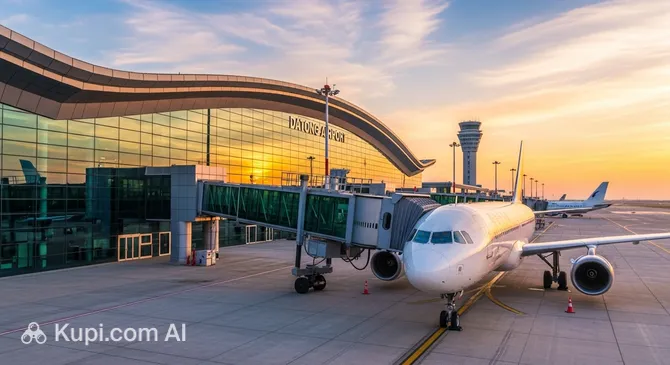
Datong Airport. Source: Kupi.com Binoculars

Datong Yungang Airport serves as the modern aerial gateway to the prefecture-level city of the same name in China, named in honour of the famous Yungang Grottoes, a UNESCO World Heritage Site. This aviation hub plays a key role in the development of regional tourism, being the second-largest civil airport in Shanxi Province. Opened in 2006, the airport has undergone significant modernisation and received international status in 2024, opening up new opportunities for travellers from around the world.

IATA Code DAT
ICAO Code ZBDT
City Datong
Distance to City Centre 15.2 km
Status International
Annual Passengers approx. 885,000 (2021)
Popular Airlines China Eastern Airlines, Air China, Shenzhen Airlines.
Schedule Datong Airport Online Board

Datong Yungang Airport offers passengers comfortable conditions and well-planned infrastructure. It consists of two terminals: T1 for international flights and T2 for domestic routes. The 3,000-metre runway is capable of accommodating popular aircraft types such as the Boeing 737 and Airbus A321. The airport's main advantage is its convenient location — just 33 km from the famous Yungang Grottoes, making it the ideal starting point for exploring this unique cultural heritage. Passengers have access to all necessary basic services, including information desks, luggage storage, and parking facilities.

Contact Information

For your convenience, we have compiled the essential contact information for Datong Airport (DAT). We recommend verifying the data on the official website, as phone numbers and other details may change.

  • Official Airport Website: Most up-to-date information, including flight schedules and services, is available on the official website. The site is primarily in Chinese: www.dtygjc.com
  • Information Desk Phone: For flight information, services, and general enquiries, you can call: +86 352 568 8114 or +86 352 568 8025.
  • Airport Address: Datong Yungang Airport, Beijiazao Town, Yunzhou District, Datong, Shanxi, China.
  • Email: An official email address for general enquiries is not published. It is recommended to use the telephone for communication.
  • Social Media: The airport does not maintain widely known official pages on international social networks. The main channels of communication are the telephone and the official website.
  • Lost Luggage Information: If you have issues regarding lost or damaged luggage, please contact the baggage tracing service at: +86 352 568 8043.
  • Passenger Support Contacts: For general questions and passenger support, please use the main airport information desk number.

How to Get to the Airport

Getting to Datong Yungang Airport (DAT) from the city centre of Datong is quite straightforward, with several transport options available to suit any budget. The airport is located approximately 17 kilometres east of the central part of the city, making the journey quick and convenient.

The most economical way to reach the airport is by the special shuttle bus. Routes usually connect the airport with key points in the city, such as the railway station and major hotels. The bus journey takes about 50-60 minutes, depending on traffic conditions and the number of stops. This is an excellent choice for budget-conscious tourists, but it is worth checking the schedule in advance as it may change. There is currently no direct metro or rail link to the airport.

For those who value comfort and time, a taxi is the optimal choice. A trip from the city centre to the terminal will take approximately 30-40 minutes. The cost will be significantly higher than the bus, but it is the fastest and most convenient way to reach your destination, especially if you have a lot of luggage. It is recommended to use official taxis and ensure the driver switches on the meter, or agree on a price in advance. It is useful to have the airport address written in Chinese to show the driver.

If you plan to actively explore the surroundings of Datong and famous attractions of China, such as the Yungang Grottoes or the Hanging Temple (Xuankong Si), consider renting a car. Rental agencies operate at the airport and in the city. This option offers maximum freedom of movement. For drivers arriving at the airport in their own or rented vehicles, there is convenient parking with zones for short-term and long-term stays.

Although the airport in Datong is the most convenient arrival point for visiting the city, travellers planning a route through the northern region of the country may also consider other air hubs. Among them are Hohhot Baita International Airport and Shijiazhuang Daguocun Airport, though they are located at a significant distance and require additional ground transfers.

Terminals and Map

Datong Yungang Airport (DAT) is a modern and relatively small aviation hub characterised by a simple structure that is easy for passengers to navigate. All flights, both domestic and international, are handled within a single passenger terminal complex. This significantly simplifies navigation and saves travellers from having to move between different buildings.

The terminal layout is logical and intuitive. The building has several levels: typically, the departure area with check-in counters and security checkpoints is located on the upper floor, while the arrival area with baggage claim is on the lower floor. Thanks to its compact size, finding the right gate, café, or information desk is effortless. Signs in Chinese and English are present everywhere, helping tourists orient themselves easily.

Since all operations are concentrated in one building, transitions between zones are made on foot and take minimal time. The departure area is located after passing security control. Here, passengers can relax in waiting lounges, visit small shops, or grab a bite in a café. The arrival area includes baggage claim belts and customs control, after which passengers exit into the general hall where they are met by greeters and can find exits to taxis and buses.

Completing all pre-flight formalities at Datong airport is usually quite quick. For domestic flights within China, it is recommended to arrive at the airport 1.5–2 hours before departure. This time is generally sufficient for a calm check-in, baggage drop, and security screening. Small queues are possible during peak hours, but thanks to the efficient work of the staff, they move rapidly.

Airport History

The history of Datong Yungang Airport (DAT) is a clear example of how modern infrastructure can transform the tourism profile of an entire region. Its journey began relatively recently: the airport opened in 2006 under the name Datong Beijiazao. It was built to replace an old airfield and provide reliable air connections for the ancient city of Datong, an important cultural centre of China.

A key and most interesting moment in its history occurred in 2012. It was then that the airport was officially renamed "Datong Yungang". This was no accident: the new name directly references the region's main attraction — the Yungang Grottoes, a UNESCO World Heritage Site. This strategic move was made to increase the airport's recognition and attract international tourist traffic specifically to this unique monument.

With the growing popularity of the destination, passenger traffic also increased. This required significant modernisation. In subsequent years, the airport underwent major expansion: a new modern terminal was built, and the runway was extended to accommodate larger aircraft. These improvements bore fruit — by 2019, the airport's annual passenger traffic exceeded the two million mark, which was a significant achievement and a record for a transport hub of this scale.

Thus, in a short period, Datong Yungang Airport has transformed from a modest regional facility into an important transport hub that plays a key role in the development of tourism in Shanxi Province. Its history demonstrates the successful fusion of modernity and ancient culture, making the historical treasures of Datong more accessible to travellers from all over the world.

Services and Facilities

Datong Yungang Airport (DAT) provides passengers with all the necessary services for a comfortable stay while waiting for their flight. Whether you are arriving in Datong or departing from it, you will find everything for your convenience in the terminal.

For those feeling hungry, there are cafés and small restaurants offering both local cuisine and more familiar international snacks. In the shops, you can buy souvenirs to remember your trip to China, travel essentials, press, and drinks. Free Wi-Fi is available throughout the terminal, and special stations with sockets and USB ports are equipped for charging electronic devices.

Passengers who value privacy and comfort can use the services of VIP lounges. Here, in a quiet atmosphere, you can relax, enjoy complimentary drinks and snacks, and use facilities for work, such as separate workspaces. This is a good option for business travellers who need to spend their time productively before departure.

The airport also provides basic financial services: there are ATMs and currency exchange points. In case of unforeseen health situations, a medical point operates in the terminal to provide first aid. Mother and child rooms are equipped for passengers with small children. The airport is fully adapted for the needs of passengers with reduced mobility, and an assistance service can be booked in advance if necessary.

Although there is no hotel directly within the terminal building, several hotels are located a few minutes' taxi ride away, where you can stay overnight in case of a long layover or an early flight.

Dining

When planning your departure from Datong Yungang Airport, you will find several options for a snack or a full meal. Although the selection here is not as vast as in capital hubs, passengers certainly won't go hungry. The main establishments are concentrated in the airport's single terminal, both before and after passing security control.

For those who wish to experience local cuisine right before departure, a restaurant offering Shanxi regional dishes operates in the departure zone (airside). We highly recommend trying the famous daoxiaomian (刀削面) — knife-cut noodles, which are a hallmark of local gastronomy. Such a hearty meal will help pass the time while waiting for your flight. The menu usually also includes other classic Chinese dishes, such as fried rice and soups.

If you are short on time or simply want a coffee, look for the small cafés. They are available in both the public area (landside) and after security. Here you can order coffee, tea, soft drinks, as well as sandwiches, pastries, and desserts. This is an ideal option for a quick bite. Additionally, there are shops in the airport selling packaged snacks and drinks.

Regarding special dietary requirements, finding certified Halal, vegan, or gluten-free dishes may be challenging. However, in a Chinese restaurant, you can often ask for a dish to be prepared without meat, for example, vegetable noodles or rice with vegetables. Travellers with strict dietary restrictions are advised to carry small snacks with them.

Prices in establishments at Datong Airport, as in most airports around the world, are higher than the city average. Opening hours are usually tied to the flight schedule: cafés and restaurants open with the first departures and close after the last plane leaves, so you will always have time for a snack before your flight.

Travel Tips

When planning a departure from Datong airport, allow sufficient time. It is recommended to arrive 2-2.5 hours before domestic flights and at least 3 hours before international ones. This creates a comfortable buffer in case of queues. To save time, use online check-in on your airline's website if the service is provided. This way, you can head straight to the baggage drop counter or, if travelling light, directly to the security checkpoint.

Security screening procedures at airports in China can be very thorough. Be prepared to remove all electronic devices from your hand luggage. Particular attention is paid to portable chargers (power banks) — they are permitted only in carry-on luggage, and the casing must have a clear marking indicating the capacity. Standard rules for carrying liquids (in containers up to 100 ml, with a total volume of no more than 1 litre per passenger) are also strictly enforced.

When choosing a seat on the plane, consider your priorities: a window seat offers the chance to admire views during take-off and landing, while an aisle seat provides more legroom and allows you to stand up easily without disturbing neighbours. To save a little money, bring an empty water bottle with you — after security, it can be filled at drinking water fountains. Prices for food and drinks in the departure lounge can be inflated, so bringing a light snack with you is also a good idea.

If you have a connecting flight, check with the airline in advance whether your luggage will be transferred automatically or if you need to collect it and check it in again. When passing through customs control, follow the signs and be ready to present your passport and boarding pass. If you are carrying goods subject to declaration or large sums of cash, familiarise yourself with the customs regulations of the destination country in advance.

In the event of a flight delay or cancellation, first contact your airline's counter for information. Remain calm and monitor updates on the information screens. Depending on the length of the wait and the airline's policy, you may be offered vouchers for food and drinks, and in case of a long delay, hotel accommodation. Keep all receipts for unforeseen expenses — they may be needed to claim compensation.

Reached the end of the page?

That means the route is fully explored