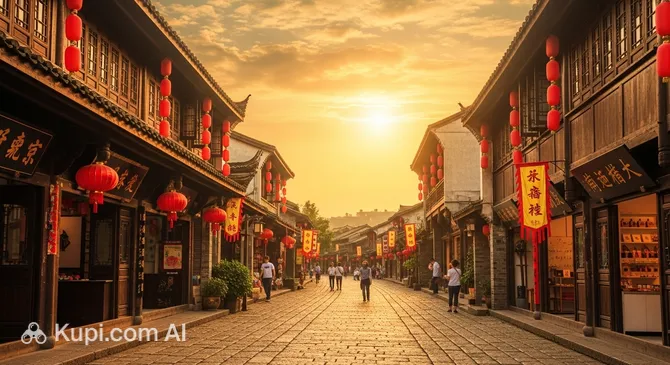
Hongjiang is not just a city, but a unique monument to commercial history, hidden away in the picturesque Hunan province. Located at the confluence of the Yuan and Wu rivers, it served for centuries as a vital trading hub connecting five provinces of China. Unlike imperial capitals, Hongjiang's architecture is imbued with the spirit of merchantry and pragmatism, creating a completely special, authentic atmosphere.
Hongjiang. Illustration.
Source: Kupi.com AI
The city's geographical position determined its fate: the rivers became the main arteries for transporting tung oil, timber, and wax. With a population of about 498,000 people, Hongjiang retains the features of provincial tranquility, avoiding noisy modern urbanism. The history of this place dates back to the Tang Dynasty, but the city acquired its current appearance, which fascinates researchers today, during the Ming and Qing Dynasties.
The crown jewel is the Hongjiang Ancient Commercial City, where more than 380 ancient buildings have been preserved. Here, you can see not only residential houses but also old guilds, offices, and warehouses that emphasize its status as the "first commercial city in Southwest China." A visit to Hongjiang is an invitation to travel back in time and witness the living legacy of the Middle Kingdom's great trading era.
Weather Overview
Hongjiang is located in a subtropical climate zone typical of Hunan province, which promises travelers mild but humid weather. Summers here are hot and rainy: in July and August, the average temperature stays around +28.5°C, often rising above the thirty-degree mark. This is monsoon time, so be prepared for heavy, though often short-lived, downpours.
Winter in the city is cool and humid, but without extreme frosts. In January, the average temperature is about +5.6°C, and frosts are rare. Spring and autumn are considered the most comfortable seasons to visit, when the city's climate offers moderate warmth and less rainfall compared to the summer months.
Due to its location at the confluence of rivers, Hongjiang often experiences high humidity and morning fogs, which give the historical quarters a mysterious and picturesque look. When planning your trip, be sure to bring light waterproof clothing or an umbrella, as there are quite a few rainy days throughout the year.
Average monthly temperature
Average monthly precipitation
Interesting Facts
Trading Capital of Five Provinces: During its peak, Hongjiang was such a significant commercial hub that its influence extended across the territories of modern Hunan, Guizhou, Yunnan, Sichuan, and Guangxi provinces.
Architectural Reserve: The city is considered one of the most complete examples of ancient commercial planning preserved in China; more than 380 historical buildings built specifically for trade needs have survived here.
Global Center for Tung Oil: Hongjiang long held the status of the largest trading center for tung oil—a vital raw material of the time used for wood protection and in industry.
Suzhou Guild: Founded in 1644, the Suzhou Guild became a symbol of the city's prosperity, attracting the wealthiest merchants from all over China to Hongjiang and turning it into the region's financial center.
A City Without Palaces: Hongjiang's uniqueness lies in the fact that its development was not dictated by imperial canons or religious needs, but entirely by the needs of the merchant class, making it a rare example of "purely commercial" ancient urban planning.
How to Get There
Despite its historical status as a major transport hub, Hongjiang today retains an air of remoteness, making a trip here feel like a real adventure. The city is located in the mountainous terrain of Hunan province, and land transport remains the primary way to reach it. You can learn more about how to plan your route, considering the specifics of regional connections.
The nearest major aviation hubs are several hours away. One option is Zhangjiajie Hehua Airport, located more than 200 kilometers away. From there, Hongjiang can be reached by intercity bus or taxi, which takes about 3–4 hours. Remember that travel times can increase during the rainy season due to the terrain and weather.
Rail travel is the most reliable and fastest way to connect with the city. High-speed trains from the provincial capital, Changsha, bring passengers to this region in 4–6 hours. The stations handle both regional and long-distance services, linking Hongjiang with key cities in central China. Within the city itself and for trips around the district, it is convenient to use taxis or local bus routes.
The main magnet for travelers in Hongjiang is the Ancient Commercial City—a massive historical district often referred to as an open-air museum. Here, an ensemble of more than 380 ancient buildings from the Ming and Qing eras is under state protection. Walking through these streets, you will see unique commercial architecture: massive trading houses, old company offices, and guild buildings that once controlled the tung oil and timber markets.
A complex of 18 key sites, including proto-banks and the headquarters of the wealthiest merchant clans, deserves special attention. The interior decoration of these buildings, despite their functionality, is striking with exquisite wood and stone carvings reflecting the owners' wealth. This place lacks the gloss of mass tourist attractions, which makes exploring its backstreets a truly exciting activity.
The Yuan and Wu rivers provide the city's natural charm. While there are no grand natural parks here, walks along the embankments offer peaceful landscapes and allow you to see the city from the water, just as merchants did hundreds of years ago. Hongjiang is ideal for those who value authenticity and want to experience the real history of China without excessive modern decorations.
Local Cuisine
The culinary traditions of Hongjiang are closely intertwined with the gastronomic culture of Hunan province, known for its love of bold, spicy, and aromatic flavors. However, the city's trading past has brought its own nuances: the proximity of large rivers made fresh river fish a staple of the local menu, and the merchant lifestyle contributed to the development of hearty meat dishes that were convenient to serve during long business negotiations.
Among the local specialties, you should definitely try fried chicken with hot peppers and various smoked meat products prepared according to old recipes. Sour and spicy soups hold a special place, as they warm you up perfectly in the humid subtropical climate. Interestingly, in the past, even oil production indirectly influenced Hongjiang's cuisine—the use of local herbs and special food processing methods creates a unique flavor profile that is hard to find in other parts of the country.
The city's gastronomic scene is best represented in the historical district, where old guild buildings and estates have been converted into cozy restaurants. While there are no Michelin-starred establishments here, authentic street food is everywhere. Don't forget to end your meal with a cup of local green tea or try the traditional rice wine, which has long been prized here for its smooth taste.
Travel Tips
A trip to Hongjiang is an immersion into the real, non-touristy China, and a few practical tips will help make your journey as comfortable as possible.
Best time to visit: Try to plan your visit for spring or autumn. During these periods, the weather is most favorable for long walks, and the humidity is lower than during the peak summer rainy season.
Clothing and footwear: Since the historical center of Hongjiang is a pedestrian zone with cobbled streets, be sure to bring comfortable shoes with good cushioning. Save elegant shoes for evening restaurants.
Finances and payment: Always have cash yuan with you. In provincial cities, international cards are rarely accepted, and ATMs that work with foreign cards may only be found in major bank branches.
Communication: English is not widely spoken in Hongjiang. It is recommended to download an offline translator in advance and carry a hotel business card with the address in Chinese for communicating with taxi drivers.
Connectivity: Wi-Fi is available in most hotels, but for navigation, it's better to buy a local SIM card. Remember the need for a VPN to access familiar Western services.
Local etiquette: Be polite and patient. Hongjiang is a city with a relaxed pace of life. A simple smile and a few words of greeting in Chinese (e.g., "Ni hao") will open many doors for you.
Safety: The city is generally very safe, but in crowded tourist areas, you should keep an eye on your personal belongings. Street crime is minimal here, but basic caution never hurts.
What to avoid: Try not to plan important travel during Chinese national holidays (e.g., "Golden Week" in October), as accommodation prices skyrocket and transport becomes overcrowded.
By following these simple recommendations, you can focus entirely on the beauty of ancient Hongjiang and get only the most positive emotions from your trip!
Entertainment & Nightlife
Entertainment in Hongjiang is primarily cultural and contemplative. The city's life centers around its historical district, where you can watch folklore performances in old merchant houses during the day and evening. These small theatrical productions often recreate scenes from the lives of traders and local residents of past eras, allowing guests to dive deeper into the local color.
Traditional nightlife in the sense of major metropolises is practically non-existent here. In Hongjiang, you won't find noisy nightclubs or modern bars; however, the evening atmosphere has its own charm. At dusk, cozy tea houses and street cafes in the historical district come to life, where locals gather for leisurely conversations. Walking along the illuminated embankments of the Yuan and Wu rivers is a favorite activity for tourists and townspeople at the end of the day.
For those looking for larger-scale entertainment or modern amusement parks, Hongjiang serves as a quiet base from which to head to larger centers in Hunan province. Nevertheless, it is the lack of hustle and bustle and the opportunity to enjoy the silence by the walls of ancient guilds that make an evening in this city truly memorable and safe for peaceful strolls.
Parks & Museums
The museum life of Hongjiang is unique in that the streets and buildings themselves are the main exhibits. Instead of standard halls with display cases, tourists are invited to visit the Ancient Commercial City, where many historical estates and guild buildings have been turned into themed museums. In them, you can see preserved 18th-century office interiors, old scales for goods, and the personal belongings of merchant families that tell the story of the local trade's golden age.
For those who want to study the architectural heritage more deeply, the doors of restored buildings are open, featuring exhibitions dedicated to Ming and Qing construction techniques. Special attention is given to the history of tung oil and timber—the goods that made Hongjiang the wealthiest city in the region. These displays allow you to literally touch the commercial past of the Middle Kingdom.
The city's green zones are mainly concentrated along the banks of the Yuan and Wu rivers. Small parks and embankments offer residents and guests places for relaxation and outdoor exercises. The dense historical development limits the size of parks within the center, but the proximity to water and the surrounding forested hills create a pleasant natural backdrop for walks between visits to historical sites.
Getting Around
The transport system in Hongjiang is simple and efficient for a city of its size. The main form of public transport is buses, which connect various city districts with the historical center and the railway station. A trip across the entire city usually takes no more than 30–40 minutes, making buses a convenient way for tourists to travel when planning to see attractions outside the pedestrian zone.
In the Ancient Commercial City itself, the best way to get around is walking. The narrow ancient streets were not designed for cars, and only a walk on foot allows you to fully appreciate the details of Ming and Qing architecture. For longer distances or if you're short on time, you can always use the services of taxis, which are numerous and quite affordable here.
Bicycles and electric scooters, often used by locals, are popular alternatives for short distances. There is no metro system in the city, but the developed road network and the relative compactness of the center make moving around trouble-free. Bus fares are most often paid in cash (exact change needed) or via mobile apps, which is typical for modern China.
Accommodation
Accommodation in Hongjiang offers tourists a rare opportunity to live surrounded by history. The main housing stock is concentrated in the historical center and consists primarily of guesthouses and middle-class hotels, corresponding to a 3-4 star level. Many of them are located in restored merchant houses, allowing guests to feel the atmosphere of old China without sacrificing modern comfort.
The most popular choice among travelers is precisely the themed mini-hotels inside the Ancient Commercial City. Staying here is convenient not only because of the proximity to key attractions but also for the chance to see the evening life of the old quarters when the daytime tourist crowds thin out. Accommodation prices in Hongjiang remain quite affordable compared to China's popular metropolises.
If you plan a trip during Chinese national holidays or the peak tourist season, it is highly recommended to book accommodation in advance. During these times, the demand for authentic guesthouses increases significantly. Apartments for long-term rent are rare here, as the city is oriented towards cultural and educational tourism rather than long-term stays for expats.
Nearby Cities
Hongjiang serves as an excellent starting point for exploring the colorful towns and natural areas of central China. The region surrounding the city is rich in historical settlements and modern transport hubs, allowing you to switch from the atmosphere of a merchant quarter to the dynamics of a major center in a single day.
Just 43 kilometers away is the city of Huaihua, which is an important railway junction for the region. For lovers of more secluded places, a trip to Tangjia or Banqiao may be of interest, where you can observe the daily life of provincial Hunan. Also within reach is Tongren in the neighboring Guizhou province, famous for its mountain landscapes.
If you have more time, consider a trip to the famous Zhangjiajie National Forest Park. Although it is over 200 kilometers away, convenient transport links allow you to get there in a few hours to see the famous "floating mountains" that inspired the scenery for the movie "Avatar." Exploring the surroundings of Hongjiang will reveal a multifaceted and amazing China.
Shopping & Souvenirs
Shopping in Hongjiang is primarily about finding unique items with local character. You won't find huge shopping malls with global brands here; trade is still concentrated in traditional shops and markets located in the old buildings of the historical center. Walking through the trading rows, it feels as if you've entered a fair from the past, where every object has a story.
The main souvenir and pride of the city is tung oil and products treated with it. Hongjiang is also famous for its high-quality tea and traditional crafts. Look out for local textiles and handmade wooden items—they make excellent reminders of your trip. The trading streets of the Ancient City offer many authentic items, from calligraphy to ceramics.
Shops usually operate from morning until late evening, and payment in most places is made in cash or via popular Chinese payment apps. While cards are sometimes accepted in tourist zones, it's better to have a supply of yuan for small purchases at markets. The buying process here is often accompanied by friendly interaction with the seller, which adds a special charm to the shopping experience.