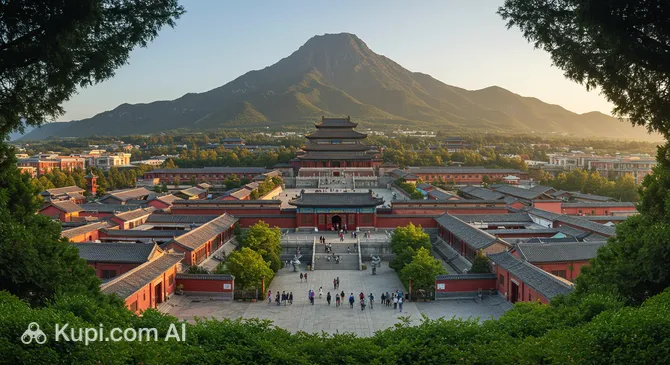
Tai'an is an amazing city in Shandong Province that serves as the main gateway to one of China's most revered shrines. Located about 100 kilometers south of Jinan, this prefecture-level city with a population of about 5.5 million people wonderfully combines the energy of a modern metropolis with the tranquility of ancient spiritual traditions. The city's name is inextricably linked to its main pride—the sacred Mount Tai (Taishan), at the foot of which it lies.
The geographical location of Tai'an makes it an important transport and cultural hub for the region. The city is permeated with an atmosphere of harmony and deep respect for the rich heritage that has been shaped over thousands of years. For many travelers, Tai'an becomes not just a point on the map, but a place of power where one can touch age-old legends and feel the rhythm of life in the true Middle Kingdom.
Tai'an. Illustration.
Source: Kupi.com AI
The main magnet for tourists here is undoubtedly Mount Tai, a UNESCO World Heritage site, and the magnificent Dai Temple complex. Visiting Tai'an is an invitation to a journey through time, where everyone will find their own way to the top, whether through thousands of stone steps or through the cozy streets of the lively city.
Weather Overview
The climate in Tai'an is distinctly seasonal, which directly affects the planning of an ascent of Mount Tai. Late spring (May–June) and early autumn (September–October) are considered the most comfortable times to visit the city. During these periods, moderate temperatures and clear weather prevail, ideal for long walks and contemplating panoramas.
Summer in the region is quite hot and humid: in July, the average temperature is about 26.6°C, and precipitation reaches its maximum, which can lead to frequent fogs on the peaks. Winter in Tai'an is cold and dry; in January, the thermometer often drops to -5°C. A winter ascent requires special equipment due to possible ice, but offers a chance to see snow-covered temples in amazing silence.
To get up-to-date data before your trip, we recommend checking the forecast on the page describing the weather in Tai'an. Remember that conditions at the top of the mountain can differ significantly from those in the city: the temperature there is always several degrees lower, and the wind is significantly stronger.
Average monthly temperature
Average monthly precipitation
Interesting Facts
Tai'an is a city with deep roots and a fascinating destiny, hiding many interesting facts for the curious traveler.
Sacred Status: Mount Tai, located within the city limits, is considered the first among the five great mountains of China and is a UNESCO World Heritage site.
Administrative Past: During the Qing Dynasty in 1724, the city received the status of Tai'an Prefecture, which governed six counties and one department.
Geographical Heart: The city is located in the central part of Shandong Province, occupying a strategic position between the regional capital Jinan and the industrial center Zibo.
Urban Reform: The modern look of the Tai'an prefecture-level city was formed in 1985, and a few years later, in 1992, the city of Laiwu was separated from it to become an independent entity.
How to Get There
Thanks to its location on important transport corridors in Shandong Province, getting to Tai'an is easy. The city boasts excellent transport accessibility, linking the northern and southern regions of the country.
The most convenient and fastest way to reach the city is by rail. The main station receives high-speed trains from megacities such as Beijing and Shanghai, making Tai'an an ideal destination for short 1-2 day trips. The well-developed rail network allows tourists to plan flexible routes throughout eastern China.
Station
Passenger traffic
Distance
Jinan railway station
8
53 km
Jining Railway Station
3
100 km
Linyi Railway Station
3
172 km
Heze Railway Station
3
179 km
Dongying South Railway Station
3
183 km
For those who want to know more about the travel details, it is worth checking out the detailed information on how to get to Tai'an. Buses and trains run regularly from neighboring Jinan, located just 100 kilometers away, and special shuttles run from the city's central square directly to the main entrances of Mount Tai.
Main Attractions
The main and most majestic attraction of the city is Mount Tai. It is one of the Five Great Mountains of China, holding immense cultural and natural significance. Ancient temples, unique stone inscriptions, and imperial pilgrimage routes have been preserved on its slopes and peaks. Climbing the mountain is not only a physical challenge but also an opportunity to see spectacular panoramas of the Shandong Plain, which have inspired poets and philosophers for centuries.
At the very foot of the sacred mountain lies the Dai Temple (Daimiao)—the largest and most significant temple complex in Tai'an. Its architecture and layout are reminiscent of the Forbidden City in Beijing. Strolling through its courtyards, you can see centuries-old cypresses, ancient steles, and majestic halls that served as the site for rituals honoring the deity of Mount Tai.
For those who decide to conquer the summit, the ultimate goal is Jade Emperor Peak (Yuhuang Ding). Here you will find the Sacred Altar and the city's best observation decks. The sunrises witnessed from this height are considered among the most beautiful in China: as the sun slowly rises over the sea of clouds, bathing the mountain ranges in golden light, time seems to stand still.
Local Cuisine
The gastronomic scene in Tai'an is a vibrant reflection of the traditions of Shandong Province, known for its authentic Lu cuisine. Here, food is perceived not just as a meal, but as part of a cultural experience closely linked to the spirit of the sacred mountains. Travelers should prepare for an abundance of nutritious and aromatic dishes that provide strength before a long climb.
At the lively city markets and in small shops, be sure to try the local street food. A special place in the diet is occupied by various flatbreads, dumplings, and dishes made from fresh vegetables grown in the fertile valleys of Shandong. Numerous tea houses and snack bars are located along the tourist trails of Mount Tai, where you can relax with a cup of aromatic tea while admiring the mountain scenery.
The local food culture emphasizes simplicity and honest flavors. In addition to tea, traditional non-alcoholic drinks based on grains and herbs are popular in the region. In the evening, cozy restaurants open in the city where locals gather in large groups, creating the very lively atmosphere of hospitable China that tourists value so much.
Travel Tips
A trip to Tai'an promises to be unforgettable, and to ensure your acquaintance with the sacred mountain goes perfectly, we have prepared some practical tips.
Clothing and Footwear: The main rule is comfortable shoes with excellent grip. You will have to overcome thousands of steps, so trekking sneakers will be the best choice. Dress in layers: even if it's hot in the city, it can be windy and cool at the summit.
City Transport: Use tourist shuttles from the central square to get to the mountain. For long-distance travel, high-speed trains connecting the city with Jinan and Beijing are convenient.
Finances: In Tai'an, as in all of China, mobile payments (Alipay, WeChat Pay) dominate. However, always have some cash in Yuan with you for small purchases in mountain shops.
Health and Safety: Be careful on the stairs of Mount Tai and do not rush, especially in crowds. During the summer season, do not forget sunscreen and a sufficient supply of water.
Communication: English is not widely spoken. Download an offline translator and maps in advance. It is useful to carry a hotel card with the address in Chinese.
Local Etiquette: When visiting temples, keep quiet and do not disturb worshippers. Behave with restraint and respect toward cultural monuments.
What to Avoid: Try not to plan your climb during China's national holidays when the mountain is overcrowded with tourists. Also, do not ignore weather forecasts—fog can hide all the views.
Choosing a Route: For your first time, choose the historical path through the "Red Gate" (Hongmen) to see the most temples, or use the cable car if you want to save your strength.
Tai'an is a hospitable city that rewards patient and attentive travelers with stunning discoveries. Have a great journey!
Entertainment & Nightlife
In the evening, Tai'an offers tourists an atmosphere of tranquility and cultural immersion, significantly different from bustling metropolises like Shanghai. In the soft light of lanterns, the city is transformed, inviting leisurely strolls through central streets and park areas. Most activity is centered around traditional cultural sites and gastronomic locations.
The main evening entertainment for many are the night markets, where life is in full swing and the aromas of freshly prepared food fill the air. Here you can not only taste local delicacies but also observe the daily life of locals, purchase handmade souvenirs, and enjoy the lively atmosphere. Safety in the city is high, allowing for comfortable walks even late at night.
For those seeking cultural leisure, Tai'an hosts spectacular theatrical performances dedicated to the history of Mount Tai and imperial rituals. While there are few classic nightclubs in the city, their absence is more than compensated for by cozy tea houses and restaurants where you can spend the evening in conversation, recovering after a busy day in the mountains.
Parks & Museums
The main natural asset and, at the same time, a grand "open-air museum" is the Mount Tai National Park. This is a space where wilderness meets thousands of years of history: on the way to the summit, pilgrims and tourists pass numerous pavilions, ancient steles, and gates, which are valuable architectural monuments in their own right.
At the foot of the mountain, the Dai Temple is a must-visit. This is not just a place of worship, but a real historical museum that houses priceless artifacts, ritual objects, and masterpieces of calligraphy. The gardens on the temple grounds, with their centuries-old pines and cypresses, offer ideal conditions for quiet contemplation and relaxation after active walks.
For the convenience of visitors, information centers operate at the main entrances to the park area. Here you can obtain route maps and find out the latest information about the restoration of sites. The combination of majestic mountain forests and carefully preserved cultural heritage makes the parks and museums of Tai'an essential stops on any traveler's itinerary.
Getting Around
The transport system in Tai'an is oriented towards the convenience of the many tourists arriving to visit the sacred mountain. Urban public transport is represented by an extensive network of buses that connect the main residential areas with railway stations and the tourist entrances to Mount Tai park.
Specialized tourist shuttles play a key role. They run regularly from Tai'an's central square to the main access points on the mountain, such as the "Red Gate" or the Western entrance. This is the easiest and most reliable way to reach the start of the climbing route. Payment on buses is usually made in cash or via popular mobile apps.
On Mount Tai itself, there is a modern cable car and lifts. This is a paid but extremely useful alternative to the hike up, allowing you to save energy and time while enjoying breathtaking views from the cabin. Taxis are also widely available for getting around the city and can be hailed through apps or directly on the street.
Accommodation
The hotel infrastructure in Tai'an is well-developed and capable of meeting the needs of various categories of travelers. The typical range of accommodation includes budget guesthouses as well as comfortable 3-4 star hotels offering modern service and cozy rooms.
Most tourist accommodation is concentrated in two areas: the city center, which is convenient for using urban infrastructure and transport, and directly near the entrances to Mount Tai. Staying near the "Red Gate" (Hongmen) entrance or the western entrance allows tourists to save time in the morning and start their ascent or board the cable car without unnecessary haste.
When planning a trip, especially during Chinese national holidays or the summer season, it is highly recommended to book accommodation in advance. Accommodation prices in Tai'an remain quite affordable compared to China's largest metropolises, and the choice of options on popular booking platforms allows you to find the optimal price-quality ratio.
Nearby Cities
Tai'an is an excellent base for exploring the central part of Shandong Province. Thanks to its developed infrastructure, the city serves as a convenient starting point for trips to interesting neighboring locations, each with its own unique character.
Just 50 kilometers to the north is Jinan—the provincial capital, famous for its numerous natural springs and picturesque Daming Lake. It is also worth paying attention to the city of Feicheng, located just a half-hour drive away, which is known for its peach orchards and calm pace of life.
The region around Tai'an offers a rich choice of routes: from visiting modern industrial areas like the Laiwu District to cozy county towns like Xintai. Exploring these surroundings will allow you to deeper understand the diversity of Chinese culture and see provincial life beyond the main tourist trails.
Shopping & Souvenirs
Shopping in Tai'an is primarily an opportunity to purchase unique souvenirs imbued with the energy of sacred Mount Tai. The city is not a mecca of high fashion, but it offers something more valuable: traditional products that have been valued by pilgrims and travelers from all over China for centuries.
The main shopping activity for tourists is concentrated in shops along the climbing routes and at the entrances to the Dai Temple. Here, it is worth paying attention to stone products from Mount Tai, fans with calligraphy, and traditional Chinese charms. At the lively markets in the city center, you can find not only souvenirs but also traditional everyday goods, as well as try local delicacies.
Shops in the city usually stay open until late in the evening, and mobile payment systems, which have become the standard in China, are widely accepted. If you are looking for something more modern, department stores offering familiar goods and electronics are located in the center of Tai'an. Don't forget to look into the food markets—the best place to buy local tea and authentic Shandong sweets.