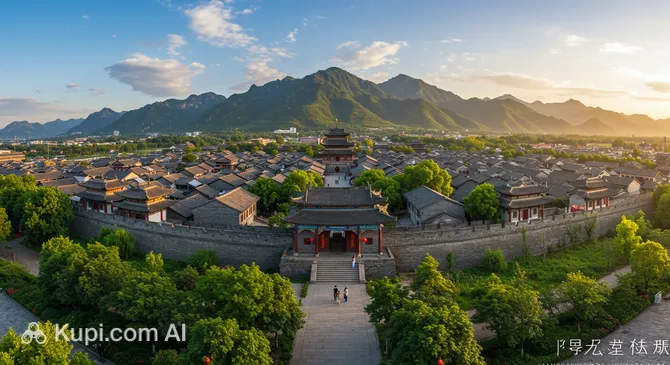
Qingzhou is a fascinating city in Shandong Province, rightfully considered a cradle of Chinese civilization. With a history spanning over 2,200 years, it harmoniously blends ancient grandeur with the tranquility of nature. Known as the "Green City," Qingzhou enchants travelers with its picturesque landscapes, where historic quarters sit alongside lush parks and gardens.
Located in eastern China, the city covers an area of over 1,500 km² and has a population of approximately 914,000 people. It is a place where time seems to slow down: narrow streets, traditional houses with grey tiled roofs, and majestic temples create the atmosphere of a living open-air museum. The city is famous for its rich historical heritage, being one of the oldest cultural centers in the region.
Qingzhou. Illustration.
Source: Kupi.com AI
The main magnets for tourists here are the beautifully preserved Ming and Qing dynasty quarters, as well as unique finds of Buddhist art. Qingzhou is also recognized as a national center for floriculture, so a stroll through its streets is often accompanied by the scent of fresh flowers and the sight of ornamental plants. Visiting this city is an invitation to experience authentic China, free from the hustle and bustle of mega-cities.
Weather Overview
The climate in Qingzhou is temperate continental with clearly defined seasons. Summers are usually warm and quite humid, while winters are dry and frosty. Thanks to the abundance of greenery and parks, the heat in the city is easier to handle than in large metropolises, creating comfortable conditions for walks most of the year.
The warmest month is July, when the average daytime temperature is about +31°C. In winter, especially in January, the thermometer can drop to -5°C and below. The highest amount of rainfall occurs in July and August, so don't forget an umbrella when planning a summer trip. Detailed up-to-date information can be found on the page describing the weather in Qingzhou.
The ideal time to visit the city is spring (April–May) and autumn (September–October). During these periods, the temperature is mildest and most pleasant (about +15°C...+22°C), and nature delights with vibrant colors: in spring, the city is drowned in flowers, and in autumn, gardens and parks turn golden hues.
Average monthly temperature
Average monthly precipitation
Interesting Facts
One of the "Nine Provinces": According to ancient texts, Qingzhou was one of the nine legendary administrative regions into which ancient China was divided over two thousand years ago.
The Golden Age of Buddhism: In 1996, a "statue pit" was discovered in the city containing over 400 Buddhist sculptures. This find revolutionized historians' understanding of the art of the Northern Qi and Northern Wei dynasties.
Flower Capital: The city is officially recognized as one of the largest flower-growing centers in the country. It hosts the massive annual China (Qingzhou) Flower Fair, attracting thousands of professionals and floral enthusiasts.
Living History: The historic center has preserved more than 120 ancient streets that have not turned into mere movie sets but remain places where residents live and work, maintaining an authentic way of life.
Home of Scholars: For centuries, Qingzhou was famous for its educational traditions; many famous philosophers and poets of the Tang and Song eras emerged from local academies.
How to Get There
The transport accessibility of Qingzhou makes it a convenient destination for travelers exploring eastern China. The city is integrated into a modern railway network, allowing for easy access from the country's largest metropolises. If you are planning a visit, useful information can be found in the section on how to get to Qingzhou.
The city does not have its own airport, so air travelers usually use Qingdao Jiaodong International Airport (TAO) or Jinan Yaoqiang Airport. From Qingdao, which is about 200 kilometers away, the city can be reached by high-speed train in just 1.5–2 hours. Intercity buses also run regularly, connecting airports with transport hubs in Shandong Province.
Rail travel is the most practical way to visit. Qingzhou North Station receives modern high-speed trains from Beijing (the journey takes about 3-4 hours) and Shanghai (about 5 hours). From the station to the city's central districts, you can quickly get there by taxi or city bus in 20–30 minutes.
Station
Passenger traffic
Distance
Weifang railway station
4
55 km
Dongying South Railway Station
3
75 km
Jinan railway station
8
134 km
Rizhao Railway Station
3
170 km
Qingdao railway station
11
178 km
Main Attractions
The city's main treasure is its Ancient City. Walking through the historic Dongmen and Nanmen streets feels like stepping back several centuries. Over 120 ancient alleys have been preserved here, with the facades of Ming and Qing dynasty houses carefully restored. Cozy teahouses, artisan shops, and small museums line the roads, allowing you to feel the spirit of old China.
Another important landmark is the Fangong Pavilion. It is not just an architectural monument but a magnificent park ensemble. Here, you can wander for hours among centuries-old trees, cross elegant bridges over lotus ponds, and enjoy the silence in traditional gazebos. The pavilion is considered a masterpiece of classical landscape design in Shandong Province.
For art lovers, the Buddhist heritage of Qingzhou is a must-see. At the end of the 20th century, a unique burial pit containing hundreds of Buddha statues dating from the 5th to the 11th centuries was discovered here. Many of them still bear traces of gilding and bright colors, making this collection one of the most significant archaeological finds in Asia. These exquisite sculptures are striking for their delicate craftsmanship and peaceful facial expressions.
Local Cuisine
The culinary traditions of Qingzhou are inextricably linked with the famous Shandong cuisine (Lu), which is considered one of the four great culinary schools of China. Here, preference is given to fresh ingredients, a delicate balance of salty and sweet, and the masterful use of seafood and vegetables. One of the unique features of local gastronomy is the use of edible flowers in cooking, highlighting the city's status as a flower capital.
Be sure to try the local steamed buns with various fillings and homemade noodles, which are prepared by hand in many shops in the Ancient City. Lotus dishes are frequently found on menus—from crispy roots to delicate soups. Equally popular are stir-fried vegetable snacks with local sauces. For drinks, fresh green tea and unique flower infusions served in traditional teahouses are worth trying.
The food culture in the city is very democratic. Numerous street food stalls are located on Dongmen and Nanmen streets, where you can grab a snack on the go. For a more substantial meal, it is better to choose one of the historical-style restaurants, where dining becomes a real ritual. Local residents value food as a way of socializing, so portions are often large and intended for sharing.
Travel Tips
A trip to Qingzhou promises to be rewarding and comfortable if you consider a few practical points specific to this region in advance.
Clothing and Footwear: Choose the most comfortable shoes possible for long walks on the cobblestone streets of the Ancient City. The weather is ideal in spring and autumn, but it can be cool in the evenings, so a light jacket will come in handy.
Transport: Download the Didi app (the Chinese equivalent of Uber)—it is the easiest way to move around the city. For bus trips, it is useful to have small change or a set-up WeChat/Alipay wallet.
Finances: Mobile payments are accepted almost everywhere in China. Cash is only necessary in very small shops. Withdraw money from ATMs of major banks (e.g., Bank of China) that work with international cards.
Connectivity: Be sure to buy a local SIM card at the airport or an official operator's office. Install a reliable VPN service in advance, as many common Western resources may be inaccessible.
Language: English is not very common here. Save screenshots of the names of attractions and your hotel in Chinese (characters), and use translation apps with a photo function.
Local Etiquette: When visiting temples, behave quietly and check if photography is allowed inside. In Qingzhou, politeness and calm are valued; a slight bow when greeting is appropriate.
What to Avoid: Do not engage in arguments on political topics and try not to photograph military or government facilities—this is a general safety rule in the country.
Best Time to Visit: Try to catch the annual flower fair if your visit falls in autumn—it is an unforgettable sight showcasing the city's main brand.
By preparing for these details, you will be able to fully focus on the beauty and ancient history of this amazing corner of Shandong Province.
Entertainment & Nightlife
Entertainment in Qingzhou is primarily cultural and contemplative. Life here does not stop at dusk, but it lacks the noise of large metropolises. The main hub of evening activity is the Ancient City, where historic buildings are illuminated by the soft light of lanterns, creating a magical atmosphere for walks.
Tradition lovers should visit the local teahouses. In the evenings, they often host tea ceremonies accompanied by traditional musical instruments or performances by calligraphers. This is the perfect time to try local tea varieties and immerse yourself in the aesthetics of Chinese leisure. The city also regularly hosts flower festivals and craft fairs, which are vibrant events for all guests.
For more active recreation, locals and tourists head to park areas, where you can see dance groups or open-air qigong sessions in the evening. Regarding safety, Qingzhou is a very peaceful city. For nighttime travel, it is most convenient to call a taxi via mobile apps, which operate around the clock and ensure a car arrives quickly anywhere in the central districts.
Parks & Museums
One of the city's most picturesque spots is the Fangong Pavilion. This park is a true oasis of silence, where the classical architecture of gazebos and bridges is nestled among centuries-old trees. It is especially beautiful in summer when the surface of the numerous ponds is covered with blooming lotuses. It is an ideal place for morning walks and contemplating nature in the best traditions of Chinese aesthetics.
The cultural heart of the city is the Qingzhou Museum. It is among the best county-level museums in the country due to its unique collection. The main interest here is the Buddhist statues found during excavations of the Longxing Temple. The elegance of the lines, the preserved colors, and the gilding on sculptures over 1,500 years old leave a lasting impression. The exhibition also includes ancient ceramics, calligraphy, and household items from various eras.
The entire Ancient City district can be considered a vast open-air museum. Here, in addition to residential quarters, there are small themed galleries and temple complexes. The ancient pagodas and guild halls deserve attention, each telling its own story of the region's prosperity during the Ming and Qing eras. Visiting these sites provides a deeper understanding of how art and religion developed in Eastern China.
Getting Around
The transport system in Qingzhou is focused on the convenience of moving between key attractions and residential areas. Buses form the backbone of public transport. The route network covers the entire city, including the journey from the railway station to the historic center. Fares are fixed and very affordable, usually paid upon entry (in cash without change or via mobile apps).
There is no metro in the city, which is compensated for by a well-developed taxi service. Cars can be hailed on the street, but it is much more convenient to use the Didi app. Trips around the city are inexpensive, and drivers are generally polite, though knowing a few phrases in Chinese or having an address in characters will be an advantage. From the high-speed station to the Ancient City, a taxi will take you about 20–25 minutes.
For short trips through the cozy streets of the center, bicycles and electric scooters are extremely popular. Sharing systems are available in the city via QR codes. Walking remains the best way to explore the Ancient City, as many historic alleys are too narrow for cars. This allows tourists to leisurely enjoy the architecture and atmosphere of old China.
Accommodation
The choice of accommodation in Qingzhou allows you to find a suitable option for both budget travelers and those who prefer enhanced comfort. Most hotels are concentrated in two key areas: in the immediate vicinity of the Ancient City and near the railway station. Staying in the historic center offers the unique opportunity to wake up among ancient architecture and stroll through evening streets without spending time on transport.
The city features modern middle-class hotels (3–4 stars) as well as authentic guesthouses (boutique hotels) located in restored traditional "siheyuan" courtyards. Such accommodation options are particularly popular as they allow for full immersion in the local flavor. For those traveling on business, large chain hotels with a full range of services are available.
Accommodation prices in Qingzhou remain quite affordable compared to mega-cities. However, during major flower exhibitions or national holidays (such as early May or October), it is recommended to book accommodation in advance. Major booking services, such as Trip.com, offer a wide range of options with traveler reviews.
Nearby Cities
Thanks to its prime location in the center of the province, Qingzhou serves as an excellent starting point for exploring the surroundings of Shandong. Just 60 kilometers away is the city of Weifang, the world capital of kites. A trip there takes less than an hour by train, and you can visit a unique kite museum and picturesque parks.
For those interested in industrial history and ancient ceramics, a trip to Zibo is an excellent option. This city is only 40 kilometers away. Another interesting destination is Shouguang, known for its agricultural innovations and giant vegetable exhibitions. If you have a full free day, consider a trip to Qufu—the birthplace of Confucius—which is a few hours' drive away.
The region around the city offers a rich variety of cultural and natural sites. A well-developed network of bus services and high-speed trains allows for comfortable day trips, returning in the evening to the cozy atmosphere of Qingzhou.
Shopping & Souvenirs
Shopping in Qingzhou is primarily about searching for unique items with a history and traditional crafts. The main shopping routes pass through the historic Dongmen and Nanmen streets. There are no huge, glittering malls here, but there is an abundance of shops where craftsmen create works of art before your eyes. The city is especially famous for its calligraphy scrolls and writing supplies, which make for exquisite gifts.
As a center of floriculture, Qingzhou offers tourists flower-related goods. In local markets and specialty shops, you can find seeds of rare plants, decorative pots, and even products made from dried flowers. It is also worth paying attention to local antiques and souvenirs made of wood and stone, crafted in the style of the Ming and Qing dynasties.
Shops in tourist areas generally operate from 9:00 to 20:00, while markets open early in the morning. Payment is most often accepted via popular Chinese systems (Alipay, WeChat Pay), but large shops may also accept international cards. Bargaining in markets and small private shops is not only possible but encouraged—it is part of the local etiquette that will help you make a purchase on better terms.