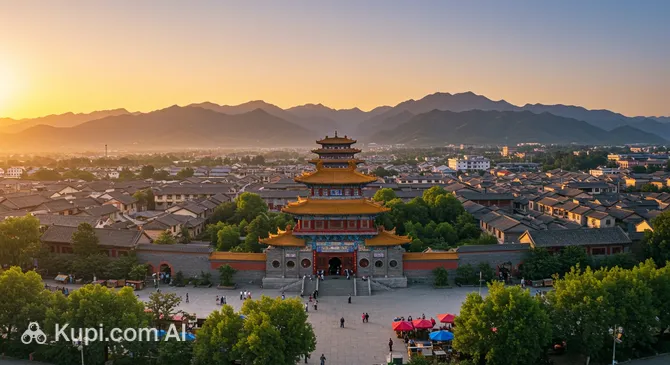
Wuwei is a peaceful regional center in Gansu Province, located in northwest China. The city occupies a strategically important position in the legendary Hexi Corridor, which for centuries served as a vital section of the Great Silk Road. Unlike the bustling eastern metropolises, Wuwei offers travelers a more relaxed pace of life and a deep immersion into the region's cultural traditions.
Geographically, the city is surrounded by arid landscapes, which leaves an imprint on its architecture and atmosphere. The population of the prefecture-level city is about 1.8 million, but the city center itself maintains a cozy, provincial feel. Exploring the city's historical heritage, you can discover amazing evidence of ancient eras when trade caravans and cultural currents of the East and West intersected here.
Wuwei. Illustration.
Source: Kupi.com AI
Tourists are drawn to Wuwei primarily by its Buddhist and Confucian monuments, such as ancient pagodas and majestic temple complexes. This place is ideal for those who want to see the "real" China, unburdened by mass tourism, and touch the living history of the Silk Road. We invite you to discover this unique hub of transport and spiritual connections in the northwest of the Celestial Empire.
Weather Overview
Wuwei is located in a dry continental climate zone, characterized by pronounced seasonal changes and significant daily temperature fluctuations. It is worth checking Wuwei's climate in advance to choose the right wardrobe for a trip to northwest China.
Winters in the region are cold and dry: in January, the average temperature drops to -7°C, and frosts down to -13°C are possible at night. Summer, by contrast, is warm and sunny, with average figures in July around +22°C, although during the day the air can warm up to +28°C. Precipitation is rare, occurring mainly in the summer months (August is the wettest period), and the air remains dry throughout the year.
An important feature of the local weather is dustiness, associated with the proximity to arid territories and winds in the Hexi Corridor. On windy days, air quality can decrease due to suspended particles, so it is useful for travelers to have a mask and a sufficient supply of drinking water.
Average monthly temperature
Average monthly precipitation
Interesting Facts
Wuwei is not just a city, but a vast prefecture-level city covering more than 33,000 km², which is comparable to the territory of some small European countries.
The city is an important historical hub of the Great Silk Road, where the exchange of goods and ideas between China and Central Asia took place for millennia.
In the international aviation system, Wuwei is recognized by its unique IATA code—WUW.
Despite its ancient history, the city maintains its status as an "off-the-beaten-path" destination, allowing tourists to view the sights without the crowds typical of Beijing or Xi'an.
How to Get There
The transport accessibility of Wuwei is due to its position in the Hexi Corridor—a historical passage connecting the country's central regions with its western borders. It is worth looking into all the ways to get to Wuwei in advance, as the route may require transfers depending on your point of origin.
For those who prefer air travel, the main hub is Wuwei Airport (WUW). This is a convenient option for arriving from distant provinces; however, due to its regional scale, direct international flights are rare here. The airport provides connections to key cities in China, making travel to the northwest faster.
Railway communication plays an equally important role in the city's life. Major trunk lines connecting the east and west of the country pass through Wuwei. The railway remains the most popular way to get here from neighboring cities in Gansu, offering tourists the opportunity to enjoy views of the rugged northwestern landscapes from the train window.
The main attractions of Wuwei are inextricably linked to its rich spiritual and historical past. One of the city's most recognizable symbols is the Luoshi Pagoda, erected in honor of the great Buddhist monk and translator Kumarajiva. This site attracts pilgrims and architecture enthusiasts with its peaceful atmosphere and ancient legends.
Equally significant is the Wuwei Confucian Temple—one of the largest and best-preserved temple complexes of its kind in Gansu Province. Strolling through its courtyards, you can appreciate the elegance of traditional Chinese architecture and learn more about the Confucian educational system that shaped the country's intellectual landscape for centuries.
In addition to the major temples, Wuwei is interesting for its historical urban locations and small pagodas found in the old quarters. While there are no dense clusters of world-class tourist attractions, every site—whether an ancient monument or a quiet temple garden—allows you to feel the spirit of the Hexi Corridor and the heritage of the legendary Silk Road more deeply.
Local Cuisine
The cuisine of Wuwei is a vivid reflection of the gastronomic traditions of Gansu Province and the northwestern region. The basis of the local diet consists of hearty noodle dishes, various flour-based products, and aromatic mutton. This is simple but very tasty food that is perfectly suited to the climatic conditions of this part of the country.
Be sure to try the local hand-pulled noodles and various meat dishes flavored with aromatic spices. The general character of the gastro-scene in Wuwei can be called democratic and practical: the best taste experiences usually await in small family-run establishments and markets where the city residents themselves dine.
To get acquainted with local cuisine, it's better to choose reliable places with many locals. You won't find a high concentration of premium restaurants here, but you will be able to appreciate the honest taste of regional specialties. Various types of tea are often served as drinks, helping to cope with the dryness of the local air.
Travel Tips
Planning a trip to Wuwei requires considering the regional specifics of northwest China, and these tips will help make your journey as comfortable as possible.
Clothing and Essentials: Due to the continental climate and possible dust in the air, be sure to bring a protective mask and sunglasses. It is better to choose layered clothing, as temperature fluctuations between day and night can be significant.
Transport: The main means of getting around the city are buses and taxis. It is most convenient to use mobile apps to call a car, as English is practically not spoken among drivers.
Finance: The main currency is the Chinese yuan. It is recommended to set up Alipay or WeChat Pay in advance by linking an international card, as many places are reluctant to accept cash, and foreign bank cards rarely work.
Health and Safety: Because of the dry air, always carry a bottle of water with you. Wuwei is a safe city, but when choosing accommodation, it's better to stick to central areas for logistical convenience.
Communication: English is rarely encountered here. Download an offline translator and learn basic phrases in Chinese. Buying a local SIM card is essential for using navigation and payment services.
Local Etiquette: When visiting temples and pagodas, maintain silence and respect the rules regarding photography. Clothing should be modest and cover the shoulders and knees.
What to Avoid: Do not plan late walks in unlit outskirts of the city. Also, do not count on a packed sightseeing schedule—it is better to maintain a calm pace here.
Additional Tip: Check the current Air Quality Index (AQI) before going for a long walk, especially if windy weather is expected.
Wuwei will reveal its secrets to you if you show patience and interest in its ancient history. Enjoy your trip through the Hexi Corridor!
Entertainment & Nightlife
Nightlife in Wuwei reflects its status as a quiet regional center: you won't find an abundance of noisy clubs or 24-hour entertainment districts here. Evening activity is mainly concentrated on the central streets and in public spaces where locals gather for walks and socializing. Most entertainment is local and family-oriented in nature.
The atmosphere of the city in the evening lends itself to leisurely walks through illuminated squares and visits to traditional teahouses or small restaurants. If you are looking for a more dynamic nightlife, keep in mind that it is moderately developed in Wuwei, and travelers usually head to the region's larger cities for vibrant parties. For tourists, the central districts remain safe areas for walking, where you can always find a taxi via mobile apps.
Daytime leisure in the city includes visiting historical monuments, walking in the park areas around temples, and exploring local cultural sites. Wuwei is ideal for thoughtful contemplation and historical study, offering guests a quality retreat far from the hustle and bustle of megacities.
Parks & Museums
The park infrastructure of Wuwei characterizes it as a typical regional city: there are no huge recreational zones, but public spaces are harmoniously integrated into the urban environment. Green zones are often located around historical monuments and temples, creating quiet oases among the city buildings where it is pleasant to relax after excursions.
The city's museums focus on preserving the rich heritage of the Silk Road and the local history of Gansu. The museum exhibition in Wuwei allows you to get acquainted with the archaeological finds of the region and better understand the city's role in the ancient system of international trade. This is a great opportunity to see unique artifacts found in the surrounding burial mounds and temples.
Although Wuwei does not claim to be a museum capital of national scale, its cultural sites deserve a specific visit. They offer a high-quality and informative overview of the history of the Hexi Corridor, making a visit to the city educational and profound without the need to spend the entire vacation in museums.
Getting Around
Public transport in Wuwei is primarily represented by a developed network of bus routes that connect central districts with the outskirts and key attractions. Since the city is small by Chinese standards, there is no metro system, and the main emphasis is on ground transportation.
To pay for bus fares, transport cards or mobile apps, which have become the standard throughout China, are most commonly used. Fares remain very affordable, making buses the most budget-friendly way to get around. Tourists are recommended to have established payment services for the convenience of transactions.
An alternative to buses are numerous taxis, which can be hailed through the DiDi app or caught directly on the street in central areas. Given the city's compactness, taxi rides between main sites do not take much time and are inexpensive. Bike rentals can also be a convenient option for getting around within the historical center.
Accommodation
In Wuwei, mid-range city hotels and practical guest houses oriented towards business travelers and tourists following the Silk Road route predominate. Luxury resorts of international chains are rare here, but there are plenty of comfortable and affordable accommodation options that provide a standard level of service.
The most convenient solution is to choose accommodation in the central part of the city or in the immediate vicinity of transport hubs. Staying in the center will significantly save time on trips to key historical monuments and ensure easy access to local restaurants and shops.
When planning your trip, it is recommended to use popular booking systems such as Agoda or Trip.com, which have a strong presence in the local market. Although Wuwei does not suffer from excessive tourist flow, booking accommodation in advance during peak seasons (spring and autumn) will help you find the best deals in terms of price and location.
Nearby Cities
Thanks to its location in the heart of the Hexi Corridor, Wuwei serves as an excellent starting point for exploring the northwestern reaches of Gansu Province. The region is rich in historical settlements and unique landscapes that can be explored as part of short trips.
One of the nearest destinations is Jinchang, located less than 80 kilometers away. This city is interesting for its industrial heritage and modern look. It is also worth paying attention to small settlements like Dengjiazhuang, which allow you to see the daily life of the province's rural areas in close proximity to the city.
Exploring the surroundings of Wuwei allows for a better understanding of the cultural and geographical context of the Silk Road. Traveling between neighboring cities, you will see how the landscape changes and how ancient history intertwines with the modern development of this important transport belt of China.
Shopping & Souvenirs
Shopping in Wuwei is mainly local and everyday in nature. There are no huge luxury malls, but there are shopping streets and medium-sized centers in the city center where you can find everything you need for life and travel. The city's retail infrastructure is primarily focused on the needs of local residents.
For tourists, local markets are of the greatest interest, where you can find authentic goods and products. As souvenirs from Wuwei, it is worth bringing back items related to Buddhist and Confucian themes, as well as pieces of traditional Chinese calligraphy. Regional food products and folk crafts typical of Gansu Province are also popular.
Shops usually stay open until late in the evening, and payment is most often made through the popular Chinese payment systems Alipay and WeChat Pay. Cash in yuan is welcome at large markets. Shopping here is a great way to experience the everyday life of northwest China and find unique items with historical flavor.