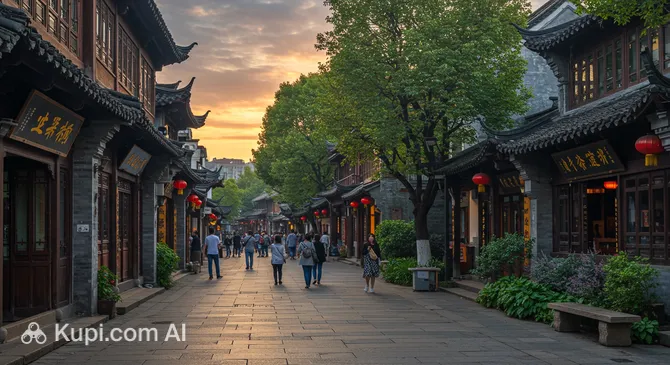
Zijinglu is a dynamically developing urban district located in the eastern part of China. As part of the massive Shandong Province agglomeration, this district is a striking example of modern Chinese urbanization, where traditional ways of life intertwine with the rhythm of a metropolis. With a population of over 807,000 people, Zijinglu has evolved into an important residential and functional hub, attracting attention for its accessibility and well-developed infrastructure.
Geographically, the district occupies a favorable position, situated in close proximity to major economic centers and the coast. The climate here is temperate with distinct seasonality, allowing visitors to enjoy both the blossoming spring and the mild autumn. Although the district is primarily focused on providing a comfortable lifestyle for locals, it possesses its own unique energy typical of fast-growing Asian neighborhoods.
Zijinglu. Illustration.
Source: Kupi.com AI
By exploring the history of the district's development, one can trace how, over recent decades, deserted outskirts have transformed into a forest of skyscrapers and modern residential complexes. The main focus here is on functionality: wide avenues, an abundance of retail outlets, and convenient transport interchanges make staying here simple and straightforward.
A visit to Zijinglu is an excellent opportunity to see "real" modern China off the standard tourist paths. We invite you to stroll through its lively streets to feel the pulse of one of the world's most populous regions and appreciate the scale of Eastern urban planning.
Weather Overview
The weather in Zijinglu is characterized by a clear change of seasons, which is typical for this part of China. Expect hot and rather humid summers, when the thermometer in July and August often rises to +29°C. Winters here are cool and predominantly dry: in January, the average temperature stays around 0°C, and light frosts are possible at night.
The most comfortable times to visit are considered spring (April-May) and autumn (September-October), when pleasant warm weather sets in, ideal for walking. A detailed forecast and the current city weather will help you pack your bags correctly and prepare for your trip.
It is worth considering that the summer months bring the bulk of the precipitation, so an umbrella or raincoat will be your faithful companions in July. During the winter period, the air can be dry and the sky clear, creating excellent conditions for urban photography despite the invigorating chill.
Average monthly temperature
Average monthly precipitation
Interesting Facts
Zijinglu is a place full of interesting details that reveal the character of a modern Chinese city. Here are a few curious facts about this district:
The name Zijinglu (紫荆路) literally translates as "Redbud Road" (Cercis) — a tree with beautiful bright pink flowers that is an important symbol in Chinese culture.
The district is part of one of the fastest-growing agglomerations in the world, where over the last 20 years, a full-fledged city with a population of nearly a million has grown on the site of former rural lands.
Thanks to its layout, Zijinglu is considered one of the most convenient districts for young families and migrants to live, offering an optimal balance between housing costs and proximity to business centers.
The construction density here is such that more people can live within a single block than in some small European cities.
How to Get There
Transport accessibility is one of the main advantages of Zijinglu. The district is integrated into the powerful transport network of eastern China, making travel here convenient at both international and regional levels. You can find more detailed information about routes in the section on how to get to the city.
The main air gateways for the region are major international airports located in neighboring metropolises. From there, the district can be reached by taxi, transfer, or high-speed train. The use of modern highways allows you to reach the city center in about an hour, although it is worth allowing extra time during peak hours due to heavy traffic.
Railway communication also plays a key role. Modern stations receive high-speed trains connecting the region with Beijing, Shanghai, and other key points in the country. Regular bus routes and taxis run from the nearest stations to the residential quarters of Zijinglu.
Station
Passenger traffic
Distance
Qingdao railway station
11
8 km
Rizhao Railway Station
3
108 km
Weifang railway station
4
136 km
Yantai Railway Station
4
186 km
Lianyungang railway station
6
198 km
Main Attractions
The Zijinglu district is primarily known for its modern urban environment rather than classical ancient monuments. The main center of attraction here is a developed network of shopping malls and local markets that reflect the daily lives of people in China. A stroll along the district's main streets allows you to see impressive examples of typical high-rise development, which is striking in its scale and density.
For those seeking cultural enrichment, the most interesting sites are within a short drive of the district boundaries. Famous museums and temple complexes of the province are located just a few kilometers away and are easily accessible by public transport. Zijinglu itself is interesting to urbanist tourists as a living laboratory of city planning, where one can observe the development of infrastructure in real-time.
Special attention should be paid to the local administrative buildings and public spaces, which are decorated with bright neon lighting in the evenings. This is an ideal place for those who want to immerse themselves in the atmosphere of a modern Chinese residential area, visit authentic food courts for locals, and feel the true rhythm of life in a huge metropolis without embellishment.
Local Cuisine
Gastronomy in Zijinglu is a true paradise for lovers of authentic Chinese cuisine. The traditions of Shandong Province prevail here, with a focus on seafood, grains, and rich sauces. At local establishments, be sure to try the classic hand-pulled noodles and steamed buns with various fillings, which are staples for the region's residents.
One of the main features of the local cuisine is the use of fresh ingredients and an abundance of spices. Beef and pork dishes cooked in a wok with the addition of chili peppers and fragrant garlic are popular. Street food is an integral part of the district's culture: at small stalls, you can find fried dumplings, skewers, and traditional Chinese pancakes prepared right in front of you.
Locals prefer to wash down spicy dishes with green tea or local light beer, which is famous for its lightness. Mid-range restaurants also offer a wide selection of juices and traditional soy or rice-based drinks. The dining culture here is very democratic: most establishments are open until late in the evening, and portions are usually generous in size.
Travel Tips
Traveling to a modern Chinese district requires a bit of preparation to make your trip to Zijinglu comfortable and safe. Here are some proven tips from experienced travelers:
Clothing and Essentials: Choose comfortable shoes for long walks and dress according to the season. It can be windy here in winter, so a windbreaker or a light down jacket won't go amiss. Don't forget a universal power adapter.
Transport: Install maps on your smartphone (such as Baidu Maps or Amap) and the Didi app for hailing taxis. This will significantly simplify getting around, as English is rarely encountered on the street.
Finance: Mobile payments (Alipay, WeChat Pay) dominate in China. Link your card to one of these apps in advance. Keep a small supply of cash Yuan for small shops.
Health and Safety: The district is very safe, but it's always worth having a hotel business card with the address in Chinese. Pharmacies are found at every turn, but medicine names may differ.
Communication: Use offline translators. Simple phrases like "Nihao" (hello) and "Xiexie" (thank you) always elicit a friendly response from locals.
Local Etiquette: Greet people with a slight bow or a nod. In restaurants, it is customary to leave chopsticks on a special stand rather than sticking them vertically into the rice.
What to Avoid: Do not engage in discussions on political topics and try not to photograph administrative facilities without permission.
Following these simple rules will help you fully immerse yourself in the atmosphere of the district and ensure only positive impressions from your visit!
Entertainment & Nightlife
The entertainment scene in Zijinglu is centered around large shopping complexes and modern cinemas. In the evening, life in the district does not stand still: numerous restaurants and cafes fill with locals, creating a lively and friendly atmosphere. There are no noisy tourist quarters with bars, which makes the district an ideal place for a quiet evening of relaxation with family or friends.
For fans of active leisure, modern fitness centers and karaoke clubs (KTV) — a favorite pastime in China — operate in the district. Karaoke lounges here offer a high level of service and private rooms where you can spend an evening with company, enjoying popular hits and local snacks. Prices in such establishments are usually quite reasonable compared to central tourist zones.
If you are looking for world-class nightclubs or large-scale concert venues, it is recommended to head to the neighboring central districts. Thanks to the developed transport network and the availability of taxis, the journey to the region's main entertainment hubs will not take much time. Within Zijinglu itself, it is worth paying attention to the night markets, where you can find not only food but also various entertainments in the spirit of traditional Chinese festivities.
Parks & Museums
In the conditions of Zijinglu's dense urban development, green zones and parks become true oases for relaxation. The district features several well-maintained squares and small parks where locals practice Tai Chi, play board games, or simply take walks. These spaces, though small, are very cozy and allow you to take a break from the noise of the metropolis.
There are currently few large museums within the district itself; however, its modern public spaces often become venues for temporary exhibitions and installations dedicated to urban planning and contemporary art. Residents and guests of the district actively take advantage of the proximity to the region's main cultural institutions, which are within easy reach.
For a full immersion into the history of the province, it is recommended to visit the Shandong Museum or the Qingdao Museum, which house rich collections of ancient artifacts, ceramics, and calligraphy. A trip there takes little time and will be a great addition to walks through the residential quarters of Zijinglu.
Getting Around
Public transport in Zijinglu is organized as efficiently as possible to serve the huge flow of passengers. The basis of the transport system is formed by bus routes that permeate the entire district and connect it with the city's key transport hubs. Buses run frequently, are air-conditioned, and equipped with electronic boards, making navigation accessible even for foreigners.
Fares are usually paid using contactless cards or mobile applications, which is the standard for modern China. The cost of a trip is extremely low, making buses the most budget-friendly way to get around. During peak hours, it is worth considering the heavy load on transport when the district's residents commute to work or school en masse.
As an alternative, many prefer to use taxis or car-hailing services via the Didi app. This is a convenient and relatively inexpensive way to reach any point in the metropolis at any time of day. E-bike rentals are also popular in the district and can be found at special parking spots — a great way to quickly cover short distances between blocks.
Accommodation
Even though Zijinglu is predominantly a residential area, visitors to the city can find decent accommodation options here. The housing stock is mainly represented by modern apartments and aparthotels, which are excellent for long stays or business trips. Such accommodation options often offer a kitchen and all necessary household amenities at very attractive prices.
For those who prefer classic hotel service, mid-range chain hotels operate within the district and on its borders. They cater to business travelers and offer a standard set of services: breakfast, Wi-Fi, and conference rooms. It is recommended to book accommodation in advance, especially during national holidays when the demand for lodging in major cities increases sharply.
If your goal is to visit luxury five-star hotels, you should consider options in the nearby central districts of the metropolis. Nevertheless, staying in Zijinglu itself provides a unique opportunity to save your budget and see the "inside" life of the country while staying in comfortable and modern conditions.
Nearby Cities
Thanks to its location, Zijinglu is an excellent starting point for exploring the eastern coast and central provinces. Just a few kilometers away are major cultural and economic centers, each of which deserves separate attention as part of a day trip.
First and foremost, it is worth visiting the magnificent Qingdao, which can be reached in literally minutes. This city is famous for its European architecture, beautiful beaches, and world-renowned brewery. Also of interest is the city of Jiaozhou, which offers a chance to get acquainted with the region's historical heritage and traditional parks.
Exploring the surroundings of Zijinglu will allow you to see the full diversity of China: from ultra-modern skyscrapers to cozy coastal areas and ancient architectural monuments. A developed network of high-speed roads makes such trips easy and pleasant.
Shopping & Souvenirs
Shopping in Zijinglu is primarily about practicality and accessibility. The district is saturated with modern shopping centers, such as branches of major international chains, where you can find everything from the latest electronics to everyday clothing and cosmetics. It is an ideal place for those who want to shop in a calm environment without huge crowds of tourists.
Local markets scattered throughout the district are of particular interest. A unique atmosphere reigns here: piles of fresh fruit, fragrant spices, and endless rows of household goods. It is customary to haggle at such markets, and buying simple tea can turn into quite an adventure. This is also the best place to find inexpensive textiles and locally produced goods.
As souvenirs from Zijinglu and its surroundings, it is worth bringing home famous Chinese tea, silk products, or traditional ceramics. Shops usually operate from early morning until 9-10 PM, and payment is most often made through mobile apps like Alipay or WeChat Pay, though cash Yuan is still accepted in most retail outlets.