Support

Balbi's Arch

About

Balbi Arch (Croatian: Balbijev luk) is one of the most recognizable and significant historical landmarks in the charming city of Rovinj, located on the picturesque Istrian peninsula in Croatia. This elegant arch serves as one of the main entrances to the Old Town, greeting visitors at Marshall Tito Square and inviting them to immerse themselves in a medieval atmosphere.
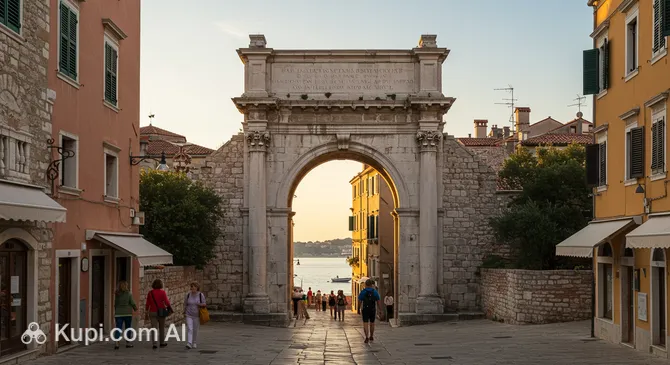
Balbi's Arch. Illustration.
Source: Kupi.com AI

Traveler photos:

Built in 1678–1679, the Balbi Arch replaced an earlier city gate, becoming an important architectural element of Rovinj. It is not just a passage, but a true symbol of the city, reflecting its rich Venetian past. Walking through the arch is like stepping into another era, opening the way to narrow cobbled streets and ancient buildings.

The Balbi Arch is crowned by an expressive bas-relief depicting the winged lion of Saint Mark—the symbol of the Venetian Republic. The lion holds an open book in its paws, which, according to legend, symbolizes Rovinj's peaceful entry under Venetian rule. This element highlights the city's deep historical ties with the powerful maritime power and gives the arch a special charm. For tourists, the arch is a popular photo spot and a starting point for exploring the Old Town.

Contacts

Balbi Arch is an iconic historical monument in Rovinj that is free and open to the public. As it is a public structure, there are no specific contact details for it. For more detailed information about the arch and other city attractions, you can contact the local tourist information center.

How to contactContact
AddressTrg G. Matteottija, 52210, Rovinj, Croatia

What to Do

Balbi Arch is not just an architectural monument, but the symbolic gateway to Rovinj's Old Town, leading to the lively Grisija Street. Passing under the arch's vaults, be sure to notice the intricately crafted details. On one side, you will see the carved head of a Venetian, and on the other, a Turk; these figures are silent witnesses to the city's rich history. At the top of the arch, a bas-relief of a winged lion proudly stands—the well-known symbol of the Venetian Republic, reminding visitors of centuries of its influence in Croatia.

After passing through the Balbi Arch, you immediately immerse yourself in the unique atmosphere of Rovinj's historical center. From here, your journey begins along cobbled, narrow streets winding among ancient buildings. These streets will inevitably lead you upwards to the city's main landmark—the majestic Church of St. Euphemia. The arch serves as an ideal starting point for a leisurely exploration of this picturesque corner, full of romance and the charm of past eras.

Getting There

Getting to the Balbi Arch in Rovinj is quite easy, as it is one of the key landmarks in the Old Town. The arch is located on Marshall Tito Square, serving as a gateway to the historical part of Rovinj. Thanks to its central location, it is very easy to find.

Since Rovinj is a small and very walkable city, the Balbi Arch is easily accessible on foot from almost anywhere in the center. If you are staying in a hotel or apartment within or near the historical core, the walk to the arch will be a pleasant stroll through narrow streets.

For those arriving in Rovinj by car, it is important to note that entry to the Old Town is restricted for private vehicles. It is recommended to leave your car in one of the many parking lots located outside the historical center and continue on foot. From most parking lots, the Balbi Arch is a 10-15 minute walk away.

If you are arriving in Rovinj from other cities in Croatia or neighboring countries by bus, you will usually arrive at the bus station, which is also within walking distance of the center. From there, you can easily reach the Balbi Arch on foot by following the signs or simply heading towards the historical part of the city and the waterfront.

Nearest city: Rovinj

History & Facts

The Balbi Arch in Rovinj is not just a beautiful structure, but an important witness to the city's rich history. It was built in 1678–1679 on the site where the main outer city gates once stood. The arch was named after Daniel Balbi, who served as the mayor of Rovinj at that time. This structure is a vivid reminder of the period when the city was under the rule of the powerful Venetian Republic.

The historical roots of Rovinj's connection with Venice go back centuries. In 1283, the city became part of the Venetian Republic, which brought it a certain degree of independence, albeit with a number of significant restrictions. Venice reserved the right to appoint a judge who oversaw all key aspects of city life—from politics and spiritual matters to administrative management and trade. Moreover, participation in the City Council was a privilege reserved exclusively for noble and influential families.

One of the most recognizable elements of the Balbi Arch is the bas-relief depicting the winged Venetian lion—the symbol of Saint Mark, the patron saint of Venice. This lion, gazing proudly from the arch, as well as a similar image on the city hall clock tower, clearly emphasizes Rovinj's historical belonging to the "Serenissima Republic." The arch served not only as an entrance to the old city but also as a demonstration of Venetian influence and power.

Today, the Balbi Arch stands before us in a beautifully preserved and carefully restored state. It is one of the key historical monuments of Rovinj and consistently attracts the attention of tourists from all over the world who wish to touch the past of this charming Croatian city and take memorable photos against the backdrop of this iconic structure.

Time Needed

It will take very little time to see the Balbi Arch itself—literally 10–15 minutes. This is enough to admire its architectural details, take a few photos, and feel the spirit of history, as the arch was built on the site of former city gates.

However, it is important to understand that the Balbi Arch is not just a standalone monument, but a kind of grand entrance to the charming Old Town of Rovinj. Therefore, when planning your visit, it is worth allowing significantly more time for a walk through its narrow streets. To leisurely explore the historical center, climb up to the Church of St. Euphemia for stunning views, and enjoy the atmosphere of this picturesque place, it is recommended to set aside 2 to 4 hours.

Thus, while the direct visit to the Balbi Arch takes only a few minutes, it will serve as the starting point for a fascinating journey through Rovinj's Old Town, which can last several hours and provide a wealth of impressions.

Working Hours

The Balbi Arch in Rovinj is a historical city gate, and the good news for travelers is that it is available for viewing 24/7. Since the arch is part of the city's architecture and leads into the Old Town, you can approach it at any time convenient for you, day or night, to admire its details.

Visiting the Balbi Arch does not require any prior booking or ticket purchase. Access is open 365 days a year, allowing you to include this landmark in your Rovinj itinerary regardless of the season of your visit. This makes it an easily accessible and must-see spot for getting to know the city's history.

Open 24 hours

Nearby

Seeing a single landmark like the Balbi Arch is undoubtedly important, but exploring its surroundings can significantly enrich your experience of visiting Rovinj. Often, the most vivid discoveries and authentic moments await you just around the corner, in small streets, cozy cafes, or near other iconic sites that complete the overall picture of the city.

By exploring the area around the Balbi Arch, you can better understand its historical and cultural context, as well as discover other interesting sites that will make your journey more fulfilling and memorable. Below is a list of some nearby attractions.

NameDistance
Tunaholic Fish Bar0.1 km
Ombra Gelato Lab0.1 km
Old Town of Rovinj0.1 km
Rovinj0.1 km
Mediterraneo Cocktail Bar0.3 km
Circolo Aperitif Bar0.3 km
Church of St. Euphemia0.3 km

Have you reached the end of the page?

So the route has been studied inside and out