Support

Archiepiscopal Museum, Ravenna

About

Housed in the ancient episcopal palace, the Archbishop's Museum is one of the most significant cultural treasures Ravenna has to offer. This unique space preserves a rich heritage from the early Christian era, presenting visitors to Italy with rare artifacts discovered within the diocese over many centuries.
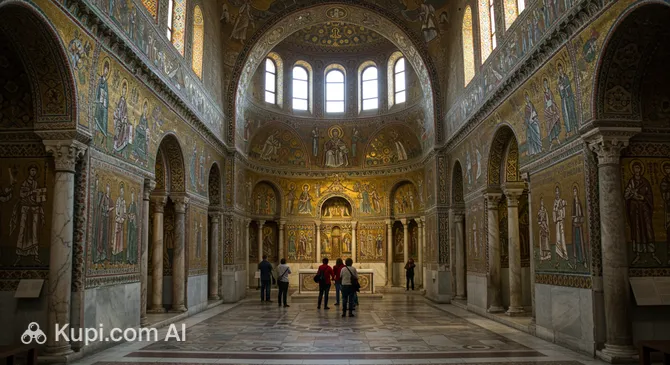
Archiepiscopal Museum
Archiepiscopal Museum. Иллюстрация. Источник: Kupi.com AI

The museum occupies historical rooms dating back to the 5th century and includes four main exhibition halls. Here, you can see fragments of ancient mosaics, exquisite sculptures, and majestic sarcophagi. The core of the collection is the lapidary hall, where Roman and Byzantine archaeological finds are harmoniously integrated into the interiors of the old residence.

The true jewel of the museum and a UNESCO World Heritage site is the Archbishop's Chapel of St. Andrew. It is the only surviving episcopal chapel from the early 5th century, adorned with dazzling gold mosaics. It is also here that the famous Throne of Maximian is kept—a 6th-century masterpiece of Byzantine ivory carving that is unparalleled in the world for its delicacy and craftsmanship.

Contacts

To plan your visit effectively, it is helpful to have current contact information at hand. Below are the official details to help you clarify visiting specifics or find your way to the exhibition. We recommend checking the official website before your trip.

How to contactContact
AddressP.za Arcivescovado, 1, 48121 Ravenna RA, Italy
Phone+39 0544 541688
Websitewww.ravennamosaici.it

What to Do

A visit to the museum offers guests a rare opportunity to encounter Byzantine art in its most refined form. Begin your journey in the lapidary hall, which houses massive Roman sarcophagi, funerary stelae, and architectural fragments from ancient basilicas. Be sure to take time to study the Throne of Maximian in the Salustra Tower—its detailed ivory carvings remain breathtaking even after fifteen hundred years.

The most profound emotional experience awaits you in the Chapel of St. Andrew. Here, you can spend ages admiring the unique 5th-century mosaics, where Christ is depicted as a warrior. The contrast between the intimate atmosphere of a small private church and the grandeur of the golden vaults creates an unforgettable sensation. Don't miss the Hall of the Planets, which displays a collection of 15th–18th-century paintings, as well as the room featuring the silver cross of Archbishop Agnellus, decorated with embossed medallions.

For those who appreciate historical details, the museum displays fragments of 12th-century mosaics from the now-lost Ursiana Basilica. These works, created by Venetian masters, allow you to trace the evolution of Ravenna's artistic style. A walk through the museum's halls is more than just viewing exhibits; it is a true immersion into the spiritual and cultural heritage of the city, which is best complemented by using an audio guide to understand the subtle theological meanings embedded in the decor.

Getting There

Located in the heart of the historic center, the Archbishop's Museum is situated at P.za Arcivescovado, 1. It is in the immediate vicinity of the Duomo (Cathedral) and the Neonian Baptistery, making it easily accessible during a walking tour of the city's main attractions. From the Basilica of San Vitale or the Mausoleum of Galla Placidia, it is just a 10–15 minute walk.

If you are arriving at the Ravenna railway station, the walk to the museum takes about 20 minutes at a leisurely pace along the scenic Viale Farini and Via dei Mille. Alternatively, city buses No. 1, 4, 5, and 70 run from the station, dropping you off very close to the square. For those who prefer maximum comfort, local taxis are always available to take you quickly from anywhere in the city directly to the museum doors.

For travelers arriving from other regions, the nearest major transport hub is Bologna Airport (approx. 70 km away). From there, the most convenient way is to take a train to Ravenna (travel time is about an hour). Flying into Forlì Airport is another option, from where a bus or taxi ride takes about 30–40 minutes. If you are traveling by car, bear in mind that the city center is a Limited Traffic Zone (ZTL), so it is best to leave your vehicle in the paid parking areas (zona blu) outside the historic core.

Ближайший город: Ravenna

History & Facts

This unique collection of antiquities was founded in 1734 by Archbishop Maffeo Niccolò Farsetti, making it the first diocesan museum in Italy. The decision to establish the museum arose during a major reconstruction of the local cathedral: the archbishop wished to preserve the most valuable artifacts found during the work for posterity—including ancient marbles and decorative fragments—rather than simply returning them to the renovated church.

The building housing the museum holds significant historical value, with its foundations and some walls dating back to the 5th century AD. One of the complex's architectural highlights is the Salustra Tower, which in ancient times served as part of the Aqua Traiana Roman aqueduct. Over the centuries, the museum has expanded several times, most actively in the early 20th century, when the collection was enriched with numerous archaeological finds discovered throughout the entire diocese.

The museum's primary treasure is considered to be the Archbishop's Chapel of St. Andrew, built at the turn of the 5th and 6th centuries during the reign of Bishop Peter II. It is the only surviving orthodox private chapel from the period when Arianism dominated Ravenna under King Theodoric. Since 1997, the chapel has been included in the UNESCO World Heritage list due to its magnificently preserved mosaics, serving as a silent witness to the golden age of Byzantine art in Italy.

Time Needed

To explore all the halls without rushing and to enjoy the details, an average visitor will need approximately 1–1.5 hours. This is quite enough time to study the exhibits in the lapidary hall, admire the famous ivory throne, and spend some quiet time in the Chapel of St. Andrew looking at the mosaic vaults.

If you plan to combine your museum visit with the neighboring Cathedral and the Neonian Baptistery, the total duration of your walk may increase to 2–3 hours. Given the concentration of masterpieces per square meter, we recommend not rushing and, if possible, using an audio guide for a deeper immersion into the context of early Christian art.

Working Hours

The museum is open to visitors daily, with no days off. The standard schedule makes it easy to fit a visit into your sightseeing day: the museum welcomes guests from 9:00 to 18:30.

Please note that entry to the Chapel of St. Andrew and the main exhibits is possible throughout the specified hours. However, it is recommended to arrive no later than half an hour before closing to ensure you have enough time to comfortably see all the rooms and the main relics of the collection.

9:00 – 18:30

Nearby

Exploring the surroundings of the Archbishop's Museum allows you to fully immerse yourself in the atmosphere of ancient Ravenna. Most of the key Byzantine-era monuments are within walking distance, forming a single route that is convenient to explore on foot.

NameDistance
Archiepiscopal Chapel of St Andrew0 km
Neonian Baptistery0.1 km
Rasponi Palace delle Teste0.2 km
Dante's Tomb0.3 km
Piazza del Popolo0.3 km
Cabiria Wine Bar0.3 km
Trattoria La Rustica0.4 km

Reached the end of the page?

That means the route is fully explored