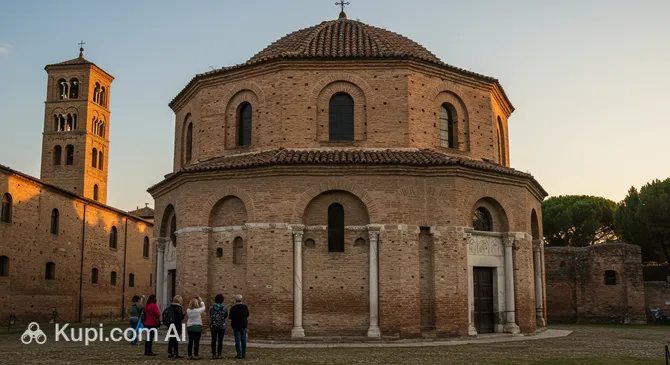
When exploring the historical heart of Ravenna, you will certainly come across the Arian Baptistery — a compact but extraordinarily significant structure included in the UNESCO World Heritage list. This octagonal red-brick building was constructed at the turn of the 5th and 6th centuries by order of the Ostrogothic King Theodoric the Great. Today, it is recognized as one of the most important monuments in Italy, preserving unique features of the Arian period.
Traveler photos:
Externally, the baptistery looks austere and, over the centuries of its existence, has partially "sunk" into the ground, sitting almost 2.5 meters below the modern street level. It was once part of a large religious complex and was connected by a corridor to the neighboring Church of the Holy Spirit. The main treasure is hidden inside: the ceiling of the dome is decorated with a magnificent mosaic depicting the scene of the Baptism of Christ surrounded by the twelve apostles.
This site is of interest not only for its architecture but also for its theological subtext. The mosaics of the Arian Baptistery reflect the specific views of that era on the nature of Christ, making it a rare testament to the religious disputes of early Christianity. It is a must-visit for anyone who appreciates Byzantine art and the quiet, authentic atmosphere of ancient cities.