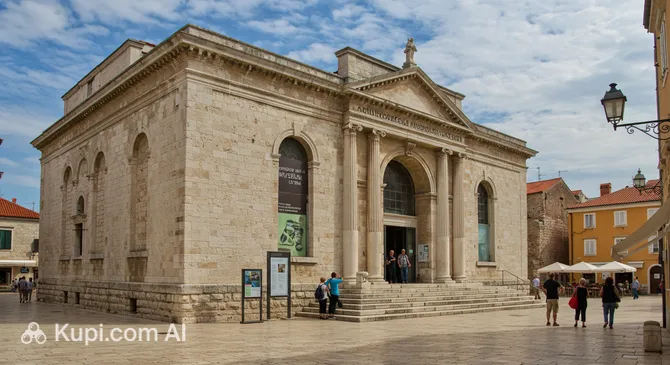
Did you know that in the heart of the Adriatic lies a treasure house holding over a hundred thousand artifacts? The Archaeological Museum of Zadar is a place where time seems to stand still, allowing visitors to Zadar to touch history spanning from the Stone Age to the early Middle Ages. It is one of the oldest and most significant museums that modern Croatia takes pride in.
Archaeological Museum Zadar. Illustration.
Source: Kupi.com AI
Traveler photos:
The museum is located in a stylish modern building opposite the St. Mary's Monastery complex. Its exhibition is masterfully distributed over three levels, each dedicated to a specific era. Here, you can see not only household items and jewelry of ancient peoples but also monumental architectural fragments displayed outdoors on the territory of the ancient Roman Forum.
The museum's status as one of Dalmatia's key cultural sites is confirmed by the uniqueness of its collections. The Roman sculpture collections and rare finds recovered from the seabed during underwater archaeological expeditions invariably attract special attention from tourists. This is a must-visit spot on the map for anyone wanting to understand the origins of European civilization in this region.
Contacts
For information about special exhibitions or organizing group tours, you can contact the museum administration directly.
A visit to the museum offers a fascinating journey through the centuries, starting from the top floor where the prehistoric collection is presented. Here you can admire exquisite Neolithic pottery and massive Bronze Age weapons. Of particular interest is the jewelry of the Liburnians, whose metalworking craftsmanship is still impressive thousands of years later.
Moving down, you will find yourself in the world of antiquity. Be sure to pay attention to the Roman glass collection — it is considered one of the best in Europe. Looking at the statues of Roman emperors and detailed models of early Christian basilicas, it is easy to imagine the bustling life in these lands during the Roman Empire. Don't forget to check out the underwater archaeology hall, which displays items that rested in the depths of the sea for centuries.
On the first floor, evidence of the early Middle Ages awaits you. Artifacts related to the Byzantine period and the birth of the Croatian state are presented here. It is recommended to conclude your tour with a walk through the adjacent forum, where lapidary monuments — stone slabs with inscriptions telling stories of long-gone heroes — are displayed among ancient stones and columns.
Getting There
Finding this cultural center is easy, as it is located in the very heart of the historical peninsula of Zadar. The museum is situated at Trg opatice Čike 1, in close proximity to St. Mary's Monastery and the famous Roman Forum. If you are already walking through the Old Town, the walk from the Sea Organ or the Church of St. Donatus will take no more than 5–10 minutes at a leisurely pace.
For those coming from more distant areas or the airport, it is most convenient to use a taxi or public transport. Buses arrive at the main bus station (Zadar Autobusni Kolodvor), from where you can walk to the museum in about 15–20 minutes while enjoying views of the city walls. If you are traveling by car, keep in mind that parking in the Old Town is limited, so it is best to leave your car at one of the paid parking lots at the entrance to the historical district.
Nearest city: Zadar
History & Facts
Founded back in 1832, this museum is one of the oldest research and cultural institutions in Dalmatia. It began its rich history just ten years after the opening of a similar museum in Split, making it the second oldest in the region. For a long time, the Zadar exhibitions were housed within the walls of the Church of St. Donatus, and it was only in the mid-20th century that the museum moved to the modern building where it remains today.
The museum's collections are a living chronicle of the region. They house evidence from the era of the Liburnians — an Illyrian people who inhabited these lands before the arrival of the Romans. In the halls dedicated to antiquity, you can see unique artifacts from the Roman military camp Burnum and magnificent glassware that has preserved its fragile beauty over millennia. A special place is held by monumental sculptures of emperors found during excavations in the town of Nin.
The medieval period is represented just as vividly: exhibits from the 8th to 11th centuries illustrate the time of the formation of the Croatian state. The museum is constantly updated with new finds thanks to active archaeological research conducted both on land and underwater, revealing the secrets of sunken ships and ancient ports of northern Dalmatia to researchers.
Time Needed
To leisurely explore the three floors of the main exhibition and view the artifacts in the open area of the forum, most visitors need between 1.5 to 2 hours. This time is sufficient to appreciate the main masterpieces of ancient sculpture and the ancient glass collection.
If you are a true history buff or plan to study the explanatory materials in detail and use an audio guide, it is better to allocate about 2.5 hours for the visit. The museum is quite compact, but the high concentration of interesting details often makes visitors stay at the displays longer than initially planned.
Working Hours
When planning your visit, please note that the museum follows a morning schedule. The institution's doors are open to visitors from Monday to Friday, from 9:00 to 14:00.
The museum is closed on Saturday and Sunday, so it is better to dedicate the weekends to exploring open-air architectural monuments. It is recommended to arrive no later than an hour before closing to have time to see all the halls without rushing.
Day
Working hours
Monday
9:00 – 14:00
Tuesday
9:00 – 14:00
Wednesday
9:00 – 14:00
Thursday
9:00 – 14:00
Friday
9:00 – 14:00
Saturday
Closed
Sunday
Closed
Nearby
The museum's location in the historical core allows tourists to create a rich walking itinerary without spending much time on travel. Just a few steps from the entrance, views of ancient ruins and architectural monuments from different eras open up.
Exploring the surroundings will help you deeper feel the atmosphere of the ancient city, where antique columns stand alongside modern art installations.