Support

Ragione Palace

About

The Palazzo della Ragione is a magnificent architectural monument and a symbol of civic power that Padua takes great pride in. Located in the heart of the historical center, this majestic palace separates the city's two main market squares. The building is recognized as a UNESCO World Heritage site and is considered one of the most significant attractions that Italy has to offer history enthusiasts.
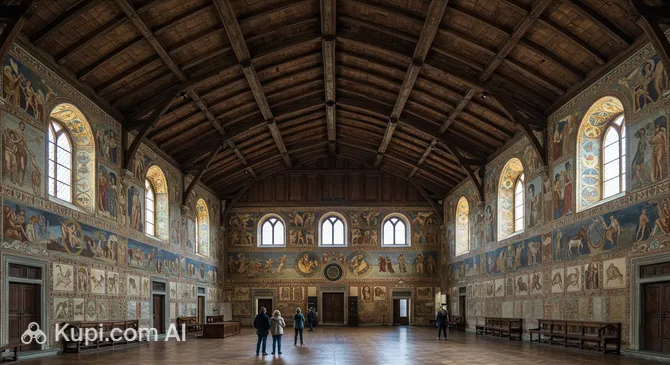
Palazzo della Ragione
Palazzo della Ragione. Иллюстрация. Источник: Kupi.com AI

The main feature of the palace is its upper hall, "Il Salone," which for centuries remained one of the largest indoor spaces in Europe built without intermediate support columns. The impressive roof, shaped like an inverted ship's hull and three tiers of elegant loggias give the building a unique and easily recognizable silhouette. Inside, the walls are decorated with a massive cycle of 333 frescoes dedicated to astrology, religious themes, and the everyday life of medieval citizens.

Today, it is not just a museum but a living space where history meets modernity. The lower floors of the palace are still occupied by colorful food stalls, continuing a trading tradition that dates back to the 12th century. A visit to the Palazzo della Ragione allows you not only to touch the great art of the Renaissance but also to feel the authentic rhythm of life in an ancient Italian city.

Contacts

For the latest information on exhibitions or potential schedule changes, you can contact the palace administration directly. The city's culture office is ready to provide detailed information for organized groups and individual travelers.

Below are the main contact details for communication and navigation:

How to contactContact
AddressPiazza delle Erbe, 35100 Padova PD, Italy
Phone+39 049 820 5006
Websitewww.padovanet.it

What to Do

First, it is worth heading up to the vast main hall, where the scale of the space and the abundance of color are breathtaking. Here, you can spend hours examining the 15th-century astrological frescoes: pay attention to the depictions of zodiac signs and scenes of seasonal work, which provide insight into the daily lives of the ancestors of the people who inhabit Padua. The focus is also on the massive wooden statue of the "Trojan Horse" and the famous Foucault pendulum, located above the mysterious Stone of Dishonor.

Be sure to step out onto the palace's open loggias and terraces. From the height of the galleries, there is a magnificent view of Piazza delle Erbe and Piazza dei Signori, where life never stands still. It is an ideal spot for photographs, allowing you to see the details of the facades of neighboring historic buildings and the corner towers of the palace itself.

After descending, immerse yourself in the atmosphere of the ancient market. A walk between the stalls, smelling of fresh herbs, cheeses, and truffles, will be the perfect end to your visit. Here, you can not only buy local products but also have lunch in one of the small eateries, experiencing the true taste of the Veneto region.

Getting There

The famous palace is located in the very heart of the historical center that Padua is so proud of. If you are arriving from Venice airport, it is most convenient to take the train — the journey to the Padova station takes about 30–40 minutes. From the railway station, you can reach Piazza delle Erbe on foot in 15–20 minutes, enjoying the architecture of the ancient streets.

Within the city, the public transport system is well-developed. The modern Sir1 tram runs from the station to the center; you should get off at the Piazza Garibaldi or Prato della Valle stops, after which it’s just a few minutes' walk. You can also use a taxi, and the ride from the station will take no more than 10 minutes.

Since the central part of the city is a limited traffic zone, travelers arriving by car are recommended to leave their vehicles in paid parking lots outside the historical core. Walking is the best way to experience the atmosphere of this place, especially since the walk from other iconic sites, such as the Scrovegni Chapel, takes only about 5 minutes.

Ближайший город: Padua

History & Facts

The history of this grand structure began back in 1172, when the foundation for the city court building was laid on the site of a former municipality. In its original form, the building consisted of three separate rooms. However, in 1306, the Augustinian monk Giovanni degli Eremitani radically changed the building's appearance: he added the upper floor and unified the space under a unique wooden roof resembling an inverted ship's hull.

In the early 14th century, the walls of the main hall were decorated with a cycle of frescoes on astrological themes, the concept of which was developed by the philosopher and physician Pietro d'Abano. It is believed that Giotto himself had a hand in their creation. Unfortunately, the original paintings were lost during a devastating fire in 1420. Nevertheless, by 1440, the frescoes were painstakingly restored, and Venetian masters under the guidance of Bartolomeo Rizzo finally turned the three halls into the single space that Padua prizes so highly today.

The architectural appearance of the palace's exterior also underwent changes. In the 19th century, the facade facing Piazza delle Erbe was reconstructed in the Neoclassical style, adding a sense of austerity and grandeur to the building. Special attention should be paid to the Lamberti Tower and the corner towers, which served as symbols of the city's power and independence for centuries.

Interestingly, the Palazzo della Ragione has never lost its connection to commercial life. From the 12th century to the present day, the first floors of the building have been occupied by market stalls. This is a rare example of a medieval civic building that has preserved its original function and atmosphere for nearly nine centuries, which is why it was included in the UNESCO World Heritage list.

Time Needed

To unhurriedly tour the palace interiors and appreciate the scale of its architecture, most travelers need about 1–1.5 hours. This time is quite sufficient to study the frescoes in the main hall in detail, examine the historical exhibits, and observe the movement of Foucault's pendulum.

If you also plan to walk along the loggias, take panoramic photos of the squares, and browse the market stalls on the lower level, it's worth setting aside a bit more time. A visit to the Palazzo is often combined with lunch or coffee in one of the adjacent squares, turning the tour into a pleasant two-hour stroll through the heart of the city.

Working Hours

When planning your visit to the Palazzo della Ragione, please take note of the opening hours. The palace is open to visitors from Tuesday to Sunday, with Monday traditionally being a closing day.

Opening Hours:
• Tuesday – Sunday: 9:00 AM – 6:30 PM
• Monday: Closed

It is recommended to arrive an hour before closing to have enough time to quietly explore all the halls and loggias. During holidays, opening hours may change, so it is worth checking the information in advance.

DayWorking hours
ПонедельникЗакрыто
Вторник9:00 – 18:30
Среда9:00 – 18:30
Четверг9:00 – 18:30
Пятница9:00 – 18:30
Суббота9:00 – 18:30
Воскресенье9:00 – 18:30

Nearby

The location of Palazzo della Ragione within the "golden triangle" of Padua's squares makes it an ideal starting point for further exploration of the city. A walk through the surrounding neighborhoods will allow you to see both luxurious Renaissance palaces and the cozy corners of the old ghetto.

Exploring nearby attractions will help you gain a deeper understanding of the region's cultural context and enjoy the variety of architectural styles from the Middle Ages to the present day.

NameDistance
Piazza della Frutta0 km
Piazza dei Signori0.1 km
Jewish Ghetto of Padua0.1 km
All'Ombra Della Piazza0.1 km
Palazzo Bo0.2 km
Clock Tower0.2 km
Pedrocchi Café0.2 km

Reached the end of the page?

That means the route is fully explored