Support

Eremitani Museums

About

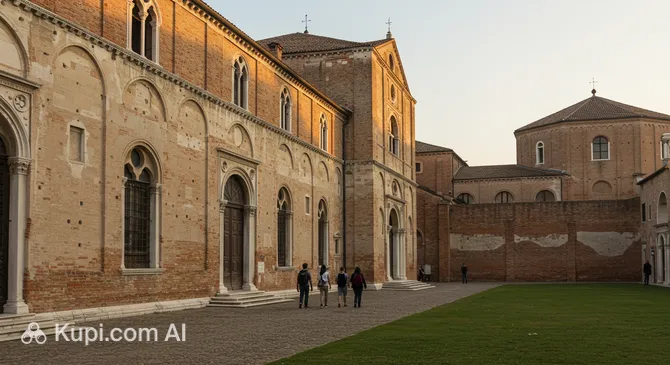
If you are looking for the cultural heart of the city, the Eremitani Museums are an absolute must-see. Located in charming Padua, this vast complex is considered the oldest in the Veneto region. It occupies a former Augustinian monastery and sits harmoniously alongside the majestic ruins of an ancient Roman amphitheater—a reminder of the centuries-old history that Italy is so proud of.
Eremitani Museums
Eremitani Museums. Иллюстрация. Источник: Kupi.com AI

Today, it's not just a single museum but a whole constellation of cultural venues united by a common courtyard. The complex includes the rich Archaeological Museum and the Museum of Medieval and Modern Art, offering guests a journey through time—from prehistoric eras to 19th-century artistic masterpieces.

The modern appearance of the halls is the result of careful restoration by renowned architects Franco Albini and Franca Helg. Thanks to their work, the historical walls of the monastery have been transformed into a high-tech and comfortable space where every exhibit tells its own unique story.

Contacts

For your convenience, we have gathered the essential contact information to help you easily find the Eremitani Museums and plan your visit. Below are the current details, including the address and the official website of the complex.

How to contactContact
AddressPiazza Eremitani, 8, 35121 Padova PD, Italy
Phone+39 049 820 4551
Websitepadovacultura.padovanet.it

What to Do

In the halls of the Museum of Medieval and Modern Art, a magnificent picture gallery awaits you. It houses about 3,000 paintings, including works by great Venetian masters such as Titian, Tintoretto, Veronese, and Giorgione. This is a rare opportunity to trace the evolution of Venetian painting across five centuries in one place.

History enthusiasts should pay special attention to the Archaeological Museum. Its collections include unique finds from the Paleo-Venetian period, including famous painted vases and steles from necropolises dating from the 8th to 3rd centuries BC. The Roman section of the exhibition is impressive with its monumental funerary monuments, mosaics, and delicate bronze figurines found within the region.

Don't forget to head up to the second floor to see the Bottacin Museum, which features one of Europe's most significant numismatic collections, donated to the city by merchant Nicola Bottacin. And if your historical journey continues at the famous Caffè Pedrocchi, you can visit the Museum of the Risorgimento (part of the complex), which tells the story of the struggle for independence through unique archival documents and newsreels.

Getting There

Finding the complex is very easy, as it is located in the heart of historic Padua at Piazza Eremitani, 8. The museums are within walking distance of most central squares and adjacent to the famous Eremitani Church and the picturesque ruins of the ancient Roman arena.

If you are further from the center, it is most convenient to use a taxi or local public transport. From the Padua railway station, you can reach the museum entrance on foot in just 10–15 minutes by heading toward the center. Look for signs for the Cappella degli Scrovegni, as the museum entrance is located in almost the same place.

For those who prefer detailed planning, it is useful to know the coordinates: 45.4110486° N and 11.8797297° E. You can always get an up-to-date map of bus and tram routes passing through the historic part of the city at the tourist information center.

Ближайший город: Padua

History & Facts

The history of this place began long before the museum opened. The building itself was erected as an Augustinian Hermits' monastery between 1260 and 1276. The hermit monks arrived in the city back in 1237, and their cloister soon became an important spiritual and educational center, maintaining its significance for many centuries.

The formation of the museum's funds is equally fascinating. The foundation was built from the treasures of suppressed monasteries and valuable private donations. The oldest core of the collection emerged in 1784 when, after the abolition of the San Giovanni di Verdara monastery, its artistic treasures were transferred to the municipality. Interestingly, in 1825, the first lapidary exhibition was solemnly inaugurated by Austrian Emperor Franz I.

The museum complex experienced a rebirth in the 20th century. Following extensive work to restore and adapt the ancient premises for modern needs, the renovated Eremitani Museums opened their doors to the public in 1985. The reconstruction project, carried out by famous architects Franco Albini and Franca Helg, allowed for the unification of disparate collections into a single, harmonious space.

Time Needed

When planning your walk through the complex, consider its scale. For a brief introduction to the main painting masterpieces and key archaeological artifacts, you will need at least 2–3 hours. This time is enough to get a feel for the atmosphere and see the key exhibits in all the main sections.

If you are a true art or history connoisseur and want to study every stele in the archaeological department and examine all the numismatic rarities in the Bottacin collection in detail, it is better to set aside half a day (3–4 hours). A relaxed pace will allow you to enjoy the works of the great Venetians without rushing and observe the smallest details of the Roman mosaics.

Working Hours

The doors of the museum complex are open to guests daily, making it convenient for tourists with any schedule. The operating hours are stable: from Monday to Sunday inclusive, the museum welcomes visitors from 9:00 to 19:00.

Given that exploring the extensive collection takes considerable time, we recommend arriving no later than an hour and a half to two hours before closing, so you have time to walk through the main halls before the complex closes for the day.

9:00 – 19:00

Nearby

A walk around the Eremitani Museums is an excellent opportunity to see many other iconic sites in Padua without essentially leaving the historic center. The proximity of key sites allows for a very full itinerary, where every turn of the street reveals a new page of history.

NameDistance
Museum of Nature and Humankind0.1 km
Scrovegni Chapel0.1 km
Altinate San Gaetano Cultural Center0.3 km
Pedrocchi Café0.4 km
Palazzo Bo0.5 km
Piazza della Frutta0.5 km
Palazzo della Ragione0.5 km

Reached the end of the page?

That means the route is fully explored