Support

Abbazia di Santa Giustina

About

Located in the heart of the ancient city of Padua, the majestic Basilica of Saint Justina (Abbazia di Santa Giustina) is one of the most significant religious complexes that Italy takes pride in. This active Benedictine abbey, whose history dates back to ancient times, is striking in its scale and ranks among the largest Christian churches in the world.
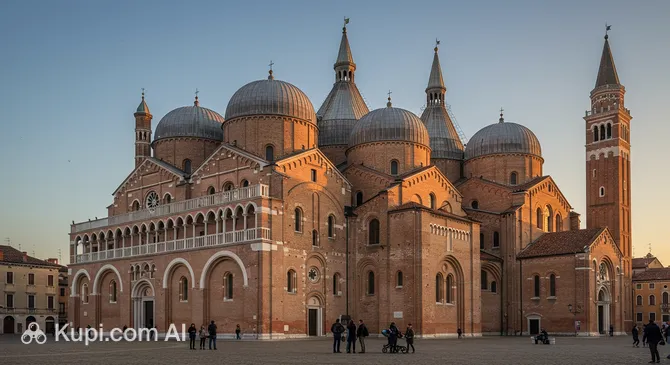
Basilica of Saint Justina
Basilica of Saint Justina. Иллюстрация. Источник: Kupi.com AI

The architectural appearance of the basilica is unique: its building, nearly 119 meters long, is crowned with eight lead-covered domes, with the central dome reaching a height of 70 meters. The cathedral's facade rises impressively over the spacious Prato della Valle square, creating a harmonious and recognizable ensemble. Inside, visitors will find a restrained yet solemn space in the shape of a Latin cross, filled with light and silence.

The church's interiors are of particular value, where 17th-century geometric marble floors are combined with ancient relics. The relics of saints and apostles are kept here, and the complex itself is not just a museum of architecture but also an important spiritual center where Benedictine monastic traditions are still maintained today.

Contacts

To ensure your trip is as comfortable as possible, we recommend checking the contact information for this spiritual center in advance. Official details will help you find your way and contact abbey representatives if needed.

Below is the primary contact information for communication and navigation:

How to contactContact
AddressVia Giuseppe Ferrari, 2/A, 35123 Padova PD, Italy
Phone+39 049 822 0411
Websitewww.abbaziasantagiustina.org

What to Do

Inside the basilica, the first thing to note is the sheer scale of the interior: 26 massive pillars support the majestic vaults, creating a sense of incredible space. As you walk through the temple, be sure to look down — the floor, made of yellow, white, and red marble, is a true work of art, inlaid with fragments from even older structures.

One of the most powerful experiences is visiting the Corridor of Martyrs. This path leads to the sanctuary of Saint Prosdocimus, the city's first bishop. Here you can see a unique 6th-century Greek iconostasis and Roman sarcophagi that have been carefully preserved for centuries. In the main chapel of the presbytery, don't forget to examine the magnificent 17th-century altar and the masterfully crafted wooden choir stalls.

For those seeking peace, the Basilica of Saint Justina offers ideal conditions for quiet contemplation and prayer. The strict classical style with Baroque elements does not distract from the spiritual, and the presence of Benedictine monks fills the place with a special energy. After exploring the interior, it is pleasant to stroll through the monastery gardens or step out onto the square to appreciate the grandeur of the facade from the outside.

Getting There

The Basilica of Saint Justina is located in the very heart of the city at Via Giuseppe Ferrari, 2/A, directly adjacent to the famous Prato della Valle square. If you are already in the historic center, a stroll from the Piazza delle Erbe or the Scrovegni Chapel will take no more than 15–20 minutes at a leisurely pace through picturesque streets.

From the main railway station, Padova Centrale, the church can be reached quickly by public transport. Bus lines 3, 12, 18, 22, and many others (including AE1) stop at Prato della Valle. It is also convenient to use the SIR1 city tram, which will take you almost to the very entrance of the abbey in just a few minutes.

For travelers arriving by car, please note that the basilica is located in a Limited Traffic Zone (ZTL). Paid parking spaces are available around Prato della Valle, but they are often occupied. If you are driving from Venice or Verona via the A4 motorway, it is more convenient to leave your car at one of the park-and-ride lots and use public transport or a taxi to avoid navigation difficulties in the center.

Ближайший город: Padua

History & Facts

The history of this sacred site began as early as the 5th–6th centuries, when Prefect Opilio erected the first church over the burial site of Saint Justina of Padua. The young martyr was executed in the 4th century, and her grave quickly became a pilgrimage site. Even in those distant times, contemporaries described the Basilica Opilionea as a magnificent structure adorned with precious marble and mosaics.

In 1117, a powerful earthquake practically wiped the building off the face of the earth, but the Benedictine community did not abandon the site. At the beginning of the 16th century, a decision was made to undertake a large-scale construction of a new complex, which lasted for nearly a hundred years. Outstanding masters of their time, such as Andrea Briosco and Andrea Moroni, worked on the project, creating one of the most impressive architectural ensembles of the Renaissance.

Interestingly, it was within these walls in the 15th century that an important church reform by Abbot Ludovico Barbo originated, leading to the creation of the Cassinese Congregation. Although the monastery was plundered and used as a military hospital during Napoleonic times, the basilica retained its spiritual power. In 1909, Pope Pius X granted it the honorary status of a minor basilica, highlighting its enduring significance for the Christian world.

Time Needed

To explore the majestic interiors of the basilica, study the ancient chapels, and walk through the famous Corridor of Martyrs without rushing, the average tourist will need about 1.5–2 hours. This is plenty of time to soak in the atmosphere and appreciate the skill of Italian architects and sculptors.

If you plan to visit the shrine of Saint Prosdocimus, stay for prayer, or join one of the rare tours occasionally conducted by Benedictine monks, we recommend setting aside up to 2.5 hours. Don't forget to also allow an extra 30–40 minutes for a walk around the adjacent Prato della Valle square, which is an outstanding landmark for sightseeing and photography in its own right.

Working Hours

The Basilica of Saint Justina is open to visitors daily; however, its schedule includes a midday break, which is typical for many Italian churches. You can visit the sanctuary in the morning from 7:30 to 12:00 or in the afternoon from 15:00 to 18:00.

This schedule applies to all days of the week, including Saturdays and Sundays. Nevertheless, tourists should take into account that access to certain chapels may be restricted during festive Masses or special services, so it is best to choose a time between services for a detailed tour.

7:30 – 12:00, 3:00 – 18:00

Nearby

The Basilica of Saint Justina is situated in an area with an incredible concentration of historical and cultural monuments. A stroll through the surroundings will allow you to see Padua in all its diversity: from grand squares to the cozy quarters of the old city.

Below are the most interesting sites located within walking distance of the church:

NameDistance
Prato della Valle0.3 km
Equestrian Statue of Gattamelata0.6 km
Basilica of Saint Anthony of Padua0.6 km
Birreria Da Carre0.6 km
San Leopoldo Mandic Sanctuary0.8 km
Otium Bar Restaurant Pizzeria Lunch Café0.9 km
Museum of the History of Medicine in Padua1 km

Reached the end of the page?

That means the route is fully explored