Support

Basilica di Sant'Apollinare Nuovo

About

The Basilica of Sant'Apollinare Nuovo is an outstanding masterpiece of Early Christian architecture located in the ancient city of Ravenna. Built at the turn of the 5th and 6th centuries by order of the Ostrogoth King Theodoric the Great, it originally served as his palatine chapel and still impresses today with the grandeur of its design.
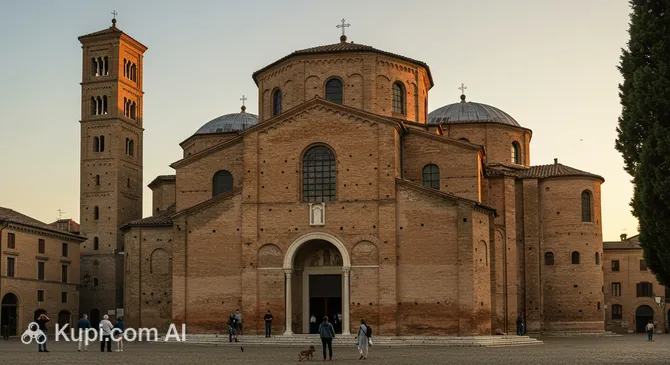
Basilica of Sant
Basilica of Sant'Apollinare Nuovo. Иллюстрация. Источник: Kupi.com AI

The primary value of the basilica lies in its magnificent mosaics, which are considered some of the most significant examples of Byzantine art in the world. Since 1996, the temple has been included in the UNESCO World Heritage List, being an integral part of the cultural wealth preserved by Italy.

The building's architectural ensemble stands out for its austere harmony and its famous cylindrical campanile (bell tower). Inside, visitors are greeted by a spacious nave whose walls are adorned with shimmering gold images depicting biblical events and patron saints.

Contacts

To plan your visit to this architectural masterpiece, it is helpful to check the contact details in advance. Below is the up-to-date information to help you easily locate the temple and contact the museum complex administration for any visit details.

How to contactContact
AddressVia di Roma, 53, 48121 Ravenna RA, Italy
Phone+39 0544 541688
Websitewww.ravennamosaici.it

What to Do

A visit to the basilica offers a rare opportunity to witness the evolution of Christian art with your own eyes. The main focus should be on examining the mosaic cycles on the walls of the central nave. Here, you will see majestic processions of martyrs and virgins, as well as detailed scenes from the earthly life of the Savior, preserved in remarkably good condition.

As you stroll slowly along the colonnades, notice the contrast between the early Ostrogothic and the later Byzantine decorative elements. This place literally breathes history, allowing the modern traveler to feel the spiritual atmosphere of the early centuries. Be sure to examine the architectural details, including the elegant column capitals and the famous round bell tower, which has become one of the symbols of the city.

Getting There

Finding this cultural heritage site is quite easy, as it is located in the historic center that Ravenna is famous for. If you are arriving from other major Italian centers like Bologna or Florence, the most convenient way is to use rail transport.

From the railway station, the building at Via di Roma, 53 is just a 10–15 minute leisurely stroll away. The route takes you through the picturesque streets of the old town, where clear signs to the main UNESCO monuments are posted everywhere.

For those who prefer comfort, taxis are always available at the station and in the city center. You can also use local bus routes that stop in the immediate vicinity of the attraction.

Ближайший город: Ravenna

History & Facts

The history of the temple began over 1,500 years ago when Theodoric the Great ordered the construction of a church next to his royal palace. Originally, it served as the court Arian cathedral and was dedicated to Christ the Redeemer. However, after the Byzantines reconquered these lands in the 6th century, Emperor Justinian I ordered the building to be handed over to the Orthodox community.

In 561, the basilica was re-consecrated in honor of Saint Martin of Tours, a well-known foe of heresies. Interestingly, part of the original mosaics depicting Theodoric's court were altered for religious reasons. Today, on some columns, you can still spot faint outlines of hands—remnants of the "erased" figures of Ostrogothic nobility, replaced by images of curtains.

The church received its current name, Sant'Apollinare Nuovo, only in the 9th century. In 856, due to frequent pirate raids, the relics of Saint Apollinaris, the city's first bishop, were moved here from the suburban church in Classe. The suffix "Nuovo" ("New") was added to distinguish it from an older church with the same dedication.

Time Needed

To fully appreciate the beauty of the interiors and study the unique mosaic panels in detail, most tourists need about 1 to 1.5 hours. This is usually enough time for a calm exploration of the central nave and getting acquainted with the architectural details.

If you are a fan of art history or Byzantine iconography, it is worth setting aside a bit more time to study the symbolism of the mosaics. Don't forget to linger outside for a moment to admire the elegant cylindrical campanile and the harmonious facade of the building.

Working Hours

The doors of the basilica are open to visitors daily, making it easy to include in any sightseeing itinerary. The opening hours remain consistent throughout the week, providing access to these mosaic masterpieces on both weekdays and weekends.

The site is open from 9:00 AM to 6:30 PM. It is recommended to plan your visit for the morning or an hour before closing to ensure you have enough time for a peaceful contemplation of the interiors.

9:00 – 18:30

Nearby

A walk around the basilica's surroundings will allow you to immerse yourself deeper into the atmosphere of the past that Ravenna carefully preserves. Many other iconic sites that form the city's unique historical landscape are located nearby.

After admiring the famous mosaics, be sure to check out the neighboring architectural monuments and museums, many of which are within walking distance.

NameDistance
Basilica of San Giovanni Evangelista0.2 km
Dante's Tomb0.3 km
Grinder Coffee Lab0.3 km
MAR - Ravenna Art Museum0.3 km
Arian Baptistery0.3 km
Public Gardens of Ravenna0.4 km
Piazza del Popolo0.5 km

Reached the end of the page?

That means the route is fully explored