Support

Natural History Museum Rijeka

About

In the heart of the lush Nikola Host Park, within the walls of Count Nagroni's historic mansion, lies the Natural History Museum of Rijeka. It is the first regional museum in this part of the country and one of the oldest scientific institutions that Croatia takes pride in. The museum harmoniously combines the spirit of classical science with modern multimedia technologies.

Today, Rijeka offers its guests a unique opportunity to see more than 3 million exhibits. The collection covers various fields—from zoology and botany to geology. Special attention is given to marine flora and fauna, reflecting the city's inseparable link with the Adriatic Sea.
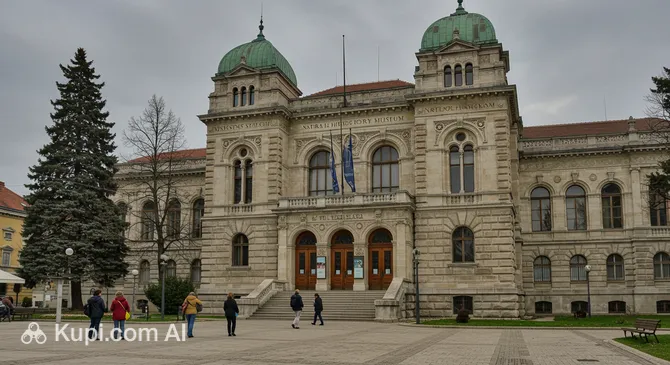
Natural History Museum Rijeka
Natural History Museum Rijeka. Иллюстрация. Источник: Kupi.com AI

The museum's significance is underscored not only by its age but also by its modern approach to exhibitions. It serves as an important center for marine research and houses a specialized library, attracting both curious tourists and serious scientists from around the world.

Contacts

To plan your visit to the Natural History Museum of Rijeka, please use the following contact information:

How to contactContact
AddressLorenzov pro. 1, 51000, Rijeka, Croatia
Phone+385 51 553 669
Websitewww.prirodoslovni.com

What to Do

The main magnet for visitors is the halls dedicated to Adriatic life. Here, you can examine in detail a sperm whale skeleton—the largest such specimen ever found off the Croatian coast. Collections of sharks and rays allow you to meet the formidable inhabitants of the deep without going underwater.

The "Aquarium" multimedia center is of particular interest. It is a space where, with the help of interactive tablets and digital technologies, you can literally "peek" beneath the sea's surface. Here, nature comes to life, telling the story of invertebrate life and the minerals hidden on the ocean floor.

Don't forget to stop by the Botanical Garden surrounding the museum building. After viewing the geological and zoological exhibitions, a walk among exotic and local plants is a great way to end your visit. Here, you can also see collections of reptiles and amphibians that inhabit the city's surroundings.

Getting There

The museum is located in the central part of the city at Lorenzov pro. 1, nestled in the shady Nikola Host Park. The route from the city center is a pleasant walk; however, keep in mind that the building is situated on a hill among the winding streets of the old town, so be prepared for a bit of a climb up the stairs.

If you prefer public transport, most city bus routes pass through the central Korzo district, from where the museum is a 5–10 minute walk. You can also take a local taxi, which will drop you off right at the park entrance if you want to avoid the uphill walk.

For those traveling by private or rental car, it is worth noting that parking in the historic center can be limited. It is recommended to leave your car in one of the paid parking lots in the lower part of town and complete the journey on foot, soaking in the atmosphere of old Rijeka.

Ближайший город: Rijeka

History & Facts

The founding of the museum in 1876 was a major milestone for the region's cultural life. The initiative came from Professor Josef Lorenz, whose development program was supported by the city's mayor, Giovanni de Ciotta. At that time, the concept was based on the advanced standards of the Vienna Museum of Natural History, which was considered the benchmark for museum science in Europe.

For a long time, the collections were part of the City Museum, but after 1945, the institution gained independence and moved to its current building—the former home of Count Nagroni. Interestingly, until the 1960s, the museum grounds featured not only exhibition halls but also a zoo and aquarium, making it a favorite spot for family outings.

Since the 1960s, the museum has focused on serious scientific research. Particular attention is paid to paleontology and the study of underwater caves in the Vinodol Channel. Today, it is not just a repository of antiquities but an active center for marine research, boasting one of the richest specialized libraries in Croatia.

Time Needed

To leisurely explore all levels of the museum and get acquainted with its rich collections, an average tourist typically needs about 1.5–2 hours. This is enough time to visit the multimedia center, study the geological finds, and admire the Botanical Garden.

If you plan to study the interactive panels in the Aquarium in detail or are a passionate natural science enthusiast, your visit may extend to half a day. The museum is compact but packed with information, so it fits perfectly into a busy city sightseeing schedule.

Working Hours

The Natural History Museum of Rijeka is very convenient to visit thanks to its schedule. It is open to guests daily, from Monday to Sunday.

You can plan your visit at any convenient time from 9:00 AM to 8:00 PM. Such a long working day allows you to stop by even after the main city tours or at the end of the day.

9:00 – 20:00

Nearby

After discovering the riches of nature, it is worth taking some time to explore the city's architectural heritage. The area surrounding the museum is steeped in history, and many iconic landmarks are within walking distance, making it easy to put together a full walking itinerary.

A stroll through the neighborhood will help you better feel the spirit of Rijeka—from ancient Roman ruins to the industrial monuments of the past century.

NameDistance
Maritime and History Museum of the Croatian Coast0.1 km
Nikola Host Park0.1 km
PEEK&POKE Computer Museum0.2 km
St. Vitus Cathedral0.2 km
City Clock Tower0.3 km
Petar Kružić Stairway0.4 km
Youth Club Rijeka0.4 km

Reached the end of the page?

That means the route is fully explored