Support

Convent of San Domenico

About

If you find yourself in the charming city of Perugia, the Basilica of San Domenico will undoubtedly catch your eye. This majestic church in the heart of the city is not just a religious building, but one of the most important architectural monuments that Italy is proud of.
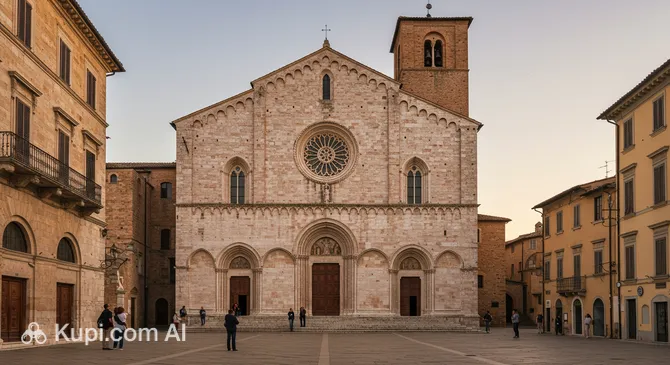
San Domenico Convent
San Domenico Convent. Иллюстрация. Источник: Kupi.com AI

The church, dedicated to Saint Dominic, founder of the Dominican Order, is a striking example of Gothic architecture. It stands out with its monumental facade and elegant Baroque staircase, while the interior hides a space in the shape of a Latin cross with three naves. One of the main jewels of the interior is the giant painted window in the apse—its dimensions (23 by 8.5 meters) make it one of the largest in the country.

The San Domenico monastic complex served as a model for other buildings in the region for a long time, including the famous San Lorenzo Cathedral. The combination of austere Gothic style and rich interior decoration makes it a must-see for history and art enthusiasts.

Contacts

To plan your visit to this architectural masterpiece, it is helpful to have current information on hand. The Basilica of San Domenico is an active religious site and is open to tourists.

How to contactContact
Address06121 Перуджа, Италия
Phone+39 075 572 4136
Websiteturismo.comune.perugia.it

What to Do

Inside the walls of the basilica, world-class masterpieces await visitors. Be sure to look up at the apse to see the painted window from 1411—the result of a collaboration between Bartolomeo di Pietro and Mariotto di Nardo. This is one of the largest stained-glass works in all of Europe, and it still impresses with its vibrant colors and delicate craftsmanship.

The individual chapels also deserve attention. In the Rosary Chapel, you will see an altar created by Agostino di Duccio in the mid-15th century, while the Chapel of Saint Catherine preserves unique 14th-century frescoes by Benedetto Binda. Don't forget to also examine the ancient wooden choir and the magnificent golden organ from 1660, which remains a source of pride for the church.

History buffs should find the tomb of Pope Benedict XI. This monumental memorial, dating back to 1304, is attributed to a pupil of the famous Arnolfo di Cambio and is considered a fundamental example of medieval funerary sculpture. In the left transept, you can also see the work "Pentecost" by the artist Suor Plautilla Nelli, dated 1554.

Getting There

The Basilica of San Domenico is conveniently located in the historic city center on Piazza Giordano Bruno. Since this part of the city is pedestrianized, a walk through the narrow medieval streets will be a pleasant addition to your visit. You can look for via del Castellano, which leads directly to the complex.

If you are coming from another part of town, it is most convenient to use public transport to the central stops or take a taxi to the edge of the pedestrian zone. From the city's main squares, the walk to the monastery takes only a few minutes at a leisurely pace—just follow the signs for "Basilica di San Domenico."

Ближайший город: Perugia

History & Facts

The history of this site dates back to 1304, when Pope Benedict XI handed over the parish church of St. Stephen to Dominican monks. The design for the new Gothic structure was developed by the renowned Giovanni Pisano, who drew inspiration from Northern European hall churches (hallenkirche). Although the church was consecrated by Pope Pius II in 1459, construction of the famous 126-meter bell tower continued until the end of the 15th century.

In the early 17th century, the building faced a major challenge: due to structural flaws, the vaults and supporting columns collapsed in 1614 and 1615. The restoration was undertaken by the famous Roman architect Carlo Maderno, whose style is recognizable in St. Peter's Basilica in the Vatican. It was he who redesigned the interior in the Baroque style, giving it a resemblance to the most important church in the Catholic world.

The current appearance of the church was finalized by 1632 after a second consecration. Although the facade retains its austere late 16th-century portal and grand staircase, the interior now bears the mark of lavish Baroque. Significant contributions to the preservation of the monument were made through restorations following damage sustained during World War II.

Time Needed

To leisurely explore the interiors, study the works of art in the chapels, and examine the details of the facade, it usually takes between 1 and 1.5 hours. This is quite enough time to soak up the atmosphere of the place and enjoy the silence of the ancient vaults.

If you plan to study every painting in detail or visit the monastery courtyards, you should set aside a little more time. A visit to the basilica fits easily into a busy itinerary through the historical center, leaving a wealth of impressions without the need for rushing.

Working Hours

The Basilica of San Domenico is open to visitors daily from Monday to Sunday. The church's doors are usually open in two sessions: from 07:00 to 12:00 in the morning and from 17:00 to 19:00 in the evening.

As this is an active church, the opening hours may be adjusted based on services or religious holidays. Before your visit, it is recommended to check the information on the city's official tourism portal.

07:00–12:00, 17:00–19:00

Nearby

A stroll around the San Domenico monastery allows you to discover many other iconic city sights. The concentration of historical monuments in this area is so high that a new discovery awaits you at literally every turn.

Exploring the nearby streets will significantly enrich your understanding of ancient architecture, as both ancient Etruscan sites and luxurious Renaissance palaces are within walking distance.

NameDistance
National Archaeological Museum of Umbria0 km
Palazzo della Penna Civic Museum0.2 km
Rocca Paolina0.3 km
Trattoria Oberdan Perugia0.3 km
Carducci Gardens0.3 km
Piazza IV Novembre0.6 km
Fontana Maggiore0.6 km

Reached the end of the page?

That means the route is fully explored