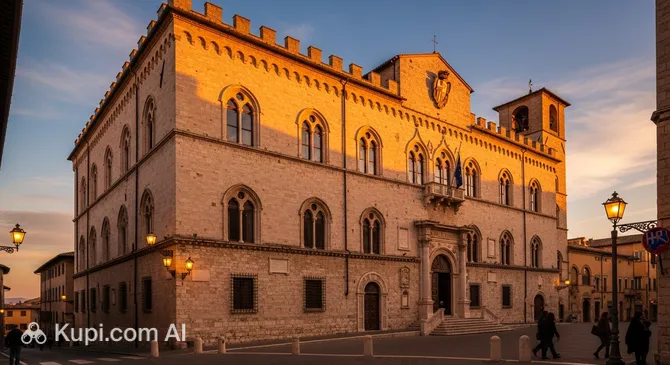
Located in the heart of the ancient city of Perugia, the Palazzo della Penna Civic Museum is a fascinating fusion of eras and styles. This cultural center, housed in a 16th-century aristocratic residence, is a must-visit for anyone traveling through Italy in search of authentic art. The museum is unique because it literally stands on the foundations of history: the ruins of an ancient Roman amphitheater are hidden beneath its halls.
Palazzo della Penna Civic Museum. Illustration.
Source: Kupi.com AI
Traveler photos:
Today, Palazzo della Penna serves as the city's headquarters for contemporary art. Here, magnificent 19th-century neoclassical frescoes coexist harmoniously with bold works by avant-garde masters. The building itself is an exhibit: its architectural appearance transitions smoothly from ancient stone to an elegant modernist spiral staircase.
The museum's significance is highlighted by its collections dedicated to Futurism and iconic 20th-century performances. It’s not just a gallery, but a living space hosting street culture exhibitions and contemporary photography, making it a vital link between Umbria's rich past and current global art trends.
Contacts
For information on special exhibitions or to book group tours, you can use the museum's official contact details.
When visiting the museum, be sure to devote time to the permanent collections that have made this place famous. The heart of the exhibition features works by Gerardo Dottori, one of the leading theorists of Aerofuturism. His dynamic, "flying" landscapes and sacred themes offer a glimpse into the world through the eyes of someone from the early 20th century, intoxicated by speed and new technologies.
The installation dedicated to Joseph Beuys is equally impressive. It houses unique materials and blackboards created by the artist during his historic meeting with Alberto Burri in 1980. Sculpture enthusiasts should look out for the "Hellens" by Brajo Fuso — vibrant polychrome figures that served as precursors to the Arte Povera movement.
Be sure to head down to the lower levels to see the Roman ruins, and then climb the famous spiral staircase to the halls decorated with frescoes of mythological scenes. Between exploring the art, you can stop by the cozy café or pick up a stylish souvenir at the bookshop, which features books on art history and photography.
Getting There
The Palazzo della Penna Civic Museum is located in the heart of the city at Via Prospero Podiani, 11. Finding it is easy: the building is situated at the foot of the famous Rocca Paolina fortress. If you are already exploring the historic center, the walk from San Lorenzo Cathedral or the Fontana Maggiore will take no more than 10–15 minutes.
For those using public transport, it is most convenient to take bus lines C, E, or H to the Piazza Italia or Piazza Partigiani stops. From there, it’s a short walk downhill. If you are arriving by car, we recommend leaving it at the Piazza Partigiani parking lot, where an escalator system will take you almost right to the museum's doors.
Travelers arriving from Umbria Airport should first get to Perugia Fontivegge station and then transfer to the futuristic Minimetrò, which will quickly take you to the central part of the city.
Nearest city: Perugia
History & Facts
The history of this site dates back to antiquity. The Palazzo della Penna was built on the ruins of the ancient Roman Marzio Amphitheater, which dates to the 1st century AD. In the museum's basement, you can still see fragments of ancient masonry and remains of a medieval road that became the foundation for the future aristocratic residence.
The palace itself acquired its grand features in the 16th century when it became the home of the noble Arcipreti della Penna family. Over the centuries, the building was expanded and decorated. In the early 19th century, the interiors were transformed thanks to Antonio Castelletti, who created exquisite neoclassical frescoes depicting the story of Paris, and Pasquale Angelini, who painted the famous "Hall of Landscapes."
The building was given a new lease on life in the 1970s when architect Franco Minissi designed a project to transform it into a museum. He masterfully combined historical halls with modern elements, adding the striking spiral staircase that today serves as a link between eras—from the ancient ruins in the basement to the avant-garde art on the upper floors.
Time Needed
For a standard visit to the main collection, including viewing the Futurist paintings and Roman ruins, you will need about 1.5–2 hours. This is enough time to walk through all levels of the palace and appreciate the craftsmanship of the neoclassical frescoes without rushing.
If you plan to explore temporary exhibitions in detail, browse the bookshop for rare art publications, or spend time over a cup of coffee in the local café, it’s worth setting aside about 2.5 hours for your visit.
Working Hours
The museum is open to visitors from Tuesday to Sunday. The doors are open from 10:00 AM to 6:00 PM without a break. Please note that the museum is closed on Mondays.
As operating hours may change during holidays or special cultural events, it is recommended to check for current information on the museum's official website before your visit.
Day
Working hours
Monday
Закрыто
Tuesday
10:00–18:00
Wednesday
10:00–18:00
Thursday
10:00–18:00
Friday
10:00–18:00
Saturday
10:00–18:00
Sunday
10:00–18:00
Nearby
Exploring the area around Palazzo della Penna is a great way to delve deeper into the atmosphere of ancient Perugia. The museum is located in a high concentration of historical monuments, allowing your cultural itinerary to be as rich and interesting as possible.
Most of the city's iconic landmarks are within walking distance, making it easy to combine a gallery visit with exploring medieval fortresses, grand cathedrals, and ancient arches.