Support

Palazzo dei Priori

About

In the heart of the city of Perugia stands the magnificent Palazzo dei Priori — one of the most majestic examples of civil Gothic architecture in all of Italy. This monumental palace, built between the 13th and 15th centuries, still impresses with its austere yet elegant appearance. Its facades, decorated with characteristic crenelations and pointed-arch windows, have become a true symbol of the former power and freedom of the Perugian commune.
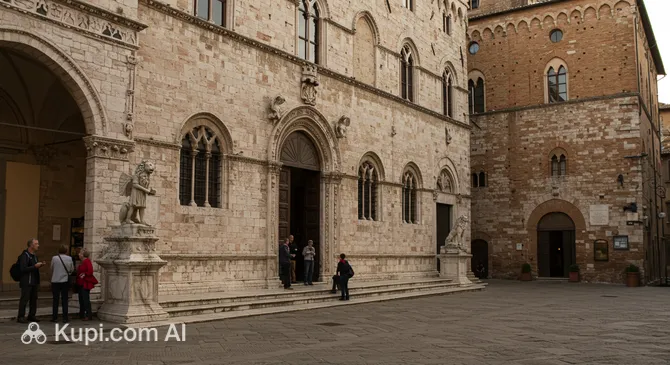
Palazzo dei Priori
Palazzo dei Priori. Иллюстрация. Источник: Kupi.com AI

The palace is notable for its unusual architecture, which evolved gradually as the city's holdings expanded. The main entrance from the square is crowned by a bronze griffin and lion — the city's patrons, guarding the peace of this historical site. Inside the palazzo, true treasures are hidden: from the opulent Hall of Notaries with its rich paintings to the rooms of the ancient guilds, which have preserved the spirit of medieval craftsmanship.

Today, Palazzo dei Priori plays a dual role: it remains the active seat of the municipality and simultaneously serves as a cultural center of world importance. It is here, on the upper floors, that the National Gallery of Umbria is located, transforming historical halls into a space where masterpieces of Italian art come to life, making the palace an essential stop for any lover of history and beauty.

Contacts

To check current information about special exhibitions or official events, we recommend contacting the museum complex administration directly.

How to contactContact
AddressPiazza IV Novembre, 06123 Perugia PG, Италия
Phone+39 075 577 2339
Websiteturismo.comune.perugia.it

What to Do

A visit to Palazzo dei Priori offers guests a deep immersion into the atmosphere of medieval governance and art. First, it is worth looking into the famous Sala dei Notari (Hall of Notaries), where the vaults are decorated with vibrant 14th-century frescoes. These depictions of mythological and biblical subjects create an amazing visual sequence, complemented by massive antique benches lined along the walls.

Equally interesting are the halls of the ancient guilds — the Collegio del Cambio (Bankers’ Guild) and the Collegio della Mercanzia (Merchants’ Guild). Here you can see incredible woodwork: inlaid panels and carved ceilings that are considered among the best in Europe. In the bankers' halls, be sure to notice the frescoes by Perugino, in which the master embodied allegories of virtues and images of ancient heroes.

Art lovers should head up to the National Gallery of Umbria. Its exhibition allows you to trace the development of the region's art from Byzantine traditions to the heights of the Renaissance. You can conclude your visit with a leisurely walk along the outer walls of the palace, examining the Gothic trifora windows and the massive staircase, which offers an excellent view of the main square and the Fontana Maggiore.

Getting There

Palazzo dei Priori is located in the heart of the historical center on Piazza IV Novembre, directly across from the famous Fontana Maggiore. This is a pedestrian zone, so the best way to reach the building is a pleasant walk through the city's ancient streets. If you are in the lower part of the city, take the unique Minimetrò to the Pincetto station, which is just a few minutes' walk from the square.

For those arriving by train at Fontivegge station, it is most convenient to take bus lines C, E, or H, which will bring you to the edge of the old city in 10–15 minutes. If you are traveling by car, it is recommended to leave it at one of the park-and-ride lots, such as Piazza Partigiani or Pian di Massiano, and take the escalators or elevators up to the center while enjoying views of the valley.

Taxis are also an available option, though keep in mind that access directly to the palace doors may be restricted due to the ZTL (Limited Traffic Zone) status. In any case, the palace's high tower, visible from many points in the city center, will always serve as your landmark.

Ближайший город: Perugia

History & Facts

The history of this grand structure began in 1293, when architects Jacopo di Servadio and Giovannello di Benvenuto started building the first part of the facade. Construction took place in stages over more than a hundred years, which explains its asymmetrical yet harmonious structure. The building was originally conceived as a symbol of the city's independence and a residence for the city magistrates.

In the 14th century, a striking staircase and a right wing were added to the palace, taking the place of an old church. Although the expansions occurred at different times, the master builders sought to maintain a unified Gothic style, using characteristic trifora windows and massive portals. Interestingly, during the period of papal rule, the palace underwent changes: the merlons, which symbolized secular power, were removed from its roof, and the interior rooms were remodeled to suit the needs of the new governors.

It was only after the unification of Italy in the 19th century that the building was returned to its medieval appearance, with lost decorative elements restored. Since 1878, the upper floors of the palace have housed the National Gallery of Umbria, transforming former administrative halls into a treasury of art. Today, every stone of this palazzo preserves the memory of great Renaissance masters and the political intrigues of the past.

Time Needed

To fully appreciate the building's architecture and tour the main halls, such as the Hall of Notaries and the guild rooms, most travelers will need about 1–1.5 hours. This is enough time to admire the frescoes and the intricate wood carvings that decorate the interiors.

However, if you plan to visit the National Gallery of Umbria located on the upper floors, you should allow at least 3 hours for your visit. The gallery's collection is extensive and includes masterpieces by Perugino and Pinturicchio that require careful study. Thus, a total visit to the complex can take an entire morning or afternoon.

Working Hours

To plan your visit, it is important to know that Palazzo dei Priori follows a specific schedule. On Mondays, the doors are open from 09:00 to 13:00 and from 15:00 to 19:00. Tuesday is the day off, when the museum halls are closed to visitors.

From Wednesday to Sunday, the palace operates as usual: in the morning from 09:00 to 13:00 and in the afternoon from 15:00 to 19:00. However, we recommend checking the official website before your visit, as opening hours may change on public holidays or during temporary exhibitions.

DayWorking hours
понедельник09:00–13:00, 15:00–19:00
вторникЗакрыто
среда09:00–13:00, 15:00–19:00
четверг09:00–13:00, 15:00–19:00
пятница09:00–13:00, 15:00–19:00
суббота09:00–13:00, 15:00–19:00
воскресенье09:00–13:00, 15:00–19:00

Nearby

Its location in the very center of the city makes Palazzo dei Priori an ideal starting point for further exploration of the region's rich heritage. The surrounding streets literally breathe history, offering a unique blend of Etruscan antiquity and medieval grandeur.

A stroll through the neighborhood will allow you to see both the city's main symbols and its hidden gems, located just a few steps from the main square. Exploring these sites will help you form a complete impression of the cultural landscape of this part of the country.

NameDistance
Piazza IV Novembre0 km
Fontana Maggiore0 km
National Gallery of Umbria0 km
Etruscan Well0.1 km
Caffè dal Perugino0.1 km
Cathedral of San Lorenzo0.1 km
Underground Perugia0.1 km

Reached the end of the page?

That means the route is fully explored