Support

Ipogeo dei Volumni e Necropoli del Palazzone

About

Imagine a journey through time, hidden underground in a picturesque region famous for its ancient heritage. The Hypogeum of the Volumni and the Palazzone Necropolis is one of the most significant archaeological finds that Perugia has to offer. This unique complex consists of an underground family tomb of the Etruscan Velimna clan, dating back to the 2nd century BC, and an extensive cemetery with hundreds of burials.
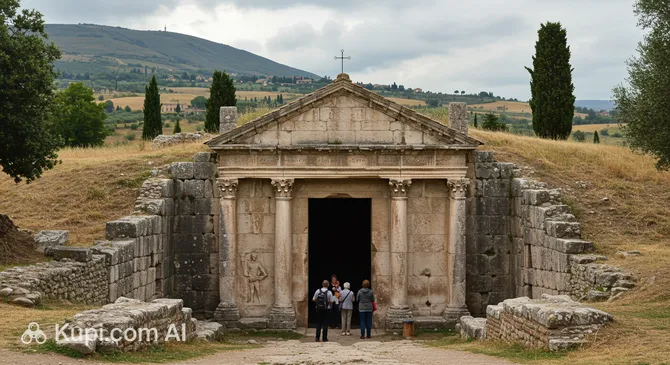
Hypogeum of the Volumnus Family and Palazzone Necropolis
Hypogeum of the Volumnus Family and Palazzone Necropolis. Иллюстрация. Источник: Kupi.com AI

The heart of this attraction in Italy is the hypogeo (underground tomb), whose interior layout masterfully imitates the structure of a classic aristocratic home. After descending a steep staircase, visitors enter a world of ancient rituals: ten rooms with intricate ceiling patterns and magnificent funerary urns, the highlight being the monumental urn of the family head, decorated with a sculptural depiction of a banquet.

In addition to the main tomb, the archaeological zone includes the Palazzone Necropolis — a true city of the dead carved into the rock. Here you can see about 200 stone tombs decorated with images of mythological creatures, griffins, and sea monsters. This site is not just a museum, but a rare opportunity to come into contact with the secrets of the great Etruscan civilization in its most majestic form.

Contacts

To confirm current information before your visit, you can use the official communication channels. It is recommended to check for special events or temporary exhibitions on the complex's website in advance.

Below are the main contact details for the administration of the archaeological zone:

How to contactContact
AddressVia Assisana, 53, 06126 Perugia PG, Италия
Phone+39 075 397969
Websitewww.musei.umbria.beniculturali.it

What to Do

Your introduction to the complex begins with a descent into the underground hypogeum via an ancient dromos — a long corridor with steps. Inside, you can examine in detail the urn of Arnt Velimna, surrounded by figures of Lasas — winged guardians of the underworld. Pay attention to the architectural details: the tomb's ceilings imitate the wooden beams of a residential house, creating the feeling of being a guest in an ancient aristocrat's home.

A walk through the open territory of the Palazzone Necropolis will reveal the scale of Etruscan burials. Although access to some tombs, such as the "Tomba Bella," may be restricted by protective screens, you will still be able to appreciate the skill of the ancient stone carvers. Be sure to visit the antiquarium — a small but informative museum displaying artifacts from everyday life: from household items to warriors' weapons, which help to better understand the social structure of this mysterious people.

Art lovers should carefully study the collection of urns before the entrance to the hypogeum. They preserve rare ancient paintings that are over two thousand years old. Images of griffins symbolizing Perugia, mythological subjects, and scenes of funerary banquets allow you to literally see the world through the eyes of people who lived long before us.

Getting There

The archaeological complex is located at Via Assisana, 53, in the Ponte San Giovanni district, approximately 5–7 kilometers southeast of the city center. Thanks to its proximity to major transport arteries, reaching it is quite straightforward.

If you are traveling by car, follow the SS75 highway from the center in the direction of Assisi. The trip will take about 10–15 minutes, and parking for visitors is provided near the entrance to the archaeological zone. You can also take a taxi from the main square or the railway station.

For those who prefer public transport, buses run from the city center (for example, from Piazza Partigiani) towards Ponte San Giovanni (line E007 and others). After getting off at the correct stop, you will need to walk for about 10–15 minutes along Via Assisana. Before your trip, it is advisable to check the current schedule on the website of the local carrier, Umbria Mobilità.

Ближайший город: Perugia

History & Facts

The story of this site's discovery reads like an adventure novel: in February 1840, during roadwork on Via Assisana, workers accidentally stumbled upon the entrance to the underground chamber. The excavations were led by archaeologist Giovan Battista Vermiglioli, and news of the sensational find quickly spread far beyond the region, attracting researchers from all over Europe.

The Hypogeum of the Volumni itself was built in the 2nd century BC as a family tomb for the wealthy Etruscan Velimna family (Volumni in Latin). The uniqueness of this site lies in the fact that it remained in use until the 1st century AD, clearly demonstrating the gradual transition of Etruscan culture under the influence of the Roman Empire. In the central hall lie the remains of Arnt Velimna, the head of the family, whose urn is a true masterpiece of ancient sculpture.

The Palazzone Necropolis, surrounding the main tomb, contains about 200 burials, most of which date back to the Hellenistic period. However, even older, archaic tombs from the 6th–5th centuries BC have been found here, testifying to the centuries-long use of this territory by the ancient inhabitants of the Tiber Valley.

Time Needed

To leisurely explore the underground hypogeum, walk the paths of the necropolis, and study the antiquarium's exhibits, it is recommended to set aside 1 to 2 hours for your visit. This is enough time to feel the ancient atmosphere and examine the details of the bas-reliefs.

If you have a deep interest in Etruscan history and plan to study each of the 200 tombs and the numerous painted urns in detail, the visit could last half a day. In any case, there is no need to rush — the peace and quiet of the archaeological zone invite thoughtful contemplation.

Working Hours

At this time, exact operating hours for the complex are not provided in official sources. Visits to archaeological zones in this region are usually possible in the morning, but the schedule may change depending on the season and ongoing restoration work.

We strongly recommend checking the current schedule on the official website or confirming the information by phone before your trip. Keep in mind that in many state museums in Italy, Monday is a closing day.

Nearby

A visit to the ancient necropolis is just one part of immersing yourself in the region's rich history. The surrounding area offers many other iconic sites that help complete the picture of this land's past.

A walk through the city center will allow you to see magnificent medieval and ancient monuments, located just a few kilometers from the archaeological zone.

NameDistance
La Nuit d’Or Bar Pasticceria0.1 km
Monterone Castle2.1 km
Abbey of San Pietro2.7 km
Frontone Gardens2.7 km
National Archaeological Museum of Umbria3.3 km
San Domenico Convent3.3 km
Level X553.5 km

Reached the end of the page?

That means the route is fully explored