Support

Palazzo Pubblico

About

Palazzo Pubblico is a majestic historic administrative building located in the heart of Siena, Italy, on the famous Piazza del Campo. It is an outstanding example of medieval Italian architecture, built from characteristic brick and decorated with white travertine, which gives it a particular monumentality and recognizable appearance.
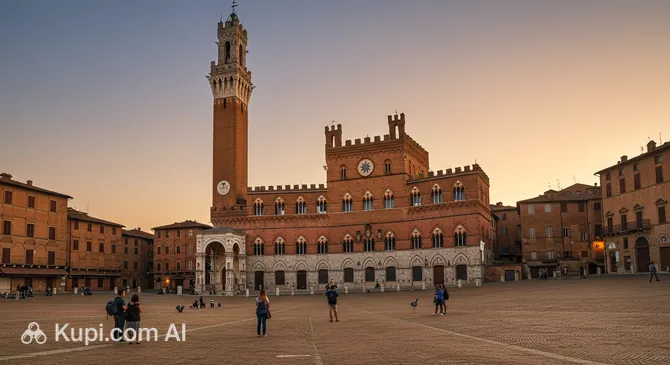
Palazzo Pubblico. Illustration.
Source: Kupi.com AI

Traveler photos:

Today, Palazzo Pubblico serves two important functions. The first floor of the building houses the Civic Museum (Museo Civico), where visitors can see priceless works of art, including famous frescoes by masters such as Simone Martini and Ambrogio Lorenzetti. The second floor is occupied by the administrative offices of the modern Siena City Hall, continuing the palace's historical tradition as a center of city government.

The palace is not just a building but a key element of the unique architectural ensemble of Piazza del Campo. This square is considered the first fully developed urban space in Europe, specifically designed as a center for secular and festive city life. Palazzo Pubblico effectively closes the lower part of the square, which has an unusual shape of a giant shell, where numerous ancient stepped streets converge, creating the unique atmosphere of a medieval city.

Contacts

For the latest information on opening hours, ticket prices, and planning your visit to Palazzo Pubblico, we recommend checking the attraction's official website. Additional information and assistance are also available at the tourist information centers in Siena.

How to contactContact
AddressIl Campo, 1, 53100 Siena SI, Italy
Phone number+39 0577 292111
Websitemuseocivico.comune.siena.it

What to Do

A visit to Palazzo Pubblico in Siena offers tourists a unique opportunity to touch the history and art of this magnificent Italian city. On the first floor of the palace, there is a museum exhibition whose crown jewels are undoubtedly the frescoes by the great masters Simone Martini and Ambrogio Lorenzetti. These works are considered masterpieces of Italian painting and hold immense artistic and historical value, deserving the close attention of every visitor.

Upon stepping out onto Piazza del Campo, where Palazzo Pubblico is located, you will be impressed by the view of the colossal hundred-meter Torre del Mangia, added to the town hall in the mid-14th century. Like a beacon, this tower rises above the city and is one of its most recognizable symbols. Piazza del Campo itself is also of great importance, as it is here that the famous Palio horse races take place—traditional competitions between the contrade (districts) of Siena, whose history officially dates back to 1310, coinciding with the completion of the palace itself.

Exploring Palazzo Pubblico is more than just a museum visit; it is a true immersion into the atmosphere of medieval Siena. Here, you can not only enjoy the magnificent architecture and priceless works of art but also feel the spirit of history, imagining how the Council of Nine, which ruled the city during its golden age, once met within these walls. This place allows for a deeper understanding of the rich cultural heritage of Siena and Italy as a whole.

Getting There

Palazzo Pubblico, an iconic landmark of Siena in Italy, stands majestically on the city's main square—Piazza del Campo. Thanks to its central location in the historic core, reaching the palace is easy regardless of where you are staying in Siena.

You can reach the historic center of Siena, where Palazzo Pubblico is located, by taking one of the city buses. Look for routes heading toward "Piazza del Campo" or "Centro". From the nearest stops, it is a pleasant short walk through medieval streets. It is recommended to check current route numbers and schedules in advance, as traffic for private and public transport may be restricted in the historic part of the city.

If you arrive in Siena by train or intercity bus, you can get from the station (located slightly lower than the historic center) to Piazza del Campo by local bus or taxi. Taxis are also a convenient option for traveling from any part of the city directly to the entrance of the pedestrian zone. However, given the compact nature of Siena's historic center, many tourists find walking to be the most atmospheric way to reach Palazzo Pubblico. This allows you to leisurely enjoy the beauty of the narrow streets and medieval architecture of this unique city in Italy.

Nearest city: Siena

History & Facts

Palazzo Pubblico in Siena is more than just an ancient building; it is a true symbol of the city, with a history closely intertwined with its golden age. The idea for its creation arose in the 1280s when city authorities decided to house the customs office, the mint, and city council offices under one roof. Construction of this grand palace began in 1297. The site was strategically chosen between two important squares, Piazza Mercato and Piazza del Campo, with the main, slightly concave facade facing the famous Piazza del Campo. Interestingly, to maintain the square's architectural harmony, a special law was passed to regulate the appearance of all buildings facing it.

Construction was initially overseen by master Conte di Rinfredo, and from 1299, he was succeeded by Master Giovanni, who, according to records, was a skilled miniaturist and calligrapher. Originally, Palazzo Pubblico consisted of a central four-story section rising above two two-story side wings. The left wing housed the apartments of the podestà (the head of the city's executive power), while the right wing contained the offices of the Council of Nine, which effectively ruled Siena at the time. Most of the palace's construction was completed around 1308, except for the left wing, where the podestà's residence was finished later, between 1325 and 1330.

Palazzo Pubblico was built during the rule of the Guelphs, as evidenced by the characteristic rectangular battlements on its towers. The final completion of the construction is dated to 1310, an event that significantly coincided with the start of the official history of the famous Sienese horse race—the Palio—which is still held today on Piazza del Campo. Later, between 1338 and 1348, the majestic hundred-meter-high Torre del Mangia was added to the town hall, becoming a dominant feature of the entire cityscape. It is also worth noting that at that time, Siena played an important role by being on the main pilgrimage route from London to Rome, which undoubtedly contributed to its prosperity and cultural development.

Time Needed

When planning a visit to Palazzo Pubblico in Siena, keep in mind that it is not just one building but a whole complex including the Civic Museum (Museo Civico) and the famous Torre del Mangia. The amount of time needed for your visit will depend on your interests and how thoroughly you wish to explore each part.

Exploring the Civic Museum, which houses masterpieces of the Sienese school of painting, including Ambrogio Lorenzetti's famous frescoes "The Allegory of Good and Bad Government," usually takes from 1 to 2 hours. This is enough time to walk leisurely through the halls, admire the works of art, and feel the atmosphere of a medieval palazzo. If you are particularly interested in art, you might spend more time here.

If you decide to climb Torre del Mangia to enjoy panoramic views of Siena and its surroundings, allow about 1 hour more. This time includes not only the climb and descent via a rather narrow staircase but also time for photography and contemplation. Thus, for a complete experience at Palazzo Pubblico, including the museum and the tower, it is recommended to set aside from 2 to 3 hours. If time is limited, you can choose either the museum or the tower climb.

Working Hours

Palazzo Pubblico in Siena is one of the city's key attractions, and its opening hours may vary depending on the season. Generally, such historical sites are open to visitors for most of the year, but it is best to check the exact schedule, including weekends and holidays, in advance.

We highly recommend checking current information on opening hours and ticket prices on the official Palazzo Pubblico website or at Siena's tourist information centers before your visit. You should also find out about the need for advance ticket booking, especially if you plan to visit during the peak tourist season, to avoid long waits or the possibility of tickets being unavailable for your preferred time.

10:00 – 19:00

Nearby

Palazzo Pubblico is undoubtedly the heart of Siena and one of the main reasons to visit this amazing Tuscan city. However, to truly feel the spirit of this place, it is worth venturing beyond its famous square and exploring what lies nearby. The palace's surroundings hold just as many interesting stories and architectural masterpieces that can enrich your journey.

A walk through the nearby streets and squares will allow you to discover other iconic landmarks, cozy cafes, and craft shops. Each of these places will contribute to the mosaic of your impressions of Siena, complementing the grandeur of Palazzo Pubblico with new colors and emotions. Here are some of the attractions located nearby:

NameDistance
Torre del Mangia0 km
Torrefazione Fiorella0.1 km
Il Bocconcino0.1 km
Piazza del Campo0.1 km
Santa Maria della Scala0.3 km
National Picture Gallery of Siena0.3 km
Siena Cathedral0.3 km

Have you reached the end of the page?

So the route has been studied inside and out