Support

Odense Cathedral - St. Canute's Church

About

Majestic brick walls and tall spires reaching toward the sky make Odense Cathedral (St. Canute's Church) one of the most recognizable landmarks that Denmark is proud of. This masterpiece of Gothic architecture, located in the heart of the city of Odense, serves not only as the main Lutheran church of the Diocese of Funen but also as an important historical monument preserving the secrets of the Danish monarchy.
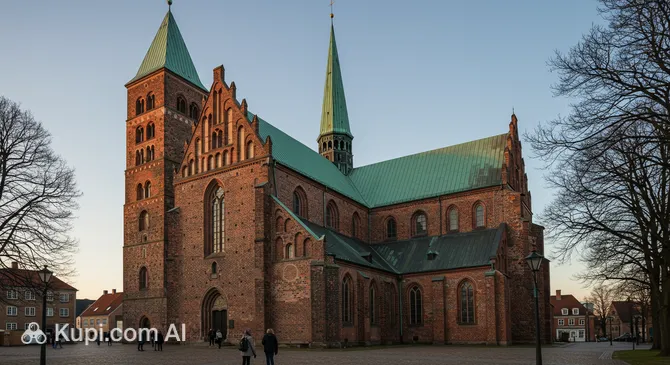
Odense Cathedral (St. Canute
Odense Cathedral (St. Canute's Church). Иллюстрация. Источник: Kupi.com AI

The cathedral's main feature is that it was named after King Canute IV the Saint, the country's patron saint, whose relics still rest in the church's crypt. The cathedral represents a unique example of the evolution of religious architecture: started as a Romanesque building in the 11th century, it eventually transformed into a model of Northern Gothic with characteristic pointed arches and exquisite stone carvings.

Inside, visitors will find a stunning gilded altar by Claus Berg, which is considered one of Scandinavia's most valuable artistic treasures. The cathedral's spacious halls are filled with light passing through stained glass, and the magnificent acoustics make it a popular venue for sacred concerts, bringing together history, faith, and art under one roof.

Contacts

If you need to clarify details before your visit or find out about special church services, you can use the cathedral's official contact information. We strongly recommend checking the cathedral's website for the current schedule of organ concerts and temporary exhibitions.

Cathedral staff are usually available to answer tourists' questions during opening hours, helping you better plan your cultural immersion into the city's history.

How to contactContact
AddressKlingenberg 19, 5000 Odense, Denmark
Phone+45 66 12 03 92
Websitewww.odensedomkirke.dk

What to Do

Inside the cathedral, the first thing to do is head to the crypt, where the relics of King Canute IV and his brother Benedict rest in transparent reliquaries. This place has a special energy and allows you to touch Danish history from the Viking Age and early Christianity. Pay attention to the detailed craftsmanship of the ancient sarcophagi and the silence that reigns in the underground part of the church.

The main hall of the cathedral is impressive in its scale and its magnificent 16th-century altar, consisting of more than 300 carved figures. Music lovers can time their visit for a rehearsal or an organ concert, when the sounds of the ancient instrument fill the entire space, creating a unique atmosphere. During the summer, tourists are often offered the opportunity to climb the tower, which offers the best panoramic view of the tiled roofs of the old city.

For a deeper dive into the context, we recommend using an audio guide or joining a guided tour. You can learn the history of the unique frescoes preserved on the walls and examine the details of the astronomical clock. Don't forget to stop by the small museum corner at the cathedral, where church artifacts and art objects found during restorations are on display.

Getting There

Finding the city's main sanctuary is easy, as it is located in the heart of Odense at Klingenberg 19. If you are arriving by train, the walk from the central railway station (Odense Station) takes no more than 15 minutes through the picturesque pedestrian streets of the old center.

For those who prefer public transport, bus routes No. 1, 2, 5, and 6 stop in the immediate vicinity of the cathedral (Odense Domkirke stop). If your journey begins at Copenhagen Airport, the most convenient way is to take a direct train, which will bring you to Odense in about 1.5–2 hours.

Travelers by car can use the paid parking near Flakhaven square; however, it is worth remembering that the city center is very compact, and the best solution is to leave your car at a hotel parking lot and explore on foot or by rental bike, which is very popular in Denmark.

Ближайший город: Odense

History & Facts

The history of this majestic structure began as early as 1081 at the initiative of King Eric I. The construction of the temple was inextricably linked to the tragic fate of his brother, King Canute IV, who was killed in 1086 right within the walls of a neighboring church. After his canonization, the cathedral became a place of pilgrimage, and the wooden building was gradually replaced by a stone Romanesque basilica.

Between the 13th and 15th centuries, the cathedral's appearance underwent fundamental changes as it was rebuilt in the classic Gothic style. It was during this time that its famous pointed windows, high vaults, and massive tower appeared. By 1494, the main construction work was completed, and the church acquired the features we admire today.

An important stage in the life of the cathedral was the 16th-century Reformation, after which it passed to the Lutheran community. Despite the destructive wars and fires that affected Denmark over the centuries, the cathedral was preserved and carefully restored in the 19th century, returning the interior to its former grandeur and the austerity characteristic of Northern Gothic.

Time Needed

To leisurely explore the interior, descend into the crypt to see the relics of Saint Canute, and admire the magnificent altar, most tourists need between 1 and 1.5 hours. This is sufficient time for a self-guided tour of the architecture and main relics.

If you plan to climb the bell tower for a panorama of the city or attend one of the organ concerts, you should allow at least 2.5 hours for your visit. Morning hours on weekdays are usually the quietest, allowing you to enjoy the silence and majestic atmosphere of the cathedral without the crowds.

Working Hours

Odense Cathedral is open to visitors daily, though the operating schedule varies by day of the week. On Monday and Sunday, the doors open to tourists later than usual—at 12:00 PM—and welcome guests until 4:00 PM.

On other days, from Tuesday to Saturday, the cathedral operates on an extended schedule: from 10:00 AM to 4:00 PM. Please note that during church services, weddings, or baptisms, access for sightseeing may be limited.

DayWorking hours
Понедельник12:00 – 16:00
Вторник10:00 – 16:00
Среда10:00 – 16:00
Четверг10:00 – 16:00
Пятница10:00 – 16:00
Суббота10:00 – 16:00
Воскресенье12:00 – 16:00

Nearby

A walk around the cathedral is a true journey through time, as the historical center of Odense is literally steeped in the spirit of antiquity. Just a few steps from the church fence, you will find cozy cobblestone streets and architectural monuments that will help you better feel the atmosphere of the birthplace of the great storyteller.

Be sure to take some time to explore the surroundings, where medieval ruins sit alongside royal residences and quiet monastery gardens. Below is a list of interesting locations within walking distance of St. Canute's Cathedral.

NameDistance
Hans Christian Andersen's Childhood Home0.1 km
Papas Papbar0.2 km
Den Gamle Kro0.3 km
Hans Christian Andersen's House0.4 km
Carlsens Kvarter0.5 km
Brandts Cloth Factory0.5 km
Brandts Art Museum0.5 km

Reached the end of the page?

That means the route is fully explored