Support

Hans Christian Andersen's Childhood Home

About

Imagine a tiny house with half-timbered walls, where the story of one of the world's greatest storytellers began in the early 19th century. Hans Christian Andersen's Childhood Home in Odense is a unique memorial museum located exactly where the future author of "The Little Mermaid" and "The Ugly Duckling" spent his most important formative years from 1807 to 1819.
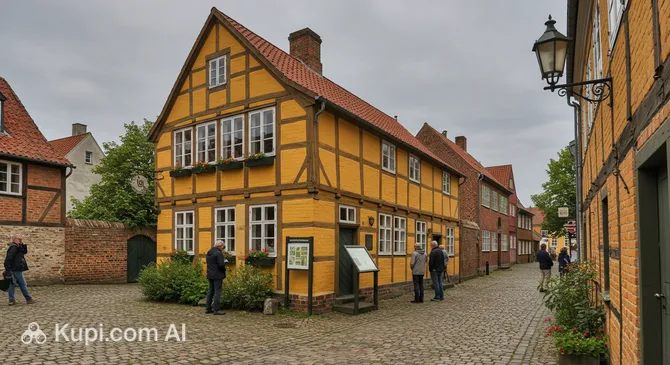
Hans Christian Andersen
Hans Christian Andersen's Childhood Home. Иллюстрация. Источник: Kupi.com AI

This spot in Denmark is striking in its modesty and authenticity. Inside, the setting of a poor shoemaker's family has been recreated: you will see tiny rooms, simple wooden furniture, and even the earthen floor that was common back then. The museum allows you to see the world through the eyes of little Hans, whose imagination transformed cramped spaces into entire kingdoms.

Today, the house is part of a large museum complex and carefully preserves the spirit of the old town. It is not just a historical building, but a true portal to the past, telling the story of how great masterpieces of world literature are born from extreme need and simple childhood impressions.

Contacts

To check the latest information on exhibitions and special events, you can use the museum's official contact details:

How to contactContact
AddressMunkemøllestræde 3, 5000 Odense, Denmark
Phone+45 65 51 46 01
Websitehcandersenshus.dk

What to Do

A visit to this place is, above all, an emotional journey into the past. Inside the house, you can explore the reconstructed interiors of the 1800s. Be sure to notice the parents' bed, the simple kitchen utensils, and the shoemaker father's workspace—these details help you understand the conditions in which Andersen grew up. The sense of authenticity is enhanced by the earthen floor, which recreates the actual living conditions of the poorest classes of that time.

After touring the rooms, be sure to step into the magical garden that surrounds the modern museum complex nearby. This garden was inspired by the writer's fairy tales: here you can see unusual beech trees, thick pines, and a mysterious "bottomless pool." A stroll along the winding gravel paths amidst tall grass and white flowers creates an atmosphere of mystery that changes depending on the light.

For lovers of literature and history, this is a wonderful opportunity not only to see the Andersen family's personal belongings but also to trace the connection between real locations in the city and the imagery in his works. A walk along the river flowing near the house will let you see the landscapes that the author himself described in his autobiography, "The Fairy Tale of My Life".

Getting There

Getting to this iconic spot in Odense is easy, as the house is located in the very heart of the historical center. If you are arriving from Copenhagen, the most convenient way is by train, which will take you to Odense Station in about an hour and a half to two hours. From the station, the museum is just a 10–15 minute walk through the city's charming streets.

For those who prefer public transport, the city operates a modern light rail system, with stops within walking distance of Munkemøllestræde 3. You can also use taxi services or mobile maps to navigate through the pedestrian zones of the old quarter. Navigator coordinates: 55.3945279, 10.3872878.

Ближайший город: Odense

History & Facts

The history of this humble building is inextricably linked to the early life of the great storyteller. Hans Christian Andersen moved to the house on Munkemøllestræde in May 1807, when he was just two years old. It was here, in the family of a poor shoemaker and a washerwoman, that the foundations of his rich imagination were laid: his father built him a puppet theater and read him stories from "One Thousand and One Nights," creating a magical world right inside their cramped room.

The author's childhood in Odense was filled with both inspiration and hardship. After his father's death in 1816, young Hans had to grow up quickly and began working for a weaver and a tailor. Despite the poverty, he held onto his dream and, at the age of 14, left this house for Copenhagen in search of fame, with only a small amount of money and a passionate desire to become an artist.

The house itself, built in 1799, remained an ordinary residential building in a poor neighborhood for a long time. However, in the early 20th century, the municipality purchased the building to preserve the legacy of its most famous native. In 1931, after a thorough restoration that returned the building to its original appearance from the early 19th century, a museum was opened here, which is today considered one of the most touching literary landmarks in the world.

Time Needed

To leisurely explore all the rooms and the exhibition of the Childhood Home, most visitors need 1 to 2 hours. This is quite enough time to soak in the historical atmosphere and carefully examine the household items from the early 19th century.

If you plan to combine your visit with the new modern Hans Christian Andersen Museum and a walk through the adjacent fairytale garden, we recommend setting aside at least 3 hours. This will allow you to immerse yourself in the world of literature without rushing and enjoy the landscape design of the artistically curated garden.

Working Hours

The museum welcomes guests on a fixed schedule, which is convenient to keep in mind when planning your city walk. Please note that the attraction is usually closed to visitors on Mondays.

Standard opening hours:

  • Tuesday – Sunday: 11:00 AM – 4:00 PM
  • Monday: Closed
DayWorking hours
ПонедельникЗакрыто
Вторник11:00 – 16:00
Среда11:00 – 16:00
Четверг11:00 – 16:00
Пятница11:00 – 16:00
Суббота11:00 – 16:00
Воскресенье11:00 – 16:00

Nearby

A stroll around the house-museum allows you to dive deeper into the atmosphere of old Odense, which so carefully preserves the traditions of Denmark. The neighboring streets and parks look as if they stepped right out of the pages of a fairy tale, offering tourists unique historical locations and modern spaces for relaxation.

Exploring the sights within walking distance will help you create a complete cultural itinerary through the city. Below are the most interesting sites located nearby:

NameDistance
Papas Papbar0.1 km
Odense Cathedral (St. Canute's Church)0.1 km
Carlsens Kvarter0.4 km
Brandts Cloth Factory0.4 km
Brandts Art Museum0.4 km
Den Gamle Kro0.4 km
Hans Christian Andersen's House0.5 km

Reached the end of the page?

That means the route is fully explored