Support

Al Badrashin

About

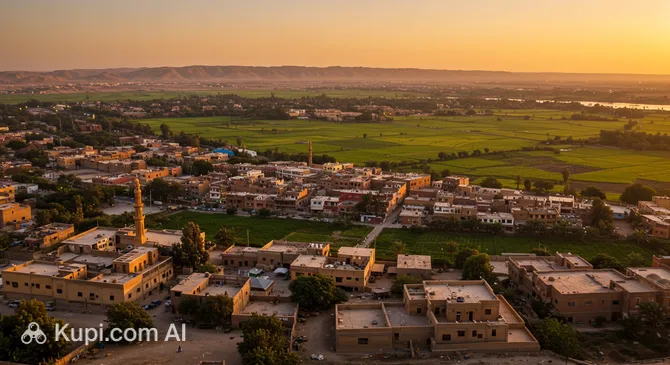
Al-Badrashin is a cozy town located on the west bank of the Nile, just 30 kilometers south of bustling Cairo. Arriving here, travelers find themselves in the heart of a fertile valley where Egypt reveals its most authentic side. Surrounded by green fields and dense date palm groves, this corner seems perfectly made for leisurely strolls and discovering the country's real life.

Al Badrashin. Illustration.
Source: Kupi.com AI

Despite its provincial charm and steady pace, the city plays an important role in the administrative structure of the Giza Governorate. Home to about 90,000 people, its streets harmoniously blend traditional customs with modern influences. Al-Badrashin attracts those seeking authentic experiences and a break from the hustle and bustle of major metropolises while observing the daily lives of local residents.

The city's main highlight is its incredible historical surroundings. It stands literally at the crossroads of time: the ruins of ancient Memphis, the former capital of the Old Kingdom, and the famous Saqqara necropolis with the Step Pyramid of Djoser are located very nearby. Al-Badrashin's deep history and its proximity to the greatest monuments of humanity make it an ideal starting point for excursions into the mysteries of the past.

A visit to Al-Badrashin will give you the chance to feel the breath of millennia and enjoy sincere hospitality. This place is worth including in your itinerary to see Egypt from a new, unexpected side and touch the treasures of antiquity in a peaceful setting.

Weather Overview

The climate in this region is typical of the desert areas of Egypt: eternal sun reigns here, and precipitation is extremely rare. When planning your trip, consider that the weather in Al-Badrashin is characterized by a sharp contrast between sweltering summers and moderately cool winters.

The summer months, especially July and August, bring intense heat: average temperatures hover around 30°C, with daytime highs often reaching 37°C. This time of year requires a hat and a supply of water. Winter, on the other hand, is mild and comfortable for long walks through the ruins of Memphis: in January, the air warms to an average of 14–19°C, but nights can be brisk, with temperatures dropping to 8–9°C.

Expect a hot, dry summer and a mild winter with cool nights and almost no rain. Even during the winter period, the number of wet days does not exceed one per month, so you're unlikely to need an umbrella.

Average monthly temperature

Average monthly precipitation

Interesting Facts

Beyond its main attractions, Al-Badrashin holds many fascinating secrets revealed only to the most curious travelers. This city lives in close connection with the great past, and here are a few facts that confirm its uniqueness:

  • Cradle of the Pyramids. The city literally borders the legendary Saqqara—the place where the Step Pyramid of Djoser rises. This is the world's first stone pyramid, so it can be safely said that the global history of Egypt's monumental construction began right on the doorstep of Al-Badrashin.

  • Legends of the Underground. Local folklore is rich with stories of hidden tunnels. Long-time residents tell tales of mysterious underground passages that supposedly connect the ancient pyramids, and archaeological finds in the city's surroundings regularly fuel interest in these myths.

  • Living Crafts. Al-Badrashin is one of the few cities where ancient traditions have not faded away. Hereditary masters of weaving and ceramics live here, creating their products using the technologies of their ancestors. Travelers can not only buy unique souvenirs but also personally witness the magic of their creation.

  • Sacred Land. According to historical data and legends, important religious processions passed through these lands in antiquity. Local legends closely link the city's territory with the names of great high priests and architects whose secrets scientists are still trying to unravel.

How to Get There

When planning a trip to this historical region, it is important to think through the logistics in advance, as the city is located in close proximity to the capital's major transport hubs. You can find out more about how to get to Al-Badrashin to choose the most convenient route.

Al-Badrashin itself does not have its own airport, so most travelers arrive via the air gates of nearby large cities. The most popular option is Cairo International Airport (CAI), located in the capital. This is the country's main gateway, receiving flights from all over the world. The airport is about 38 km from Al-Badrashin. A trip by taxi or transfer will take you about 1 hour and 20 minutes, depending on Cairo traffic.

Another convenient alternative, especially if you plan to stay closer to the pyramids, is Sphinx International Airport (SPX). It is located in the city of Giza, about 48 km from your destination. This modern airport serves both domestic and international flights. Travel time by car from here to Al-Badrashin will be approximately 1.5 hours. Both airports offer developed infrastructure and many transfer options.

For clarity, here is summary information on the main airports:

AirportPassenger trafficDistance
Cairo International Airport26 mln38 km
Giza Sphinx1.2 mln48 km
Borg El Arab Airport1.7 mln193 km
Alamein International1.2 mln295 km

Regarding rail links, Al-Badrashin is on the main line running south from Cairo along the Nile. It is most convenient for tourists to travel to the main stations in Giza or Cairo (Ramses Station), where trains from Alexandria, Luxor, and Aswan regularly arrive. From Giza station, Al-Badrashin can be reached quickly by taxi or local transport, as the distance is quite short.

Main Attractions

Al-Badrashin is a unique spot on the map where modern life is closely intertwined with the greatest heritage of humanity. The main points of attraction here are not found among the city blocks, but in the archaeological zones for which this city serves as a direct gateway. Here are the places that draw travelers from all over the world to this region.

Ruins of Memphis (Mit Rahina). Located just minutes from the center of Al-Badrashin, ancient Memphis was once the country's thriving capital. Today, it is an impressive open-air museum. Tourists come here to see the colossal limestone statue of Ramses II, lying in a special pavilion. Its size and craftsmanship are breathtaking. There is also a beautiful Alabaster Sphinx, which remains perfectly preserved despite the passing millennia.

Saqqara Necropolis. This is perhaps the most famous attraction in the immediate vicinity of the city. Here rises the Step Pyramid of Djoser—the oldest surviving large-scale stone building in the world. A walk through the complex allows you to trace the evolution of the architectural thought of ancient builders. Besides the pyramid itself, the numerous mastabas (tombs) of the nobility are of great interest, featuring amazingly bright and detailed wall reliefs depicting the daily life of that era.

Pyramids of Dahshur. Just south of Al-Badrashin lies another important archaeological site—the Dahshur necropolis. This place is usually less crowded than Giza or Saqqara, creating a special atmosphere of solitude and adventure. Here you can find the Bent Pyramid, known for its unusual shape due to a change in the angle of its slopes, and the Red (Pink) Pyramid—the first successful attempt in history to build a true pyramidal shape. Visiting Dahshur is a great chance to look inside ancient structures without the hustle and bustle of tourist crowds.

Local Cuisine

The cuisine of Al-Badrashin is a real dive into the culinary traditions of Egypt, where ancient recipes are passed down from generation to generation. Here, food is not just about satisfying hunger but is an important part of culture and hospitality. Local residents start the day with a hearty breakfast, the main stars of which are legume dishes: ful medames (stewed fava beans) and ta'ameya (the Egyptian version of falafel). They are prepared with aromatic herbs and spices, creating a rich and recognizable taste.

Strolling through the neighborhood, it's impossible to resist the aroma of fresh bread. Traditional aish flatbreads are baked in clay ovens right on the street and serve as the perfect accompaniment to meat delicacies. Fans of hearty meals should definitely try the local kebab and kofta—juicy balls of minced lamb with spices, cooked over hot coals. This simple but incredibly tasty food forms the backbone of the city's street food scene.

Those with a sweet tooth will remember Al-Badrashin for its abundance of fruits and desserts. Local markets are a riot of colors: here you can find the sweetest mangoes, figs, pomegranates, and the famous Egyptian dates. For dessert, basbousa—a syrup-soaked semolina cake—is often served, along with crispy baklava or sesame brittle. It is customary to end the meal with a glass of karkade—a refreshing drink made from hibiscus petals, which is drunk here both hot and cold, while enjoying the leisurely pace of Egyptian provincial life.

Travel Tips

Traveling to Al-Badrashin is an immersion into the atmosphere of the real Egyptian province, where the pace of life is quite different from a resort. To ensure your trip to the ancient monuments and city walks are as comfortable as possible and free of surprises, we have prepared a list of important recommendations to help you feel confident.

  1. Clothing and Belongings. Since Al-Badrashin is a city with a traditional lifestyle, you should follow a dress code. Tourists are recommended to choose modest clothing made of natural fabrics (cotton, linen) that covers the shoulders and knees; this applies to both women and men. Be sure to bring comfortable closed-toe shoes, as you will be walking a lot on sand and rocky soil in the archaeological zones of Saqqara and Memphis. Don't forget sunglasses, sunscreen with a high SPF, and a hat.

  2. Transport. For a trip to the city from Cairo or Giza, it is most convenient and safest to use ride-hailing apps (Uber or Careem), as public transport can be crowded and difficult to navigate without knowing the language. Within Al-Badrashin itself, locals often get around in tuk-tuks—this is a cheap and colorful way to get from the center to the outskirts, but the price should be agreed upon in advance.

  3. Finances. Unlike major tourist centers, local shops and cafes very rarely accept cards. You will definitely need cash—Egyptian pounds. Exchange money in advance in a large city or withdraw it from an ATM upon arrival. Also, carry small bills for tips (bakshish), which are customary to give for any small service, and for paying transport fares.

  4. Health and Safety. The main rule is to drink only bottled water and use it even for brushing your teeth. Avoid drinks with ice in street cafes. There are pharmacies in the city, but pharmacists may not speak English, so it's better to pack a basic first-aid kit (remedies for stomach upset, painkillers, band-aids) at home. The city is safe, but keep an eye on your personal belongings in the markets.

  5. Communication. The primary language is Arabic. English is less common here than in resort areas, so download an offline translator to your phone. Locals will really appreciate it if you learn a few phrases, such as "As-salamu alaykum" (greeting) or "Shukran" (thank you). It's best to buy a SIM card immediately upon arrival at the airport or in official communication salons in Cairo to have stable mobile internet for navigation.

  6. Local Etiquette. Egypt is a hospitable but conservative country. Be restrained and friendly when interacting with local residents. If you want to photograph people (especially women or elderly men), be sure to ask for permission. Men should not be the first to extend their hand to women for a handshake unless they show initiative themselves.

  7. What to Avoid. Refrain from public displays of affection (hugging and kissing), as this is considered improper in a conservative society. Also, it is categorically discouraged to consume alcohol on the streets or appear intoxicated in public places—this will cause disapproval and may lead to conflicts.

  8. Planning Tip. Take advantage of the geographical location: by staying near Al-Badrashin or arriving early in the morning, you can reach the Saqqara necropolis right when it opens (usually at 8:00–9:00 AM). This will allow you to explore the pyramids in the cool and quiet long before the main tour buses from Cairo arrive.

Following these simple rules will help you show respect for the local culture and avoid awkward situations. Al-Badrashin will open up to you as a friendly and welcoming city, ready to share its thousand-year-old secrets with an attentive and polite guest.

Entertainment & Nightlife

Nightlife in Al-Badrashin is fundamentally different from the noisy parties of metropolises or coastal resorts. You won't find neon signs of nightclubs or disco bars with loud music here. An evening in this city is an immersion into the traditional lifestyle that provincial Egypt is famous for, where the main entertainment consists of leisurely conversations, delicious food, and gazing at the starry sky over palm groves.

The main center of attraction after sunset is the traditional coffee shops, or "ahwas". This is where the city's real social life happens. Local men gather to discuss the latest news, play a round of backgammon or dominoes, and drink strong mint tea or Turkish coffee. Tourists can visit such establishments to feel the local flavor, inhale the scent of fruit-flavored shisha tobacco, and observe the lively interaction of residents, though it's worth remembering that these are predominantly male spaces.

If you're looking for a pleasant dinner in an authentic setting, the Blue Lotus guesthouse, located near the Saqqara necropolis, is an ideal choice. This establishment is known for its cozy and peaceful atmosphere. Dinner on the terrace overlooking farmland and the desert on the horizon will provide an unforgettable experience, especially at sunset. Here, you can enjoy quality home cooking away from the city's noise and bustle.

Traditional village dishes cooked in old clay ovens are the culinary hallmark of evening gatherings in this region. You must try fresh "feteer" (flaky flatbread), served with honey, salty cheese, or molasses. These simple but hearty treats are often offered in small family-run establishments or agritourism spots around farms, making it the best way to get to know the culinary heritage of the Nile Valley.

Those who enjoy walking should head to the riverbank or irrigation canals, where locals often stroll with their families. Central shopping streets remain busy until late evening: stalls selling fruit, sweets, and pastries stay open late, creating a cozy bustle.

Practical tips for evening leisure:

  • Transport: Hailing a taxi on the street at night can be difficult. The most popular local transport is tuk-tuks, but to return to your hotel (especially if you are staying in Giza or Cairo), it is better to arrange in advance with a driver who will wait for you.
  • Safety: Al-Badrashin is a safe but conservative city. Evening walks are best done in a group, and women are not recommended to walk alone in remote areas after sunset.
  • Dress code and etiquette: It can be cool in the evening, so a light jacket will come in handy. Remember that alcohol is generally not available on local cafe menus, and its public consumption is highly discouraged by local traditions.

Parks & Museums

Al-Badrashin and its surroundings offer tourists a unique combination of natural beauty and cultural heritage rarely found in modern metropolises. Here, the concept of a "park" transforms into the endless green expanses of the Nile Valley, and museums are not just buildings with exhibits, but entire open-air archaeological complexes where every stone breathes history.

While the city lacks typical European-style urban parks with benches and fountains, the role of the main green zones here is played by majestic date palm groves. These vast plantations of palms surrounding the city create a natural shaded oasis that contrasts with the nearby desert. A walk or horse ride through these groves allows you to enjoy the silence and cool air and witness a traditional rural way of life that has changed little over centuries.

Another important natural area is the Nile embankment and its adjacent farmland. The banks of the great river in this area are not confined by concrete but are covered with lush vegetation. This is an ideal place to watch the sunset when the sun sinks behind the pyramids, painting the Nile waters and the green fields in golden tones. Here you can see rare birds and feel the breath of the living nature that nourishes all of Egypt.

The cultural heart of the region beats in its museums, the most important of which is the Open-Air Museum at Mit Rahina (Memphis). Located on the site of the ancient capital, this museum houses colossal statues that could not be moved to Cairo due to their size. The central exhibit is the giant reclining statue of Ramses II, striking in the fine detail of the ancient masters' work. You can also see the beautiful Alabaster Sphinx standing among the trees, creating a special atmosphere of unity between history and nature.

Equally significant is the Imhotep Museum, located at the foot of the Saqqara complex. This is a modern and excellently organized museum dedicated to the first known architect in human history. Its halls display unique finds from the necropolis: ancient surgical instruments, exquisite ceramics, statues, and decorative elements from the pyramids. Visiting this place helps bring together scattered impressions of the ancient ruins and understand the scale of engineering thought of that era.

For those looking for something special, we suggest looking into the carpet weaving schools located along the road leading to Saqqara. Although these are not museums in the classic sense, these workshops serve as living galleries of folk art. Here, you can not only see finished handmade masterpieces but also observe the process of their creation, which is passed down from generation to generation, preserving the cultural code of the region.

Getting Around

The public transport system in Al-Badrashin is significantly different from the usual European structure: you won't find city buses with clear schedules or trams here. The city lives in the rhythm of the Egyptian province, where the main means of transport are the railway and microbuses. For a tourist, this can be a real adventure that requires some skill and a supply of cash.

The most important transport hub is the Al-Badrashin railway station, located on the main line running along the Nile. Suburban trains from Cairo (from Ramses and Giza stations) arrive here regularly. This is the fastest and cheapest way to get here from the capital independently. Tickets are purchased at the station's ticket offices before departure; their cost is nominal, but the carriages are often crowded, especially during peak hours.

Within the city and for connections to neighboring areas (including the El-Monib metro station in Giza), ubiquitous microbuses circulate. This is the primary mode of transport for local residents. They don't have fixed stops: to board, you just need to wave your hand from the roadside, and to get off, loudly ask the driver to stop. Fares are paid in cash, and money is passed to the driver through other passengers. Prices are fixed and very low, but finding change for large bills is difficult, so always carry small coins and banknotes.

For short trips within residential neighborhoods or to the outskirts, tuk-tuks are used—small three-wheeled scooters with a cabin. This is a maneuverable and affordable transport, perfect for narrow streets. However, be careful: they don't have meters, and the price of the trip must be negotiated with the driver in advance, before boarding. For tourists, the price may be inflated, so moderate bargaining is quite appropriate.

Standard city taxis are rare here; they are replaced by ride-hailing apps like Uber or Careem. This is the most comfortable and safest option for tourists wishing to visit the attractions of Saqqara or Memphis without extra stress. The app eliminates the need to explain your destination in Arabic or haggle, as the price is fixed by the system. It is recommended to call a car in advance, as wait times in this area can be longer than in central Giza.

There are no unified transport passes or travel cards in Al-Badrashin. The entire system is built on cash transactions "here and now." There are no validators on transport; ticket checks are carried out only on trains by conductors. When planning your movements, keep in mind that active transport movement starts early in the morning and dies down by night, so for late returns, it's better to rely on a pre-booked transfer.

Accommodation

When planning a stay in Al-Badrashin, it's important to adjust your expectations: this is not a typical tourist resort with a wide choice of accommodation. In the city itself, you won't find large international hotel chains or luxury hotel complexes with an "all-inclusive" system. The typical range of accommodation here consists of small, cozy guesthouses, private villas, and eco-lodges geared toward travelers seeking solitude and immersion in the rural atmosphere.

In terms of neighborhoods, the most attractive area for tourists is the zone on the border of the city and the desert, along the road leading to the Saqqara necropolis. Staying here allows you to enjoy the silence and views of palm groves and the silhouettes of pyramids in the distance, avoiding the noise and dust of the central city streets. It is in this green zone, among the farmland, that the rare but atmospheric accommodation options are located, offering mid-range comfort with elements of traditional Egyptian style.

For many travelers, the optimal strategy remains staying in neighboring Giza, where the choice of hotels is huge—from budget hostels to luxury hotels overlooking the Great Pyramids. Since Al-Badrashin is only a 30–40 minute drive from Giza, tourists often visit for a day trip. However, if you want to watch the sunrise at the Step Pyramid of Djoser, it's worth looking for local farmhouses that are available for rent and offer a unique experience of life in the Egyptian hinterland.

Price Range and Booking:

The cost of staying in local guesthouses varies from budget to mid-range. Prices here are generally lower than in the tourist center of Cairo but can increase during the winter season (from October to April) when the weather is most favorable for excursions. It is highly recommended to book accommodation in advance, as the number of high-quality options is very limited. While some properties are listed on international online platforms, many owners prefer direct communication through social networks or messaging apps. Note that payment on-site is often accepted only in cash in the local currency.

Nearby Cities

For those wishing to explore the surroundings, Al-Badrashin serves as an excellent starting point for day trips to several interesting nearby locations. Its convenient location in the Nile Valley allows tourists to quickly reach key attractions and major cities, each offering a unique experience.

Just a few dozen kilometers away is Cairo—the majestic capital and heart of the country. This is the ideal destination for those who want to immerse themselves in the bustling life of a metropolis, visit the famous Khan el-Khalili market, see the treasures of the Egyptian Museum, or enjoy the architecture of the Islamic quarter.

Even closer is Giza, a city that needs no introduction. This is where the legendary Great Pyramids and the Sphinx are located. A trip here from Al-Badrashin takes very little time, making it easy to combine a tour of the Saqqara and Giza pyramids into one grand ancient heritage excursion.

It is also worth paying attention to Helwan, located on the opposite bank of the Nile. Historically, this city was known as a resort with mineral springs and gardens. Although today it is a major residential and industrial center, it is interesting for its university, Japanese garden, and the opportunity to see the non-touristy side of life in Cairo's suburbs.

CityPopulationDistance
Helwan619 2939 km
Al Ayyat44 17121 km
Giza5 598 40223 km
Cairo20 296 00026 km
As Saff59 34826 km

These nearby destinations provide insight into the diverse culture and landscapes of the region, making your journey even more enriching.

Shopping & Souvenirs

Shopping in Al-Badrashin is fundamentally different from typical trips to shopping centers in major cities. You won't find glossy boutiques with global brands or huge entertainment malls here. Commerce in this city is primarily about meeting the daily needs of locals and selling authentic handicrafts to tourists heading to ancient monuments. For the traveler, it's a chance to see Egypt without the frills and purchase unique handmade goods directly from the artisans.

The main shopping districts and streets are concentrated in the city center, near the railway station and along the main road passing through the settlement. Life here buzzes from morning until late at night. The streets are a continuous string of small shops selling everything from fresh bread and spices to clothing and household utensils. Walking through these quarters allows you to dive into the thick of local life, where trade is conducted emotionally and loudly.

If you're looking for shopping centers in the modern sense, there are none in Al-Badrashin itself. For branded clothing, electronics, and a typical European shopping experience, you should head to neighboring Giza or Cairo, which can be reached in less than an hour. Small private shops and family-run stalls dominate Al-Badrashin, giving the shopping process a special, almost personal character.

The true heart of the city's trade is the local markets (souks). These are colorful places where stalls overflow with mounds of fresh vegetables, fruits, and herbs grown in the fertile Nile Valley. This is where you should look for aromatic spices, loose karkade tea, and traditional sweets. The atmosphere at the market is friendly but noisy; vendors readily engage in dialogue, offering samples of their goods before you buy.

As for souvenirs, the surroundings of Al-Badrashin, especially the road leading to the Saqqara necropolis, are famous for their craft traditions. The region's main pride is handmade carpets (kilims). There are many carpet weaving schools here where you can buy silk or wool products with stunning patterns. Papyrus, alabaster figurines, and, of course, local dates, which are considered some of the best in the country thanks to the extensive palm groves around the city, are also popular.

Working hours and payment have their own characteristics. Shops usually open around 10:00 AM and stay open until late evening (often until 10:00 PM or 11:00 PM), with a break for Friday prayers. Unlike tourist zones, bank cards are very rarely accepted here. For your purchases, you will definitely need cash in Egyptian pounds, and it's advisable to have small denominations. Bargaining is appropriate and even welcomed at markets and souvenir shops, but in grocery stores, prices are usually fixed.

The Tax Free (tax refund) system is not relevant in Al-Badrashin, as local shops and craft workshops are not part of this international system. VAT refunds can only be processed for purchases at large authorized stores in Cairo or at the airport upon departure, so don't count on this option in the province.
Reached the end of the page?

That means the route is fully explored