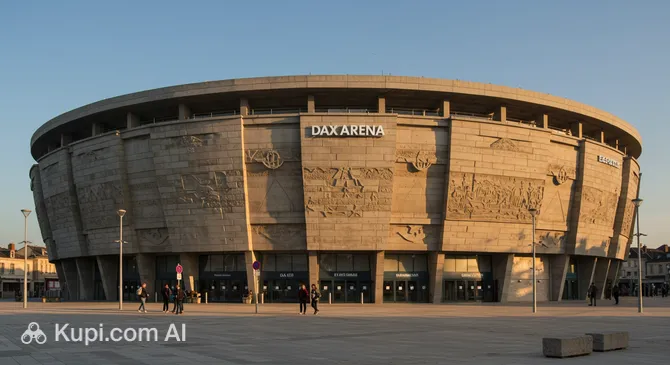
Imagine a monumental structure where centuries-old traditions meet the elegant architecture of the beginning of the last century. The Dax Arena (Arènes de Dax) is not just a stadium, but a true symbol of the cultural life of the city of Dax, located in a picturesque region in the southwest of France.
Built in 1913 from reinforced concrete, this arena replaced older wooden structures and was inspired by classical Spanish traditions, particularly the architecture of Seville. It accommodates about 8,000 spectators and remains an active center of attraction for lovers of vivid spectacles and history to this day.
Dax Arena. Illustration.
Source: Kupi.com AI
Traveler photos:
The arena is nestled within the grounds of Theodore Denis Park. Visitors are greeted by expressive sculptures by Christian Maas — a majestic bull and the figure of a "retractor," which set a ceremonial tone. The site is interesting not only for its purpose but also for its status as the first French arena equipped with a surgical infirmary, highlighting its significance in the history of bullfighting.
Contacts
For more information about upcoming events or to purchase tickets, you can use the official communication channels. Please note that ticket office hours may change during major festivals.
The main magnet for visitors are the large-scale events held here at the end of summer. If your trip is planned for mid-August, you can witness the Dax Festival (Fêtes de Dax) — six days of unrestrained fun and traditional bullfights. The second weekend of September also attracts crowds of tourists thanks to the Toros y Salsa festival, which combines the excitement of the spectacle with the rhythms of Latin American music.
Those who prefer less extreme but equally fascinating traditions should visit the Landes bullfights (course landaise), held in July and August. Unlike Spanish bullfighting, the focus here is on acrobatic jumps and the agility of the participants, making this show a great option for family viewing.
On ordinary days, a walk around the arena becomes an aesthetic pleasure. Be sure to examine the Art Deco details of the facade and find the famous sculptures in Theodore Denis Park. The local architecture and surrounding greenery provide a wonderful backdrop for photoshoots, and tickets for official events can be purchased online in advance to secure the best seats in the stands.
Getting There
Located in the heart of the city at 2 Bd Paul Lasaosa, the arena sits within the picturesque Theodore Denis Park. Thanks to its central location, it is very easy to reach on foot from any part of the historical center, using Notre-Dame Cathedral or the famous thermal complexes as landmarks.
If you are arriving by train, the Gare de Dax railway station will be your starting point. From the station, the arena can be reached by local bus or taxi in just 10–15 minutes. For those who prefer a brisk walk, the journey from the station to the site will take about 20–25 minutes.
Drivers can use the parking lots located directly in Theodore Denis Park or along Paul Lasaosa Boulevard. Additionally, the city is well-equipped for cyclists, with convenient paths leading straight to the main entrances of the complex.
Nearest city: Dax
History & Facts
The history of this majestic structure began in 1913, when architect Albert Pomade designed a permanent reinforced concrete structure to replace the old wooden arena. The architect drew inspiration from the famous Plaza de Toros in Seville, which is reflected in the monumental forms and facade details.
In 1932, the arena underwent a significant expansion, increasing its capacity to 8,000 seats. An interesting historical fact is that the Dax Arena was the first in all of France to be equipped with its own infirmary and a full surgical service — a measure dictated by concern for the safety of the participants.
The construction of the arena was an important stage in the city's development at the beginning of the 20th century. During this period, Dax was actively removing its old fortifications and building modern Art Deco buildings, aiming to attract as many tourists as possible to its famous thermal springs. Today, the arena is not only a venue for celebrations but also a protected cultural heritage monument of the region.
Time Needed
For a standard tour of the arena's architecture and a walk through the adjacent Theodore Denis Park, 1–2 hours is sufficient for most travelers. This time is enough to examine the building's facade, take photos of the sculptures, and enjoy the park's peaceful atmosphere.
However, if your visit coincides with a bullfight, a Landes bullfight (course landaise), or a festival, you should allow at least 3–4 hours. Factor in time for security checks and immersing yourself in the festive program, which is traditionally a vibrant and lengthy event.
Working Hours
The arena administration office operates on a fixed schedule, which is convenient for tourists who wish to get information or purchase tickets on-site:
Monday – Friday: 9:00 AM – 12:00 PM and 1:30 PM – 5:30 PM. Saturday: 9:30 AM – 12:30 PM. Sunday: Closed.
It is important to note that during festivals such as Fêtes de Dax or evening events, access hours to the arena itself may change significantly. It is recommended to check the event schedule on the city's official website.
Day
Working hours
Monday
9:00 – 12:00, 1:30 – 17:30
Tuesday
9:00 – 12:00, 1:30 – 17:30
Wednesday
9:00 – 12:00, 1:30 – 17:30
Thursday
9:00 – 12:00, 1:30 – 17:30
Friday
9:00 – 12:00, 1:30 – 17:30
Saturday
9:30 – 12:30
Sunday
Closed
Nearby
After visiting the arena, be sure to take a walk around its surroundings. The area around Theodore Denis Park is literally steeped in history: here you can see traces of different eras, from antiquity to the city's industrial peak.
Exploring nearby sites will allow you to better understand the multifaceted character of this French resort and enjoy its cozy atmosphere.