Support

Donjon de Niort

About

Imagine a massive stone castle rising above the banks of the Sèvre Niortaise River. This is the Donjon of Niort — an outstanding monument of medieval architecture located in the city of Niort. This unique structure in France is a rare example of a twin Romanesque keep, consisting of two majestic square towers connected by walkways.
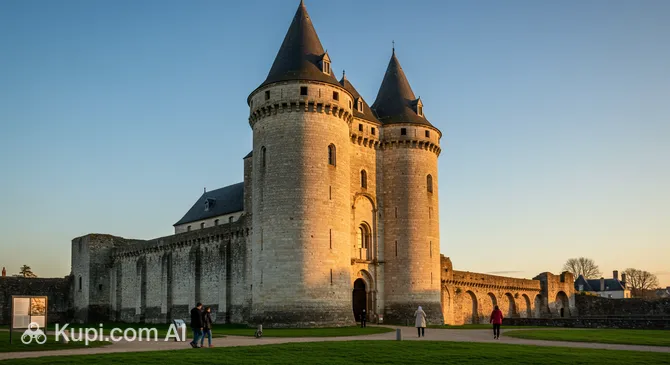
Donjon of Niort
Donjon of Niort. Иллюстрация. Источник: Kupi.com AI

The Donjon is more than just a historical monument; it is a true symbol of the region. The total length of the fortress is about 70 meters, and the height of the southern tower reaches 28 meters. Today, it houses a museum, where visitors can experience the history of Niort through rich exhibitions dedicated to archaeology and local traditions.

This site is striking in its power: walls up to three meters thick at the base and stern buttresses serve as reminders of the fortress's former defensive significance. The architectural purity of the Romanesque style makes the Donjon of Niort one of the most significant landmarks in the Nouvelle-Aquitaine region.

Contacts

To check current information about exhibitions or to book a group tour, you can use the official communication channels.

How to contactContact
AddressRue du Guesclin, 79000 Niort, France
Phone+33 5 49 28 14 28
Websitemusees.niortagglo.fr

What to Do

The main adventure when visiting the Donjon is climbing to the roof of the southern tower. From here, an impressive 360-degree view opens up over the city roofs, church spires, and the winding Sèvre Niortaise river. Inside the towers, you can examine the massive defensive elements in detail: narrow embrasures, a deep moat, and clever machicolations designed to protect the entrance.

In the museum halls, be sure to look for the decorative murals from the late 19th century and the fireplace in the great hall adorned with coats of arms. The exhibits introduce the daily life of medieval inhabitants and the history of regional crafts. Architecture enthusiasts will appreciate the impeccable stonework and the spiral staircases, which have been preserved in excellent condition.

A stroll through the inner courtyard allows you to appreciate the scale of the structure from below, and the proximity to the Les Halles city market offers a chance to combine a dive into history with a tasting of local products. Temporary art exhibitions are often held within the fortress walls, adding a modern touch to the ancient stones.

Getting There

The donjon is located in the heart of the historical center of Niort, on the picturesque banks of the Sèvre Niortaise River. Thanks to its central location, getting there is easy. If you arrive at Niort Station, a walk to the fortress will take only 10–15 minutes through lively city neighborhoods. Main public transport stops and the central market are also within walking distance.

For those traveling by car, it is most convenient to head towards Place du Donjon, where parking zones are available nearby. From Paris, the easiest way to reach the city is by TGV high-speed train (travel time is about 2–3 hours) or by car via the A10 highway. The nearest airport is in La Rochelle, about an hour's drive away.

Ближайший город: Niort

History & Facts

The history of this majestic structure in France began at the end of the 12th century. Construction was initiated by King Henry II Plantagenet of England, who sought to strengthen his holdings in Aquitaine, acquired through his marriage to Eleanor of Aquitaine. The fortress was completed by the legendary Richard the Lionheart around 1180. Originally, it was a powerful defensive complex with curtain walls, a moat, and a drawbridge.

In the 13th century, the towers were modernized: wooden galleries were replaced with stone arched machicolations. Over the centuries of its existence, the Donjon of Niort has changed many roles. It has served as both a luxurious residence and a grim prison. In the 15th century, the space between the towers was covered with a roof to create additional living quarters, and in 1749, the northern tower partially collapsed but was quickly restored.

In 1885, a large-scale restoration was carried out, during which the artist Charles Lameire decorated the interiors with murals. Today, the donjon is recognized as a historical monument of national importance. It is considered one of the finest examples of Romanesque military architecture and the second largest twin keep in the country after the Château de Vincennes.

Time Needed

To leisurely explore all levels of the towers and get to know the museum collection, it is recommended to set aside approximately 1.5–2 hours. This is sufficient time to study the architectural details, read the information stands, and fully enjoy the city panorama from the open-air platform.

If you plan to participate in a themed tour or study the temporary exhibitions in detail, your visit could last up to half a day. In any case, this site is worth taking your time to truly feel the atmosphere of the medieval fortress.

Working Hours

The Donjon of Niort is open to visitors throughout the week, except on Mondays. Please note the midday break on weekdays.

The opening hours are as follows:

  • Tuesday, Wednesday, Friday: 10:00 AM – 1:00 PM and 2:00 PM – 6:00 PM
  • Thursday: 10:00 AM – 8:00 PM (extended visiting day)
  • Saturday and Sunday: 2:00 PM – 7:00 PM
  • Monday: Closed

DayWorking hours
ПонедельникЗакрыто
Вторник10:00 – 13:00, 2:00 – 18:00
Среда10:00 – 13:00, 2:00 – 18:00
Четверг10:00 – 20:00
Пятница10:00 – 13:00, 2:00 – 18:00
Суббота2:00 – 19:00
Воскресенье2:00 – 19:00

Nearby

After visiting the fortress, it is worth strolling through the surrounding area to fully experience the charm of the ancient city. Exploring the adjacent streets and embankments will allow you to see Niort from different perspectives and find cozy places for rest.

NameDistance
11 Bis Troquet Lounge0.1 km
Niort Covered Market0.1 km
Le Chamboul'tou0.3 km
Magic Flonflon0.4 km
Le Croque Bedaine0.4 km
Le QG0.4 km
Niort Center Apartment Hotel0.6 km

Reached the end of the page?

That means the route is fully explored