Support

Fuggerei

About

The Fuggerei is more than just a landmark; it is a unique historical quarter in Augsburg, Germany, considered the world's oldest active social housing complex. Founded in the early 16th century, it still serves its original purpose, providing affordable housing to city residents in need. It is a true "city within a city", enclosed by a wall, with its own gates that close at night, streets, a church, and even a museum.
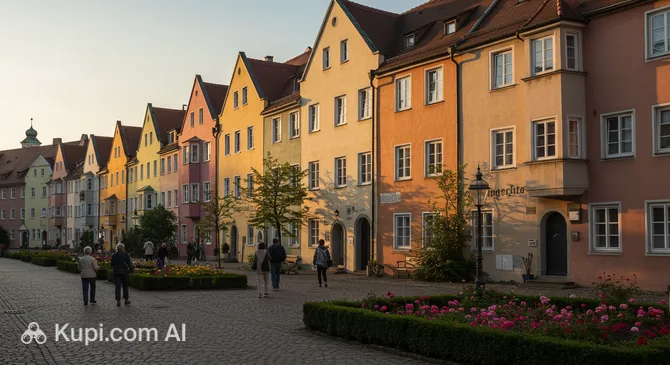
Fuggerei. Illustration.
Source: Kupi.com AI

Traveller photos:

The architectural appearance of the Fuggerei charms with its simplicity and coziness. The complex consists of more than 60 neat two-story houses with high gabled roofs and characteristic gables. Inside these buildings, there are over 140 small apartments. Walking through its cobbled streets, you feel as if you have been transported back several centuries, immersing yourself in the atmosphere of old Europe.

In addition to residential buildings, the Fuggerei territory features several interesting places to visit. You can stop by St. Mark’s Church, visit the museum that tells the story and daily life of the quarter, and see the house where Wolfgang Amadeus Mozart's great-grandfather lived. Special attention should be paid to the former World War II air-raid shelter, which now houses an exhibition about the lives of Fuggerei residents during that challenging period.

Contacts

If you are planning to visit the Fuggerei, we recommend checking the opening hours and ticket prices in advance. The most up-to-date information can be found on the official website or by contacting the complex administration directly.

How to contactContact
AddressJakoberstraße 26, 86152 Augsburg, Germany
Phone+49 821 3198810
Websitewww.fugger.de

What to Do

Visiting the Fuggerei is a unique opportunity to immerse yourself in living history. The main activity for tourists here is a leisurely stroll through its cozy streets and viewing the well-preserved historic buildings. You can visit the museum, which features detailed recreations of apartment interiors from different eras. This allows you to see firsthand how the lives of the quarter's residents have changed over the centuries and better understand their daily routine, which continues here today.

There are several iconic spots in the Fuggerei that you shouldn't miss. Be sure to stop by St. Mark’s Church, which is the spiritual heart of the quarter. The house where Wolfgang Amadeus Mozart's great-grandfather lived is of great interest to visitors—it is a unique chance to touch the history of the great composer's family. Additionally, there is an air-raid shelter on the complex grounds with an exhibition dedicated to life in the Fuggerei during World War II.

For those who want to learn more, guided tours are often available. During the tour, guides provide detailed accounts of the history of the famous Fugger family, who initiated this social project, as well as its unique architecture, traditions, and the rules that residents follow to this day. This is a great way to gain a deeper understanding of the philosophy of this amazing place in Augsburg.

Getting There

The Fuggerei is located in the very heart of Augsburg, in the historic Jakobervorstadt district, making it easily accessible for tourists. The main entrance to this unique social quarter is on Jakoberstraße. Due to its central location, the Fuggerei can be reached on foot with a pleasant walk through the streets of the old town from central points, such as the City Hall. This takes only 10–15 minutes and allows you to enjoy the atmosphere of the Bavarian city.

For those who prefer public transport, there are several tram and bus stops near the Fuggerei. This is a convenient and fast way to reach the site from anywhere in the city. If you are arriving in Augsburg from other cities in Germany by train, you can take tram No. 1 towards Lechhausen from the main railway station (Augsburg Hauptbahnhof) or walk for about 20–25 minutes, which is also a great opportunity to explore the city.

Nearest city: Augsburg

History & Facts

The Fuggerei in Augsburg is not just a historic quarter, but the world's oldest social housing complex that has been in continuous operation since its founding. Its history began in 1514–1523 at the initiative of Jakob Fugger the Younger, known as "the Rich." As one of Europe's most influential bankers, he decided to create housing for needy but respectable and devout Catholics of his city. The architect of this unique project was Thomas Krebs, who realized the idea of affordable and dignified housing for the poor.

The most striking fact about the Fuggerei is its rent. Since the 16th century, it has remained unchanged at just one Rhenish guilder per year, which today is equivalent to the symbolic amount of €0.88. In return, residents commit to praying daily for the founder and his family. These strict but fair rules remain in effect to this day, turning the quarter into a living monument to centuries of charity and social responsibility.

Having survived wars, destruction, and numerous reconstructions, especially after World War II, the quarter has preserved its historical atmosphere and original mission. Today, the Fuggerei is a "city within a city" with its own walls, gates that are locked at night, a church, and administration. For tourists, it is a unique opportunity to dive into history and see how the principles established five centuries ago continue to work in modern Germany.

Time Needed

When planning a visit to the Fuggerei, it is worth setting aside about 1.5–2.5 hours. This time is usually enough to take a leisurely stroll through its charming streets, feel the unique atmosphere of the world's oldest social settlement, and see its key sites without rushing.

During this time, you will have enough time to visit a small but very informative museum dedicated to the history of the Fugger family and their unique project. You can also peek into one of the apartments, furnished in the style of past centuries, to imagine the daily life of local residents. Visiting the local St. Mark’s Church and the World War II bunker is also part of the standard route. If you just want a quick look at the quarter, an hour might suffice, but for a full immersion into the history of this amazing place in Augsburg, it is better not to rush.

Working Hours

The Fuggerei, the world's oldest social housing complex, is open to visitors year-round, although opening hours may vary by season. Generally, during the summer months (usually from April to October), the quarter's gates are open from 8:00 to 20:00. In the winter period (from November to March), visiting hours are shorter, and you can enter from 8:00 to 18:00. There is an entrance fee, which helps maintain the complex in proper condition.

Advance booking for individual tourists is usually not required—tickets can be purchased on-site. However, before your visit, it is highly recommended to check the current schedule on the official Fuggerei website, as opening hours may change on holidays. This will allow you to plan your time accurately and ensure you can visit this unique piece of history in Augsburg.

9:00 – 20:00

Nearby

Visiting the Fuggerei is an immersion into the unique history of social housing, but your acquaintance with Augsburg would be incomplete without exploring its surroundings. The historic city center is compact, and many iconic sites are within walking distance of this famous quarter. A stroll through the neighboring streets will allow you to better understand the rich culture and architectural heritage of this Bavarian city.

By expanding your route, you can see how the Fugger family's history intertwines with other important chapters of Augsburg's life. From majestic cathedrals to lavish palaces and bustling squares, all of this creates a complete picture of a city that has been an important trade and cultural center of Europe for centuries. Below is a list of interesting places located nearby.

NameDistance
Jakobertor0.4 km
Golden Hall0.4 km
Augsburg Town Hall0.4 km
Rathausplatz Augsburg0.5 km
City-Galerie0.5 km
Schaezler Palace0.6 km
City-Galerie Augsburg0.6 km

Reached the bottom of the page?

Looks like you know this route inside out