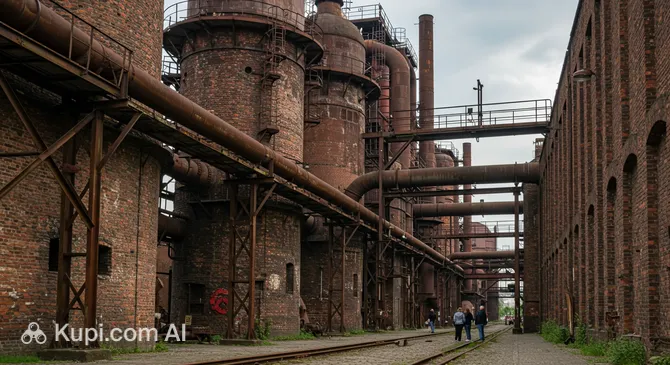
On the cultural island of Kulturinsel in the city of Dortmund stands an impressive monument — the Thomas Converter. This giant steel ladle was once the heart of a steelworks, but today it serves as a powerful symbol of the industrial past that Germany is proud of. The site, also known as "Phoenix," embodies the region's rebirth from the ashes of heavy industry into a modern cultural space.
Thomas Converter. Illustration.
Source: Kupi.com AI
Traveler photos:
The structure is a massive metal construction used for producing steel via a specific method of removing phosphorus from pig iron. It is not just a technical unit, but a true industrial sculpture integrated into the city's public art landscape. The converter serves as a reminder of the heyday of metallurgy in the Ruhr Valley.
Today, this site attracts fans of urbanism and history. The Thomas Converter is harmoniously integrated into a recreation area, becoming an iconic tourist attraction available for everyone to explore in the open air.
Contacts
To plan your visit to this industrial monument in Dortmund, you can use the following contact details:
The main reason to visit the Thomas Converter is the opportunity to literally touch industrial history. You can get right up close to the giant ladle to appreciate the scale and power of the steel sheets held together by rivets. This is an ideal location for atmospheric photos, especially during hours when sunlight highlights the texture of the metal and the marks of time.
Around the monument on Kulturinsel, there are walking areas. A visit here can be combined with viewing other public art elements and a walk along the Dortmund-Ems Canal. In the warmer months, the waterfront becomes a great spot for relaxation, and its proximity to Phoenix Lake adds a picturesque touch to the industrial landscape.
For those interested in technology, visiting the converter provides a visual lesson in metallurgy. The site is often part of cycling tours along the Ruhr's industrial route. Here, you can simply sit on a bench, contemplating the contrast between the massive steel giant and the modern architecture of the developing Dortmund.
Getting There
The landmark is located in the Hörde district at Am Kai. Getting here from the city center (for example, from St. Reinold's Church) is quite easy by public transport. You can take bus lines 410, 430, or 441 to the Am Kai or Phoenixsee stop. The trip from the main station takes about 20–30 minutes.
If you prefer comfort, you can use taxi services. A trip from the center of Dortmund to Kulturinsel will be quick and convenient, and drivers will easily find this popular tourist site. For those traveling by car, there is free parking on the Kulturinsel grounds; it is most convenient to take the A40 or A45 motorways to the Dortmund-West exit.
Outdoor enthusiasts can reach the converter by bicycle or on foot, as it is part of the popular Emscher-Tal-Weg route. For instance, from the famous Zeche Zollern mine, the walk to the monument takes just 10–15 minutes.
Nearest city: Dortmund
History & Facts
The history of this massive structure is inextricably linked with the technical revolution of the 19th century. The method that gave the unit its name was invented in 1878 by Sidney Gilchrist Thomas and Percy Carlyle Gilchrist. Their technology allowed for the production of inexpensive steel from phosphorus-rich pig iron, which was abundant in local deposits, giving a colossal boost to the development of the entire German economy.
Converters of this type were actively used at the Hoesch steelworks and other enterprises in Dortmund. Thanks to the introduction of the Thomas process, the city rapidly turned into a major industrial center, and its population exceeded half a million by the mid-20th century. This preserved ladle is a living witness to the era of "coal and steel," when the region forged the country's industrial power.
After the production facilities closed at the end of the last century, many factory halls were dismantled; however, this converter was preserved as a monument. Today, it is integrated into an industrial heritage preservation program, having transformed from a working tool into a historical relic that reminds us of the hardworking past of many generations of Ruhr metallurgists.
Time Needed
For a quick look at the structure itself and a few striking photos, 30–60 minutes is quite enough. The site is compactly located in an open area, which allows you to study its design fairly quickly.
If you plan to walk across the entire cultural island or explore the Ruhr industrial route, it's worth allocating about 1–2 hours for the visit. This will allow you to enjoy the views of the Dortmund-Ems Canal without rushing and familiarize yourself with the information materials on-site.
Working Hours
The Thomas Converter is located in an open public space, so it is available for viewing 24 hours a day. You can come here at any convenient time, whether it's early morning for quiet contemplation or late evening when the structure can look particularly mysterious in the city lights.
Since entry to the site is free, there are no specific opening hours. Nevertheless, visitors are recommended to check the city's official website for temporary events or technical work on Kulturinsel.
Open 24 hours
Nearby
The area around Phoenix Lake, where the Thomas Converter is located, is rich in interesting locations. Exploring the surroundings will allow you to dive deeper into the history of transforming industrial zones into modern centers of life, where old buildings stand side-by-side with new parks.
Below are the nearby attractions worth visiting during your walk: