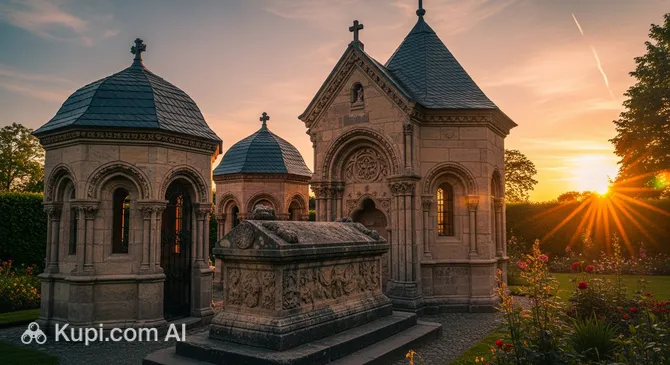
Imagine the opportunity to touch the ancient shrines of Jerusalem without leaving Europe. This is the unique atmosphere offered by the Holy Sepulchre (Heiliges Grab)—an amazing architectural complex in the city of Görlitz, which is one of the most accurate medieval copies of the Jerusalem Aedicule.
Holy Sepulchre. Illustration.
Source: Kupi.com AI
Traveler photos:
Erected at the end of the 15th century, this landmark is part of the Holy Trinity church ensemble in Germany. It was created for pilgrims who, in those times, could not make the dangerous journey to the Holy Land. The complex includes not only the tomb itself but also a recreated Calvary, as well as several chapels that recreate the topography of the sacred sites in life-size.
Today, this site is recognized as an outstanding monument of Late Gothic and Early Renaissance. Visitors are drawn not only by its religious significance but also by its artistic perfection: from the detailed sculptures to the atmospheric interiors that literally allow you to travel back in time.
Contacts
To clarify current information about events and potential changes to the schedule, you can contact the complex administration. It is also recommended to check the official website of the cultural foundation that manages this historical site.
Below are the main contact details for planning your visit:
The main impression that visitors come for is the chance to explore the exact copy of the Aedicule. You can enter the narrow chambers that recreate the burial and resurrection site of Christ, as well as examine the medieval inscriptions and mosaics that have preserved the spirit of the era. Be sure to climb the symbolic Calvary to see how skillfully the landscape was adapted to biblical narratives.
During your walk through the complex, pay attention to the Sun Organ and the rich sculptural decoration of the Holy Trinity chapels. Here you can see rare altars from the early 16th century and elegant Gothic sculpture. The place is ideal for thoughtful exploration and artistic photography, as it is rarely overcrowded.
You can conclude your visit with a self-guided tour of the grounds, studying the information plaques that tell the story of the events of Holy Week. The silence and seclusion of this place make it an excellent spot for an emotional reset before continuing your exploration of the city's lively historic center.
Getting There
Reaching this iconic landmark is easy, as it is located within walking distance of the historic center. If you arrive at the main railway station (Hauptbahnhof Görlitz), the walk to the site takes about 15–20 minutes via Demianiplatz and then along Heilige-Grab-Straße.
For those who prefer public transport, buses heading to the Görlitz Zentrum stop are suitable, from where you will need to walk for another 5–10 minutes. The city is very compact and picturesque, so moving between sites is usually a true pleasure for architecture enthusiasts.
If you value comfort or are short on time, you can use the services of a local taxi, which will quickly take you from any point in the city directly to the entrance of the complex. For travelers arriving by car from other regions, it is most convenient to use the A4 motorway, heading for the parking lots in the central part of Görlitz.
Nearest city: Görlitz
History & Facts
The history of this place dates back to the 15th century, when an urgent need arose in Europe to create local shrines for pilgrims. After the end of the Crusades, access to the original holy sites in Jerusalem became extremely difficult, and the Holy Sepulchre in Görlitz became one of the most accurate and complete replicas of that time.
The complex is closely linked to the history of the Franciscan monastery and the Holy Trinity Church, founded as early as the 1230s. Over the centuries of its existence, the structures have undergone many transformations: from a Catholic monastery to a Protestant church and school, while carefully preserving its unique architectural appearance and spiritual significance.
Of particular value is the fact that the replica of the Aedicule and Calvary was created based on detailed descriptions and drawings brought by travelers from the Holy Land. This makes the site not just an architectural monument, but also a vital testament to the medieval pilgrimage tradition in Saxony, which has preserved unique Gothic sculpture to this day.
Time Needed
To see all the elements of the complex without rushing, including Calvary, the Aedicule, and the inner chapels, usually requires 1 to 2 hours. This time is quite sufficient for a quiet study of the architectural details and immersion in the historical context of the site.
If you plan to supplement your visit with a trip to the adjacent Holy Trinity Church and a stroll through its surrounding garden, you should budget about 2.5 hours. The place invites quiet reflection, so many visitors prefer to stay longer, away from the city bustle.
Working Hours
The complex is open to visitors throughout the week, except for Wednesdays. Standard opening hours are from 10:00 to 16:00 on Monday, Tuesday, and from Thursday to Sunday.
Please keep in mind that the schedule may change on public holidays or during special church services. Before your trip, it is recommended to check the latest information on the official website of the foundation to ensure your visit is as comfortable as possible.
Day
Working hours
Monday
10:00–16:00
Tuesday
10:00–16:00
Wednesday
Закрыто
Thursday
10:00–16:00
Friday
10:00–16:00
Saturday
10:00–16:00
Sunday
10:00–16:00
Nearby
Görlitz is famous for its density of historical monuments, so after visiting the Holy Sepulchre complex, it is worth spending time on other interesting sites nearby. A walk through the ancient streets will allow you to immerse yourself deeper into the atmosphere of the city, which is often called an open-air museum.
In the immediate vicinity, you will find both majestic churches and cozy market squares, each keeping its own legends and architectural secrets: