Support

Historic fishing village Holm

About

The Historical Fishing Village of Holm is an amazing living open-air museum located in the ancient town of Schleswig. This cozy quarter, with a history spanning over ten centuries, is considered a jewel of the Schleswig-Holstein state in Germany. Once a true island cut off from the outside world, Holm allowed its residents to form unique traditions and an architectural style that have survived to this day.
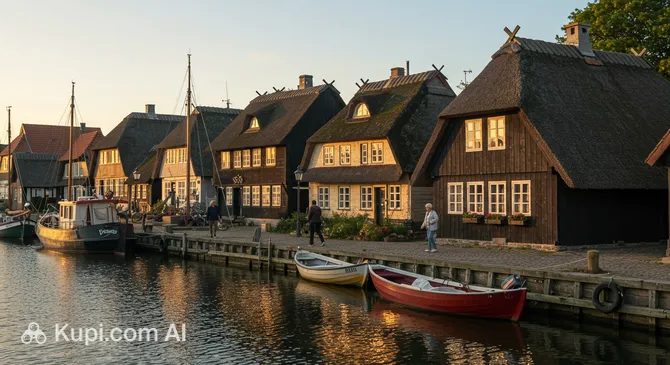
Holm Historic Fishing Village
Holm Historic Fishing Village. Иллюстрация. Источник: Kupi.com AI

The main feature of the village is its unusual circular layout. Small, neatly whitewashed houses are built in a tight circle around a central square, which houses an ancient cemetery with a chapel. This structure allowed fishermen to reach their boats on the banks of the narrow Schlei sea inlet as quickly as possible. Even after becoming part of the mainland in 1933, Holm has not lost its island charm and seclusion.

Today, this place is recognized as one of the most idyllic spots in the region. Despite the fact that families of hereditary fishermen still live here, many historical buildings have been transformed into cozy shops, cafes, and art workshops. A visit to Holm is an opportunity to literally step back in time and experience a sense of peace and quiet, broken only by the cries of seagulls and the splashing of water in the harbor.

Contacts

For those planning a visit to this picturesque place, it's helpful to have basic contact information on hand. Although the village itself is an open residential area, the local community and museum have their own coordinates.

How to contactContact
AddressSüderholmstraße 28, 24837 Schleswig, Germany
Websitewww.holmer-beliebung-sl.de

What to Do

The main pleasure in Holm is taking slow walks through its narrow, cobblestone streets. Here, every house seems to have stepped out of the pages of a fairy tale: low doors, an abundance of flowers on windowsills, and old fishing gear on display. Be sure to reach the center of the village, where the unique Friedhof der Holmer Beliebung cemetery is located. The 1876 chapel and the strict rows of graves create an atmosphere of deep tranquility and respect for ancestral traditions.

For those who want to understand the history of the place more deeply, the Holm Museum (Holm Museum) is open at Süderholmstraße 2. Inside an old fisherman's house, a rich collection of exhibits is gathered: from old nets and tools to documents telling how globalization changed the life of the small community. This is the best place to learn about the "death guild" and the privileges granted to fishermen by kings.

Don't forget to head out to the Schleswig harbor, which adjoins the village. Here you can watch modern fishermen unloading their catch or simply enjoy the view of the Schlei waters. Photographers will find an endless number of subjects in Holm: from the play of light on brick walls to panoramic views of the bay, which are especially beautiful at sunset.

Getting There

The historic district is located in the eastern part of the city at Süderholmstraße 28. Getting here from the central part of the city is quite simple: a pleasant walk or a bike ride will take no more than 15–20 minutes. Since 1933, the former island has been connected to the mainland by a reliable road, so the village is easily accessible by car, and parking spaces are provided nearby.

If you are arriving in the city by public transport, use the trains going to Schleswig station (for example, from Hamburg or Lübeck). From the station to the Holm "fishing quarter," you can take a local bus or use a taxi — the distance is about 5–10 kilometers. Look for signs to the Fischerviertel Holm, which will lead you directly to the waterfront and the historic houses.

Ближайший город: Schleswig

History & Facts

The history of this place spans over a thousand years. The name "Holm" has Danish roots and translates as "small island," a reminder of the times when the settlement was completely surrounded by water and connected to the land only by a narrow bridge. Its strategic position on the banks of the Schlei inlet made the village a vital center for fishing in the region.

A special role in the life of the community was played in 1480, when the Danish King Christian I issued the famous "Schlei Letter" (Schleibrief). This document granted local fishermen exclusive privileges — the right to free fishing along the entire waterway from Schleswig to Sieseby. These traditions were carefully preserved for centuries, forming the unique lifestyle of the "Holmers."

In 1650, following the hardships of the Thirty Years' War, the Holmer Beliebung was founded — a unique "death guild" or mutual aid brotherhood. It was responsible for maintaining the cemetery and organizing dignified funerals, which was vital during eras of epidemics. The circular layout of the village, where houses huddle around the central churchyard, has survived to this day as a symbol of the community's unity in the face of eternity.

Interestingly, at the beginning of the 20th century, about 100 families of hereditary fishermen lived here. Today, very few remain, but the village continues to thrive, having transformed from a closed island enclave into one of northern Germany's most cozy and atmospheric attractions.

Time Needed

To take a leisurely stroll through the village's circular streets, visit the ancient cemetery, and take beautiful photos of the colorful facades, 1–1.5 hours is usually sufficient. It is an ideal spot for a short but impression-filled stop during a walk around the city.

If you plan to visit the Holm Museum to study the fishermen's way of life and the history of the guilds in detail, it is worth setting aside about 3 hours for the visit. The peaceful atmosphere of this place invites contemplation, so many tourists prefer to stay longer to have dinner at one of the local fish restaurants with a view of the water.

Working Hours

The historical village of Holm itself is an open residential area, so you can walk through its streets and enjoy the architecture 24 hours a day, every day. Monday — Sunday: open 24 hours. This allows tourists to see the settlement both in the rays of the morning sun and under the mysterious evening lighting.

However, it is worth keeping in mind that the Holm Museum and local shops have their own individual working schedules, which may change depending on the season. If you plan to visit the indoor exhibitions or the chapel, it is best to come in the first half of the day.

Круглосуточно

Nearby

Schleswig is a city with a rich heritage, and a visit to Holm can easily be combined with exploring other iconic sites. A walk around the surroundings will allow you to dive deeper into the history of the region, from the Viking Age to the times of powerful dukes.

NameDistance
Bistro Marvil0.7 km
Strand Bistro Luisenbad1 km
Haithabu Archaeological Walk1.5 km
Haithabu Viking Museum1.7 km
Marienbad Beach Restaurant1.7 km
Gottorf Castle Museums Island2.1 km
Waldschlösschen Restaurant3.5 km

Reached the end of the page?

That means the route is fully explored