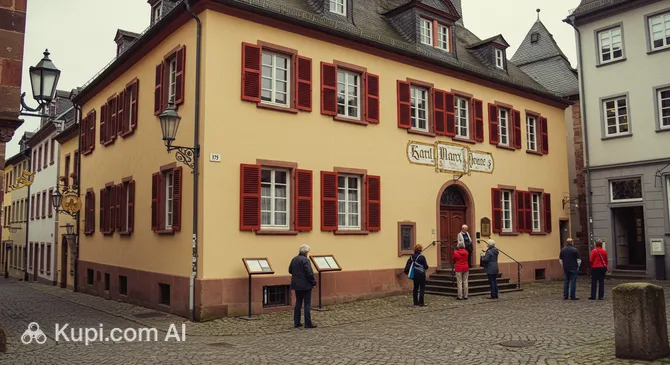
The Karl Marx House in Trier is more than just a building; it is a place steeped in history and a symbol of the birth of one of the 19th century's most influential thinkers. The structure itself has a much older history than many realize, having been built around 1550. The Marx family lived here for a relatively short time. Karl Marx was born in this house on May 5, 1818, but by October 1819, his family moved to another house in the city center known as the "Casino." Despite their brief stay, it is this house at Brückenstraße 10 that is firmly associated with the philosopher's name.
The idea of immortalizing the memory of Karl Marx in his birthplace arose much later. In 1928, the building was purchased by the Social Democratic Party of Germany (SPD) with the aim of creating a museum. However, these plans were not realized quickly due to the difficult economic situation and political instability in the country. Following the political changes in 1933, the house was confiscated from the SPD. The building was then repurposed for other needs, including housing the printing press of a local newspaper.
After the mid-1940s, the building was returned to the SPD, and work on creating the museum resumed. The official opening of the Karl Marx House museum took place on May 5, 1947, on the 129th anniversary of his birth. Since then, the museum has been expanded and updated several times. In 1968, for the 150th anniversary of Marx's birth, the exhibition was completely redesigned, and a research center was opened at the museum. Further extensive reconstruction and modernization were carried out for the centenary of the philosopher's death in 1983, and again for the bicentenary of his birth in 2018, when the new permanent exhibition "From Trier to the World: Karl Marx, His Ideas and Their Influence until Today" was unveiled.
Today, the Karl Marx House is one of the main attractions in Trier and attracts visitors from all over the world who are interested in the life and legacy of this prominent theorist and public figure. The museum's exhibition details Marx's biography, his intellectual development, key works, and the influence of his ideas on world history. Visitors can see personal belongings, manuscripts, first editions of his works, and multimedia installations that immerse them in the era in which Karl Marx lived and worked.