Support

Porta Nigra

About

Porta Nigra, which means “Black Gate” in Latin, is the landmark symbol of the ancient city of Trier in Germany. It is the largest and best-preserved ancient Roman city gate in the world, as well as the largest north of the Alps. Due to its exceptional historical and architectural value, this grand structure is included in the UNESCO World Heritage list, attracting travelers from all over the globe.
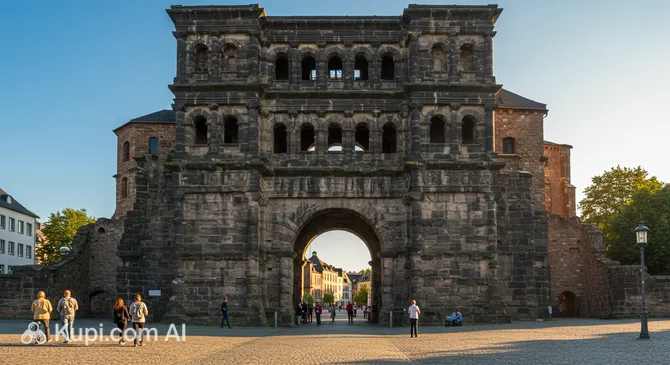
Porta Nigra. Illustration.
Source: Kupi.com AI

Traveler photos:

The height of this impressive monument of antiquity reaches 29.3 meters. Originally, the gate consisted of two massive four-story towers connected by an inner courtyard, creating an effective defensive trap. The gate received its current name in the Middle Ages because the light sandstone from which it was built significantly darkened over time. Today, its dark, almost black color gives it a particularly majestic and mysterious appearance.

For the residents of Trier, the Porta Nigra is not just a landmark but a true symbol of the city, which they affectionately call simply “Porta.” The image of these monumental gates adorns almost all local souvenirs, from postcards and magnets to beer steins, emphasizing their central role in the city's cultural life. Visiting the Porta Nigra is a unique opportunity to touch the history of the Roman Empire and feel the greatness of the past.

Contacts

To plan your visit to the Porta Nigra, check current opening hours, ticket prices, and tour information, it is recommended to use official channels. This is the most reliable way to get accurate and up-to-date information. The main contact details for visitors are provided below.

How to contactContact
AddressPorta-Nigra-Platz, 54290 Trier, Germany
Phone number+49 651 4608965
Websitewww.trier-info.de

What to Do

A visit to the Porta Nigra is more than just an opportunity to take beautiful photos in front of an ancient monument. It is a true immersion into history, as the gate is open for inspection both from the outside and the inside. A must-do for most tourists is climbing to the upper floors of the structure. After navigating the ancient steps, you will be rewarded with a magnificent panoramic view of Trier from the height of this ancient Roman giant. From here, you can see the historic city center in detail and imagine what it looked like nearly two thousand years ago.

Inside the gate, visitors have a unique chance to study the features of Roman architecture and the construction technologies used centuries ago. Of particular interest is the fact that the construction of the gate was never finished. On the northern (outer) side, you can clearly see unworked stones and protruding elements that made it impossible to install sliding gates. This “unfinished” state allows visitors to see what Roman construction looked like in progress and peek behind the scenes of an ancient building site.

Getting There

Getting to the Porta Nigra is quite easy, as the gate is located in the heart of Trier, at the northern edge of the pedestrian zone. Thanks to this central position, it serves as the perfect starting point for a walking tour of the city. Most hotels and other key attractions in the historic center are within walking distance. Even if you arrive in Trier by train, the gate is very close: a leisurely stroll from the main railway station (Trier Hauptbahnhof) will take no more than 10 minutes.

For those who prefer public transport, the trip to the Porta Nigra is extremely convenient. Trier has an extensive city bus network, and many routes pass through the stop simply called “Porta Nigra”. It is located right at the foot of the gate, so you definitely won't miss your destination. Buses from the main station depart every few minutes, and the journey itself takes only 2-3 minutes, making this method not only convenient but also very fast.

If you are traveling by car, please note that direct access to the gate is limited as it sits on the edge of the pedestrian zone. However, Trier's city center has an excellent parking system: special electronic signs will help you find the nearest available multi-level parking garage (Parkhaus). One of them, “Parkhaus Porta Nigra,” is located in the immediate vicinity of the landmark. Additionally, you can always use a taxi, which will quickly and affordably take you to the “Black Gate” from anywhere in the city.

Nearest city: Trier

History & Facts

The Porta Nigra gate was built of light sandstone after 170 AD. For a long time, the exact date of construction remained a subject of debate, but recent research has helped solve this mystery. Through the analysis of wood fragments found during excavations, scientists established that the oak used for construction was felled in the winter of 169–170 AD. This means that as of 2025, the structure is 1,848 years old, making it the oldest monument of its kind in Germany.

Contrary to first impressions, this monumental structure was built not so much for defense as for prestige. During the gate's construction, ancient Trier was experiencing a relatively peaceful period. Thus, the grand gate was intended to demonstrate the wealth and high status of the city within the Roman Empire, serving more as a symbol of power than a functional defensive fortification. This is further confirmed by the unfinished state of some elements, such as the unworked stones on the outside, which would have prevented the installation of defensive sliding gates.

The landmark received its famous name “Porta Nigra”, which means “Black Gate” in Latin, only in the Middle Ages. The reason for this was the stone darkening over time due to weather conditions. Originally, the sandstone blocks were light-colored, and some suggest the gate was named after the god of war, Mars. Rust marks on the stones still point to where iron clamps were once located, which medieval residents pulled out for reuse.

Paradoxically, the Porta Nigra owes its salvation from total destruction to the Greek hermit monk Simeon. In 1028, he settled in the gate's eastern tower, wishing to be walled inside for solitary prayer. After his death and canonization in 1035, the gate was converted into the double Church of St. Simeon. This transformation protected the ancient structure from being dismantled for building materials. It was only in the early 19th century, by order of Napoleon Bonaparte, that the church additions were removed, returning the gate to its original Ancient Roman appearance.

Time Needed

When planning a visit to the Porta Nigra, you should allow for 1-2 hours for a full and leisurely exploration. This time is generally enough to not only admire the gate from the outside but also to explore it from within. You can climb to the upper levels, which offer magnificent panoramic views of the historic center of Trier, study the information panels about the history of this unique Roman structure, and take memorable photos.

The duration of your visit may vary depending on your interests. If you are short on time, a quick outside inspection and a brief look inside will take no more than 30-45 minutes. However, for those interested in history and architecture, the visit may take longer. Inside, you can examine the details of ancient Roman masonry and construction techniques. Additionally, on certain days, theatrical tours are held—such as with a “centurion”—which add an interactive element and can increase the total time spent at the attraction.

Working Hours

You can visit the Porta Nigra on any day of the week, as the landmark is open to guests year-round. However, opening hours change depending on the season, so it is important to plan your visit in advance. During the warmest period, from April to September, the gate is open from 9:00 AM to 6:00 PM. In the shoulder seasons of March and October, the operating hours are reduced to 5:00 PM. In the winter months, from November to February, you can enter between 9:00 AM and 4:00 PM. Please note that the last entry is 30 minutes before closing.

Although advance booking is not always mandatory for a regular visit, it is highly recommended to purchase tickets online in advance, especially during the peak tourist season. This will help you avoid queues and save time. If you wish to join one of the popular theatrical tours, such as with a “Roman centurion,” advance booking is usually required as group sizes are limited. The most reliable way to find up-to-date information and purchase tickets is to check the official tourism website of the city of Trier.

9:00 – 18:00

Nearby

A visit to the Porta Nigra is just the beginning of a fascinating journey through one of Germany’s oldest cities. Thanks to its location in the heart of Trier, the “Black Gate” serves as an ideal starting point for further exploration. A stroll through the surrounding area will allow you to dive deeper into the city's rich history and discover other iconic sites, many of which are just a few steps away.

Exploring nearby attractions will not only enrich your experience but also help form a complete picture of the grandeur of ancient Roman and medieval Trier. Most key monuments are within walking distance, making a city walk especially pleasant and informative. Below is a list of interesting places to visit after touring the Porta Nigra.

NameDistance
Simeonstift City Museum Trier0 km
Walderdorffs0.3 km
Main Market Square0.4 km
Petrus Fountain0.4 km
Trier Toy Museum0.4 km
Trier Cathedral0.4 km
Church of Our Lady, Trier0.4 km

Have you reached the end of the page?

So the route has been studied inside and out