Support

Trier Amphitheater

About

The Trier Amphitheater is one of the most significant and well-preserved ancient structures in Germany, located in the historic city of Trier. This majestic historical site transports visitors back to the days of gladiatorial combat and grand spectacles that once gathered thousands of spectators, serving as a vivid testament to the city's Roman past.
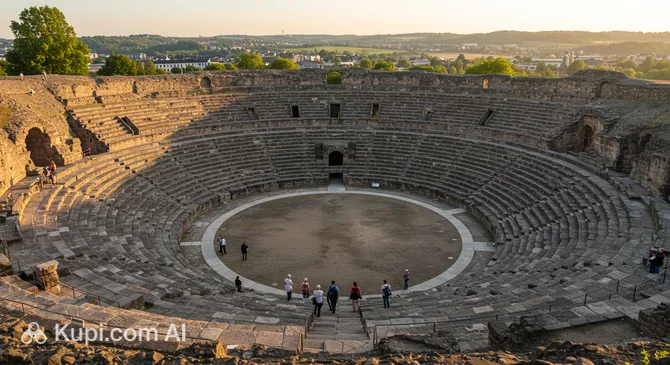
Trier Amphitheater. Illustration.
Source: Kupi.com AI

Traveler photos:

Built by the Romans around the 1st century AD, roughly around the year 100, the amphitheater was an integral part of Trier's large-scale Roman building complex, which at the time was one of the key centers of the Roman Empire. The arena is oval-shaped, measuring 75 meters long and 50 meters wide. It was surrounded by three-tiered stands with 26 rows, accommodating up to 20,000 spectators, demonstrating the grandeur of the structure and its importance to the social life of that era.

Today, the Trier Amphitheater is not only a popular tourist attraction but also a recognized UNESCO World Heritage Site. Visitors can explore the impressive arena, mysterious underground passages, and the remains of the stands, vividly imagining the atmosphere of ancient spectacles. It is a unique opportunity to touch centuries-old history and experience the greatness of Roman architecture, making the amphitheater a must-visit in Trier.

Contacts

To plan your visit to the Trier Amphitheater, including information on opening hours, ticket prices, and how to get there, we recommend visiting the official tourism portal of the city of Trier or local tourist information centers. As a major historical site, detailed visitor information is usually well-documented on these resources.

How to contactContact
AddressOlewiger Str. 25, 54295 Trier, Germany
Phone number+49 651 73010
Websitewww.trier-info.de

What to Do

Visitors to the Trier Amphitheater can fully experience the atmosphere of antiquity by walking through the arena where thrilling spectacles once took place. A highlight is the opportunity to descend into the well-preserved cellar areas. This is where gladiators and wild animals waited for their turn on the arena. You can see the unique engineering system with lifts that allowed performers to appear spectacularly before the audience from beneath the ground.

Exploring these underground corridors and chambers provides a deeper understanding of how Roman games were organized and how complex they were. This is a true immersion into history, allowing you to imagine the excitement and tension that reigned here almost two thousand years ago. Walking on these ancient stones is not just viewing ruins; it is a chance to touch the living history of Trier.

Furthermore, the Trier Amphitheater remains a living cultural venue today. Various events, including concerts and theatrical performances, are held here regularly. The annual Antiquity Festival is particularly popular, featuring impressive historical reconstructions of Roman gladiatorial battles. Such events make a visit to the amphitheater not only educational but also a truly spectacular and memorable experience for the whole family.

Getting There

Reaching the Trier Amphitheater is quite simple, as it is located on the southeastern edge of Trier's historical center. If you are already exploring the city's main attractions, a pleasant walk to the amphitheater will take you only 10–15 minutes. It is also conveniently reachable on foot from Trier Central Station, making it easily accessible for travelers arriving in the city by train.

For those who prefer public transport, Trier offers convenient options. You can use city buses that travel to stops located in the immediate vicinity of the Trier Amphitheater. This is a great way to save time and energy, especially if you are traveling with children or if your hotel is not within walking distance.

If you are traveling by car, you won't have to worry about parking. There is a designated visitor parking area near the Trier Amphitheater. This allows you to reach the site comfortably and leave your car in a safe place while you explore this impressive historical monument.

Nearest city: Trier

History & Facts

The Trier Amphitheater, built in the 1st century AD, stands as a witness to the era when Trier was one of the largest and most influential cities in the Roman province of Gaul. Its arena, designed for thousands of spectators, was the site of thrilling gladiatorial battles, fierce wild beast hunts, and other mass spectacles popular in the Roman Empire. These performances were more than just entertainment; they were a vital part of the city's social and cultural life, showcasing the power and influence of Rome.

This majestic structure served its purpose until the 5th century. However, with the decline of the Roman Empire and the onset of the Middle Ages, the amphitheater's fate changed. Its above-ground sections gradually fell into ruin, and resourceful townspeople began using its sturdy stones to build new structures in Trier. Despite this partial destruction, the amphitheater's foundation and its underground facilities have been preserved, bringing a breath of antiquity to the present day.

One of the most intriguing features of the Trier Amphitheater is its complex underground system. In these hidden chambers beneath the arena, gladiators and wild animals awaited their entrance. It also housed an ingenious system of lifts and platforms that allowed performers to appear spectacularly before the amazed public, adding to the spectacle and drama. Thanks to its scale, engineering solutions, and rich history, the amphitheater is recognized as an outstanding monument of Roman architecture and an invaluable piece of history.

Time Needed

To fully enjoy the Trier Amphitheater and explore all its corners, including the impressive arena and mysterious underground chambers, most visitors will need between 1 and 2 hours. This is usually enough time for a leisurely stroll through the grounds, viewing the surviving structures, and soaking in the atmosphere of ancient Roman spectacles.

If you plan a more detailed study—for example, if you want to read all the information boards, take plenty of photos, or simply sit on the ancient stones and absorb the history—it is best to aim for the upper end of this range, around 2 hours. In any case, a visit to the Trier Amphitheater is a fascinating journey through time that should not be rushed.

Working Hours

The Trier Amphitheater is generally open to visitors year-round; however, its opening hours may vary depending on the season. Usually, you can expect the attraction to be accessible daily from morning until evening. Since a specific schedule is not provided, it is highly recommended to check the current opening hours and any potential need for advance ticket booking on the official Trier Amphitheater website or at the Trier tourist information center before your visit.

This approach will help you plan your visit effectively and avoid any potential inconvenience. This is especially relevant if you plan a trip during public holidays or during special events at the amphitheater, when the schedule may differ from the standard one.

9:00 – 18:00

Nearby

Visiting the Trier Amphitheater is undoubtedly a highlight, but Trier, one of Germany's oldest cities, holds many more treasures nearby. Exploring the surroundings will allow you to dive deeper into the rich history and culture of this amazing place, complementing the impressions left by the majestic Roman structure.

A walk to nearby attractions won't take much time but will significantly enrich your journey, providing a more complete picture of Trier's past and present. Discover other iconic sites to make your acquaintance with the city truly unforgettable.

NameDistance
Rhineland State Museum0.5 km
Villa Hügel Restaurant0.6 km
Electoral Palace0.7 km
Friedrich-Wilhelm Wine Bar0.8 km
Viehmarkt Roman Baths1 km
Trier Cathedral1 km
Church of Our Lady, Trier1 km

Have you reached the end of the page?

So the route has been studied inside and out